A Merlin doesn't circle high and stoop like a Peregrine — it runs songbirds down in fast, low, direct pursuit, flying a hedgerow or field edge specifically to flush something into the open and chasing it down on raw speed and persistence rather than the element of surprise, though a Merlin will also watch from a perch and launch after anything that passes close enough.
The stocky build and rapid, shallow wingbeats separate it from other small falcons at a glance: bulkier through the chest than an American Kestrel, without that species' habit of hovering, and built for continuous fast flight rather than soaring or waiting.
Merlins now nest in ornamental spruces and hunt House Sparrows through city parks and cemeteries — enough of a shift that birdwatchers in some northern cities treat a wintering Merlin as routine rather than notable.
Like this? Get one bird every morning, by email.
You're in. Your first bird arrives with the next morning email (5:30am ET) — and your life list now syncs.Your account →
How to identify
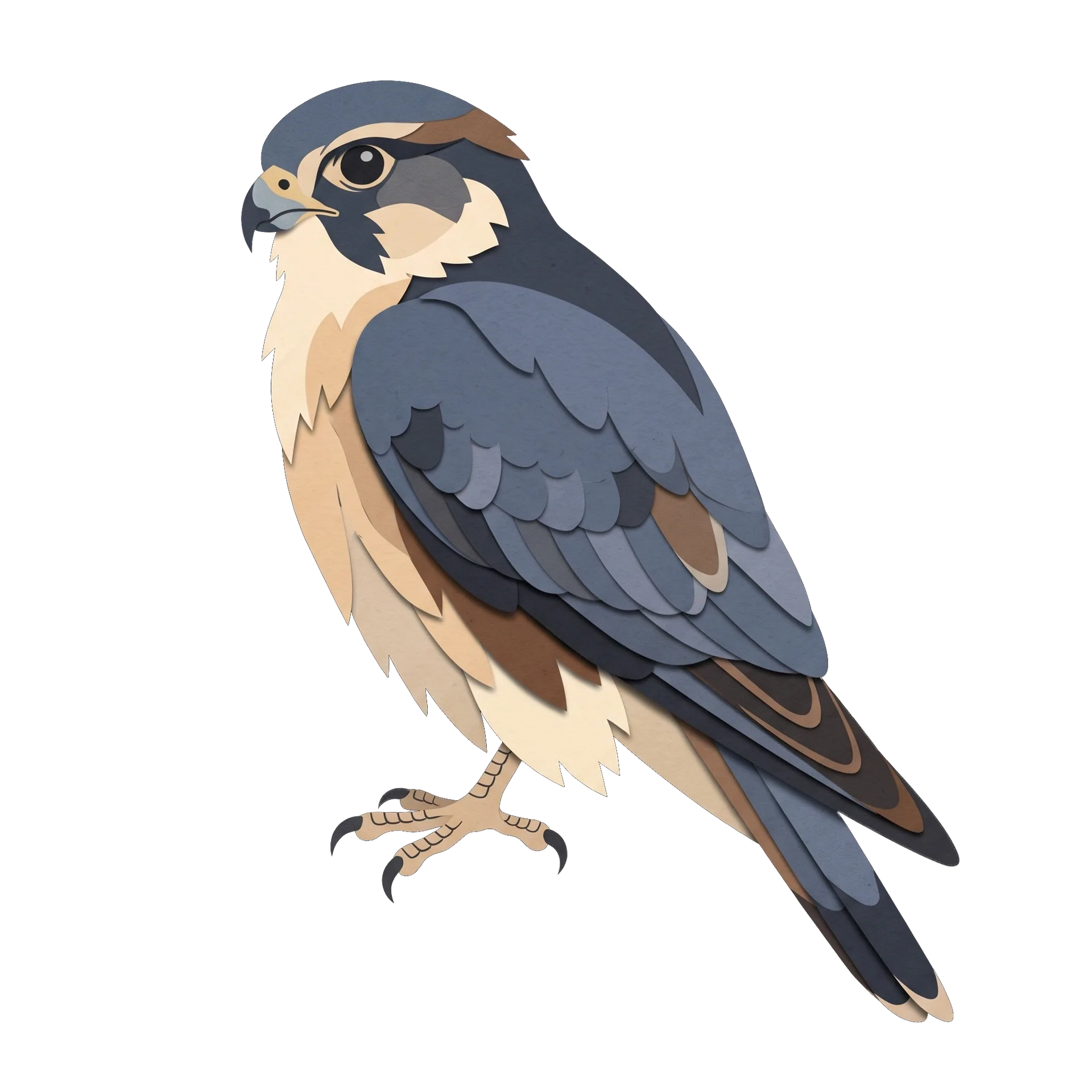
- A small, compact, powerfully built falcon — bigger than a kestrel, smaller than a Peregrine, with a stocky, broad-chested silhouette.
- Males are blue-gray above; females and immatures are dark brown, both heavily streaked below.
- Flies with rapid, powerful wingbeats and little gliding, low and direct rather than soaring.
- Unlike the American Kestrel, rarely hovers — hunts mostly by fast, low pursuit, though it also watches from a perch before flying out after prey.
Voice
A rapid, sharp, chattering ki-ki-ki-ki, higher and more urgent-sounding than a kestrel's call.
Recording: Stein Ø. Nilsen, XC861880, xeno-canto.org (CC-BY-NC-SA 4.0)
Lore
Medieval English falconry sorted hunters by the bird on their glove, and the 1486 Book of Saint Albans, credited in part to Juliana Berners, said to have been the prioress of the priory of Sopwell near St Albans, wrote the hierarchy down: an eagle for an emperor, a gyrfalcon for a king, a peregrine for an earl, a saker for a knight, a merlin for a lady, a goshawk for a yeoman, a sparrowhawk for a priest, on down through a dozen more ranks. The merlin's assignment fit the bird: it's the smallest falcon still serious enough to hunt with, light on a gloved wrist and fast enough to take skylarks in open flight, which made it the falconry bird most associated with medieval and Renaissance noblewomen for centuries after the book was printed.
At a glance
- Family
- Falconidae (falcons)
- Range
- Breeds across northern North America and Eurasia; winters south into Central America
- Habitat
- Open country, coastlines, and increasingly city centers in winter
- Diet
- Small birds, caught in fast, low-level chases
Where it lives
How big is it?
How is it doing?
Field notes
- Merlins have adapted well to city living in recent decades, nesting in ornamental conifers and hunting flocks of House Sparrows and waxwings in urban parks and cemeteries across parts of their winter and breeding range.
- The species was once known in North America as the 'pigeon hawk,' a name reflecting its build rather than its diet: Merlins rarely take pigeons, favoring smaller songbirds instead.
- A hunting Merlin will sometimes fly low and fast along a hedgerow specifically to flush small birds into the open, then run them down in direct pursuit rather than stooping from height like a Peregrine.
Go deeper
The daily email
Get tomorrow's bird in your inbox
One bird at 5:30am ET, every day. Free, no password, one-click unsubscribe — and your life list syncs across devices.
You're in. Your first bird arrives with the next morning email (5:30am ET) — and your life list now syncs.Your account →