Rather than diving from the air like their coastal cousin the Brown Pelican, American White Pelicans swim in a loose line or horseshoe formation, driving fish ahead of them into the shallows or into a concentrated ball, then scooping them up together in near-unison, a rare instance of true cooperative hunting among North American birds.
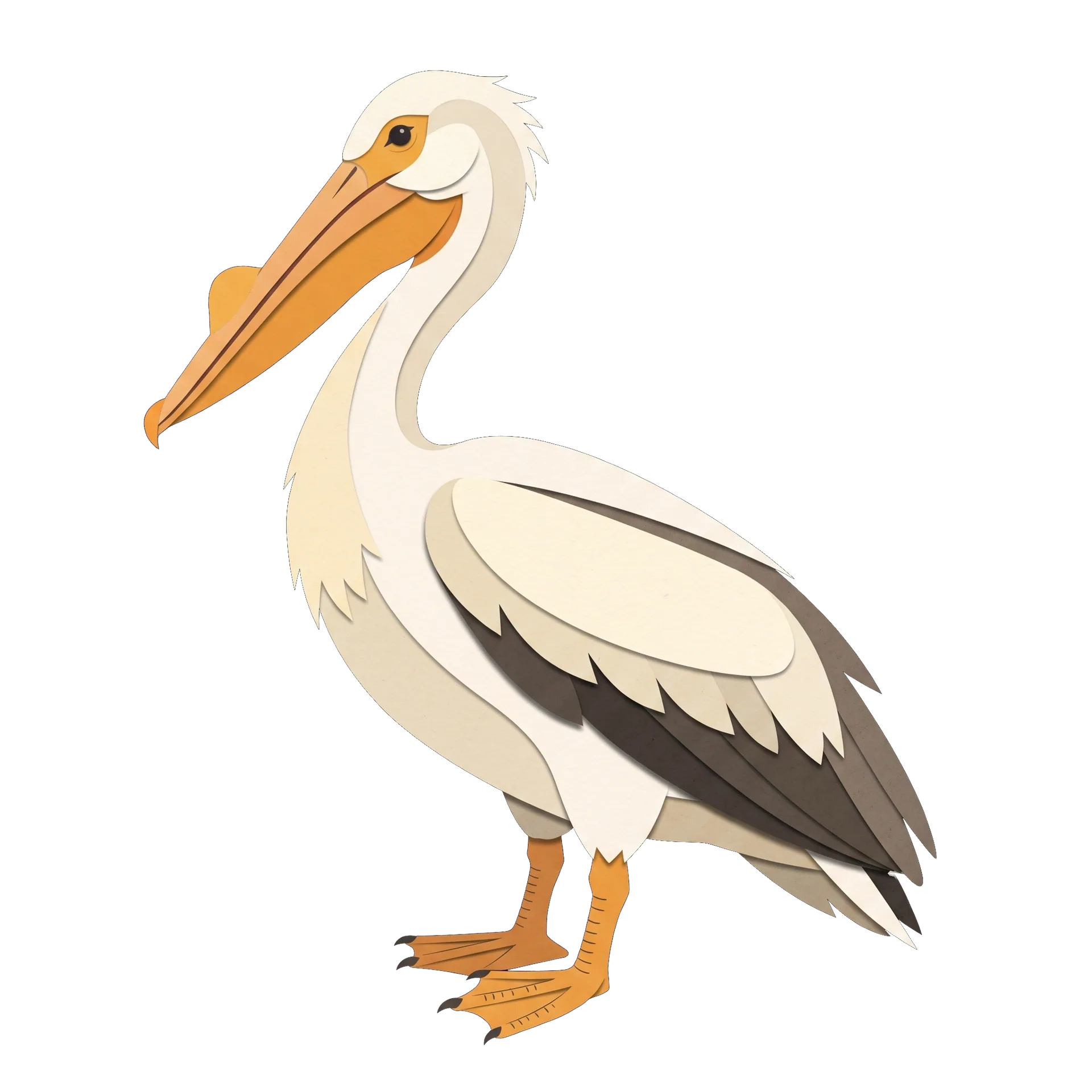
In early spring, breeding adults grow something no other North American bird bothers with: a flattened, plate-like horn that rises from the top of the bill for a few weeks, then falls away once eggs are laid. No one is fully certain what the horn is for, though it appears alongside the peak of courtship display and pairing.
For a bird this size — among the heaviest fliers on the continent, with a wingspan that can top nine feet — migration looks almost effortless. Flocks ride thermals in tight, wheeling spirals at real altitude, gaining height with barely a flap and then gliding long distances before catching the next thermal, covering hundreds of kilometers with a fraction of the energy a bird that heavy might be expected to need.
Like this? Get one bird every morning, by email.
You're in. Your first bird arrives with the next morning email (5:30am ET) — and your life list now syncs.Your account →
How to identify
- A massive white waterbird with black flight feathers visible only when the wings are spread, and a long, flattened orange bill with a deep throat pouch.
- One of the heaviest flying birds in North America, with one of the widest wingspans on the continent.
- Unlike the Brown Pelican, never plunge-dives: feeds while swimming on the surface.
- Breeding adults grow a flattened, plate-like horn on top of the bill, shed after the breeding season ends.
Voice
Mostly silent away from the colony; low grunts and croaks around nesting sites.
Lore
On August 8, 1804, the Lewis and Clark expedition was working up the Missouri River just past the mouth of the Little Sioux, in what is now western Iowa, when Meriwether Lewis noticed feathers drifting down the current, so many that they covered sixty or seventy yards of the river's width for three miles. The source was a flock of white pelicans resting on a sandbar, so many that Lewis said an estimate would sound almost incredible; they seemed to cover several acres. The party named the place Pelican Island. Lewis brought one down and measured it: nine feet four inches from wingtip to wingtip, with a throat pouch that held five gallons of water. Joseph Whitehouse added that after the boats passed the island, "better than 5 or 6000" of the pelicans kept flying ahead of them all day.
About a century later the pelicans at Chase Lake in North Dakota had nearly vanished. Great numbers had nested there in the mid to late 1800s, but by the turn of the century people were making a habit of going out on Sunday afternoons to see how many pelicans they could kill. In 1905 a local settler named H. H. McCumber counted only about 500 and watched the number keep falling. He petitioned the U.S. Biological Survey to make the lake a bird refuge, and on August 28, 1908, President Theodore Roosevelt signed an executive order setting it aside as a reserve and breeding ground for native birds. By McCumber's count only about 50 pelicans remained. He became the refuge's first federal game warden, and by the time he left in 1918 he reckoned the colony at 2,500 to 3,000 birds. It has since grown into one of the largest American white pelican colonies in North America, with a record tally of more than 35,000 breeding birds.
At a glance
- Family
- Pelecanidae (pelicans)
- Range
- Interior western and central North America; winters to the Gulf Coast and Mexico
- Habitat
- Large inland lakes and marshes for breeding; coastal bays and estuaries in winter
- Diet
- Fish, scooped up while swimming and often herded cooperatively into shallows by a group
Where it lives
How big is it?
How is it doing?
Field notes
- Groups of American White Pelicans hunt cooperatively, forming a line or a horseshoe on the water and herding fish into the shallows or into a tight ball before scooping them up together, one of the few well-documented examples of coordinated group foraging among North American birds.
- Breeding adults temporarily grow a flattened, laterally compressed plate on the upper bill (sometimes called a 'horn') that appears in early spring and drops off once eggs are laid, for reasons still not fully understood.
- Despite their enormous size, American White Pelicans are strong, efficient soarers, riding thermals in tight, wheeling flocks at considerable altitude during migration, covering long distances with surprisingly little flapping.
Go deeper
The daily email
Get tomorrow's bird in your inbox
One bird at 5:30am ET, every day. Free, no password, one-click unsubscribe — and your life list syncs across devices.
You're in. Your first bird arrives with the next morning email (5:30am ET) — and your life list now syncs.Your account →