The American Kestrel does something almost no other North American falcon bothers with: it hovers. Facing into the wind with rapid, shallow wingbeats, it holds its head nearly motionless over one patch of grass, scanning for the flick of a grasshopper or a vole, then folds and drops. Peregrines and Merlins chase prey down in open air; a kestrel is just as likely to be found working a highway median like this, one small brown-and-blue shape suspended over the traffic.
Size is the giveaway at a distance — this is a falcon barely bigger than a robin, built more like a large songbird than a bird of prey until you notice the hooked bill and the hunting stare. Two dark false eyespots on the back of its head complete a defensive trick: seen from behind, the kestrel appears to be watching in both directions at once.
The species used to be a common, everyday raptor across North America, and in many places it still is, but long-term survey data show a real decline across much of its range since the mid-20th century. Nest boxes have become the standard response: kestrels compete poorly for the tree cavities woodpeckers leave behind, and a well-placed box on a fence post or barn will often fill within a season.
Like this? Get one bird every morning, by email.
You're in. Your first bird arrives with the next morning email (5:30am ET) — and your life list now syncs.Your account →
How to identify
- North America's smallest falcon, roughly robin-sized, often seen perched on roadside wires pumping its tail.
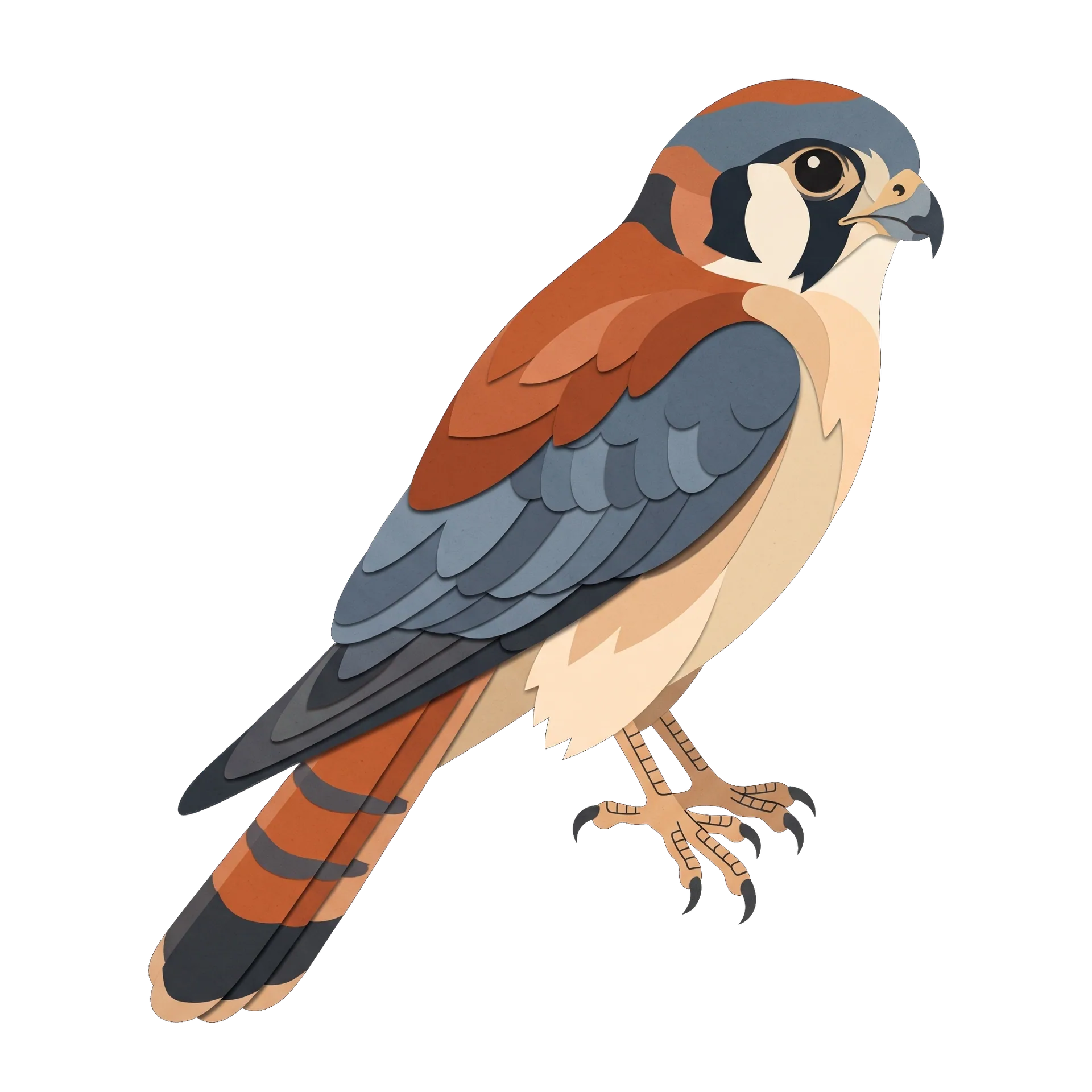
- Male: blue-gray wings with a rufous back and tail; female: rufous wings and tail, both barred with black.
- Two black spots on the back of the head: false 'eyes' thought to discourage attacks from behind.
- Hunts by hovering in place ('kiting') over open ground before diving on prey, a behavior most other falcons don't show.
Voice
A rapid, high-pitched klee-klee-klee-klee, sharper and more excitable than a larger falcon's cry.
Recording: Thomas Magarian, XC731128, xeno-canto.org (CC-BY-NC-SA 4.0)
Lore
The Hopi have a Sparrow-Hawk Clan, Kyelngyam, one of the many bird and animal clans that make up Hopi social structure, membership traced through the mother's line back to a shared clan story. A Hopi tale collected in 1905 by ethnographer H. R. Voth, credited to a narrator named Qöyáwaima from the village of Oraíbi, follows a sparrow-hawk, fed up with a boastful lizard taunting it from a crack in the rocks, who sets one of its own fledged young out as a decoy and swoops in to kill the lizard the moment it takes the bait. Voth's collection, published by the Field Columbian Museum, is one of the earliest sustained records of Hopi oral tradition set down in English.
For most of the 20th century, American field guides called it the sparrow hawk, a holdover from early colonists who assumed it was the same bird as the Eurasian sparrowhawk they knew from home. It isn't: that bird is an accipiter, built for chasing prey through cover, while the American Kestrel is a true falcon, closer kin to Merlins and Peregrines. The American Ornithologists' Union corrected the record in 1983, in the sixth edition of its official checklist, renaming it the American Kestrel. Older names hang on regardless: killy hawk, for its rapid klee-klee-klee call, still turns up in the field.
At a glance
- Family
- Falconidae (falcons)
- Range
- Throughout the Americas, from Alaska to Tierra del Fuego
- Habitat
- Open country (farmland, grassland, roadsides, and desert), hunting from wires and poles
- Diet
- Large insects, small rodents, and songbirds, often taken after hovering in place
Where it lives
How big is it?
How is it doing?
Field notes
- The false eyespots on the nape are thought to make the kestrel look alert from behind, deterring hawks and other predators from sneaking up on it while it's focused on the ground.
- Breeding Bird Survey data show steep declines across much of North America since the 1960s; the causes are debated, but nest-box programs have become a common conservation response, since kestrels readily use boxes in place of scarce natural tree cavities.
- The idea that kestrels track glowing vole urine trails under ultraviolet light traces to research on the American Kestrel's Old World cousin, the Common Kestrel. Even there, later work found raptor eyes let in too little UV for the trick to matter much, so the flashy explanation for how they find prey is probably less important than it sounds.
Go deeper
The daily email
Get tomorrow's bird in your inbox
One bird at 5:30am ET, every day. Free, no password, one-click unsubscribe — and your life list syncs across devices.
You're in. Your first bird arrives with the next morning email (5:30am ET) — and your life list now syncs.Your account →