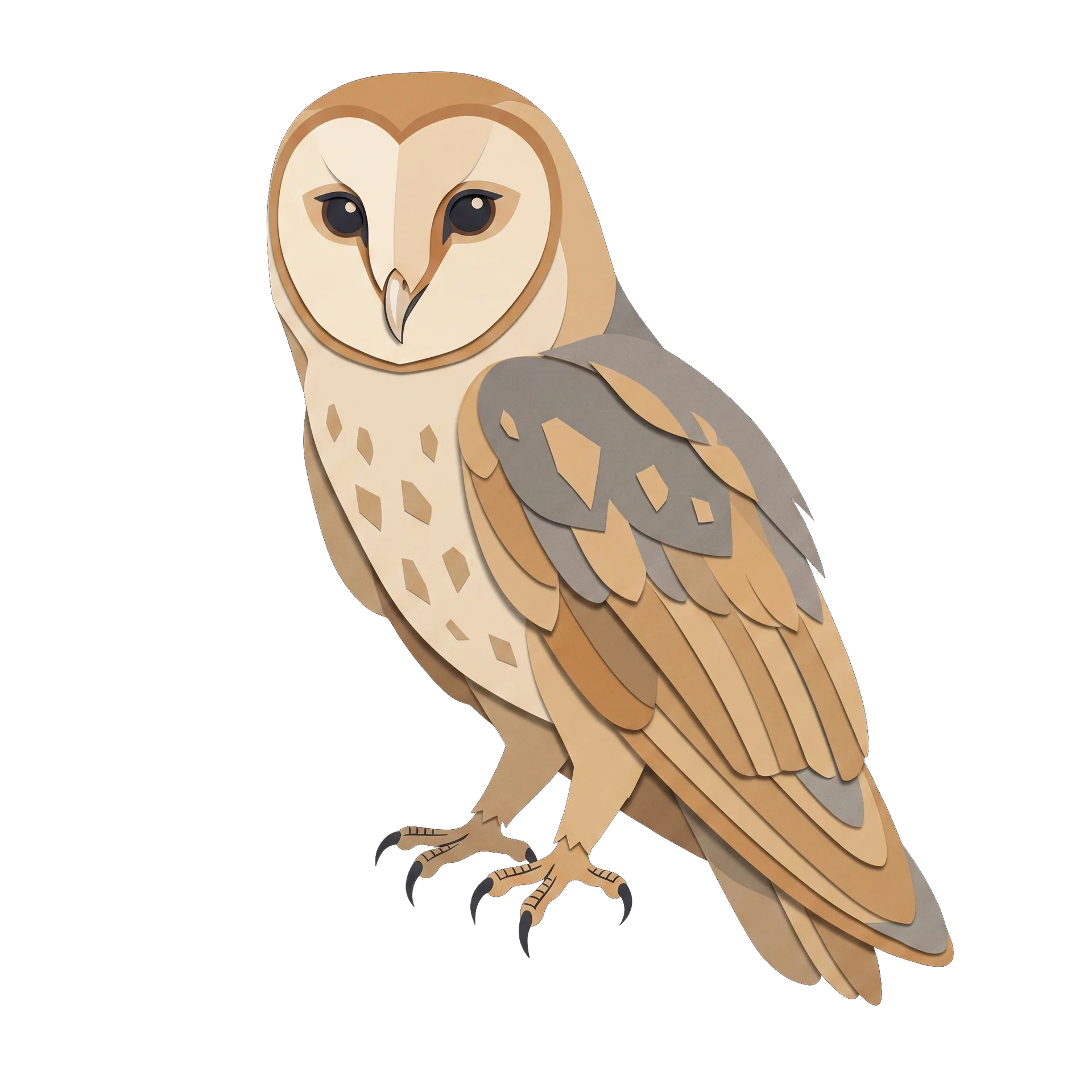
In the early 1960s, researchers at Cornell put a barn owl in a light-tight room, released a mouse on a leaf-strewn floor, and watched the owl strike it dead-center in zero light. The trick is in the lopsided head: a Barn Owl's ear openings are set at different heights, one angled slightly up and one down, so a rustle in the grass reaches each ear at fractionally different times and volumes. The heart-shaped face isn't decoration either: it works like a satellite dish, funneling sound toward the ears. The whole bird is an instrument for hearing the dark.
Barn owls as a family fly almost everywhere the night is warm enough (the veldt, Australian wheat country, European hay meadows), and taxonomists now carve that empire into three species. Ours, the American Barn Owl, holds the entire New World half: prairie farmland, Caribbean cane fields, the Argentine pampas. None of them ever learned to hoot. What they produce instead is a long, shredding shriek, the probable source of a good share of the world's ghost stories, delivered from church towers and barn lofts by a bird that looks, in headlights, like a white face floating on silent wings.
The silence is real, not poetic. Serrated leading edges on the flight feathers and a velvet surface break up the air that makes other wings whoosh, letting the owl arrive unannounced over a vole that never stopped hearing anything. Whole industries have taken note: engineers studying quiet fan and turbine blades keep returning to the Barn Owl wing for the blueprint.
Like this? Get one bird every morning, by email.
You're in. Your first bird arrives with the next morning email (5:30am ET) — and your life list now syncs.Your account →
How to identify
- A pale, long-winged owl of open country with a white, heart-shaped face and dark eyes; no ear tufts, no yellow stare.
- Ghost-white below and honey-gold above, finely speckled with gray; in headlights or moonlight it can look entirely white.
- Hunts low and buoyant over fields, wavering like a giant moth, often beginning right at dusk.
- The voice rules out every other owl: a long, harsh, hissing shriek — never a hoot.
- By day, check barn lofts, silos, church towers, and dense palms for a roosting pair.
Voice
A drawn-out, rasping shriek like tearing cloth amplified through the dark; once heard over a night field, never mistaken for anything else.
Recording: Juanita Barrera Vargas, XC805126, xeno-canto.org (CC-BY-NC-SA 4.0)
Lore
In Aztec belief, owls belonged to Mictlantecuhtli, lord of the dead and ruler of the underworld: the god was pictured wearing an owl's feathers and attended by an owl companion, an image that marked the birds as native to his realm rather than to the ordinary night. The association outlived the empire. A saying still heard in Mexico today, cuando el tecolote canta, el indio muere ('when the owl sings, the person dies'), uses tecolote, from the Nahuatl word for owl, for a call that's still taken as an announcement rather than background noise.
An American Barn Owl's own voice does nothing to dispel that inheritance: a drawn-out, rasping shriek with no hoot and no soft register, delivered as often as not from a dark barn loft or church tower at the edge of a field. It's exactly the sound that has attached omens and ghost stories to pale, night-hunting owls across cultures, long before anyone thought to credit the bird for the pest control instead.
At a glance
- Family
- Tytonidae (barn owls)
- Range
- The Americas; its two Old World sister species cover four more continents
- Habitat
- Open country: farmland, grassland, marsh edges, and old buildings
- Diet
- Rodents overwhelmingly — voles, mice, rats — swallowed whole
Where it lives
How big is it?
How is it doing?
Field notes
- A barn owl can catch a mouse in absolute darkness, guided by ears alone. Its ear openings sit at different heights, so sound arrives at each a fraction differently, enough for the owl's brain to build a sound map precise to a couple of degrees.
- Barn Owl families are rodent-control heavyweights: a pair raising chicks can deliver well over a thousand rodents to the nest in a single season, which is why farmers and vineyard owners install owl boxes instead of poison.
Go deeper
The daily email
Get tomorrow's bird in your inbox
One bird at 5:30am ET, every day. Free, no password, one-click unsubscribe — and your life list syncs across devices.
You're in. Your first bird arrives with the next morning email (5:30am ET) — and your life list now syncs.Your account →