By late fall the Arctic breeders are strung out along their flyways, flying high in loud flocks that follow narrow corridors and drop into the same traditional stopover marshes and fields year after year. Lesser Snow Geese from the central and eastern Canadian Arctic mainly follow the Central and Mississippi Flyways to winter in the Gulf Coast states and as far west as New Mexico and Chihuahua; the larger Greater Snow Goose takes the Atlantic Flyway to the Atlantic Coast.
The flocks are also at the center of an ecological argument. Numbers have grown rapidly since the mid-twentieth century and now stand at about 16 million mature individuals (BirdLife International, 2021), a boom helped along by the birds' quick adoption of farm fields and their leftover grain. In places, tundra nesting habitat is starting to suffer. The Light Goose Conservation Order, set up in 1999 with higher bag limits and extra spring hunting outside the regular seasons, did not stop the midcontinent Lesser Snow Goose population from growing, according to a 2011 study.
In many flocks you'll spot birds that aren't white: the 'blue' morph, gray-brown with a white head. Both colors belong to one species and are set by a single gene, with the dark form partially dominant over white. Mate choice complicates the arithmetic, because young birds tend to pair with partners that look like their parents. Two white geese have only white chicks, while two dark geese have mostly dark chicks and now and then a white one.
Like this? Get one bird every morning, by email.
You're in. Your first bird arrives with the next morning email (5:30am ET) — and your life list now syncs.Your account →
How to identify
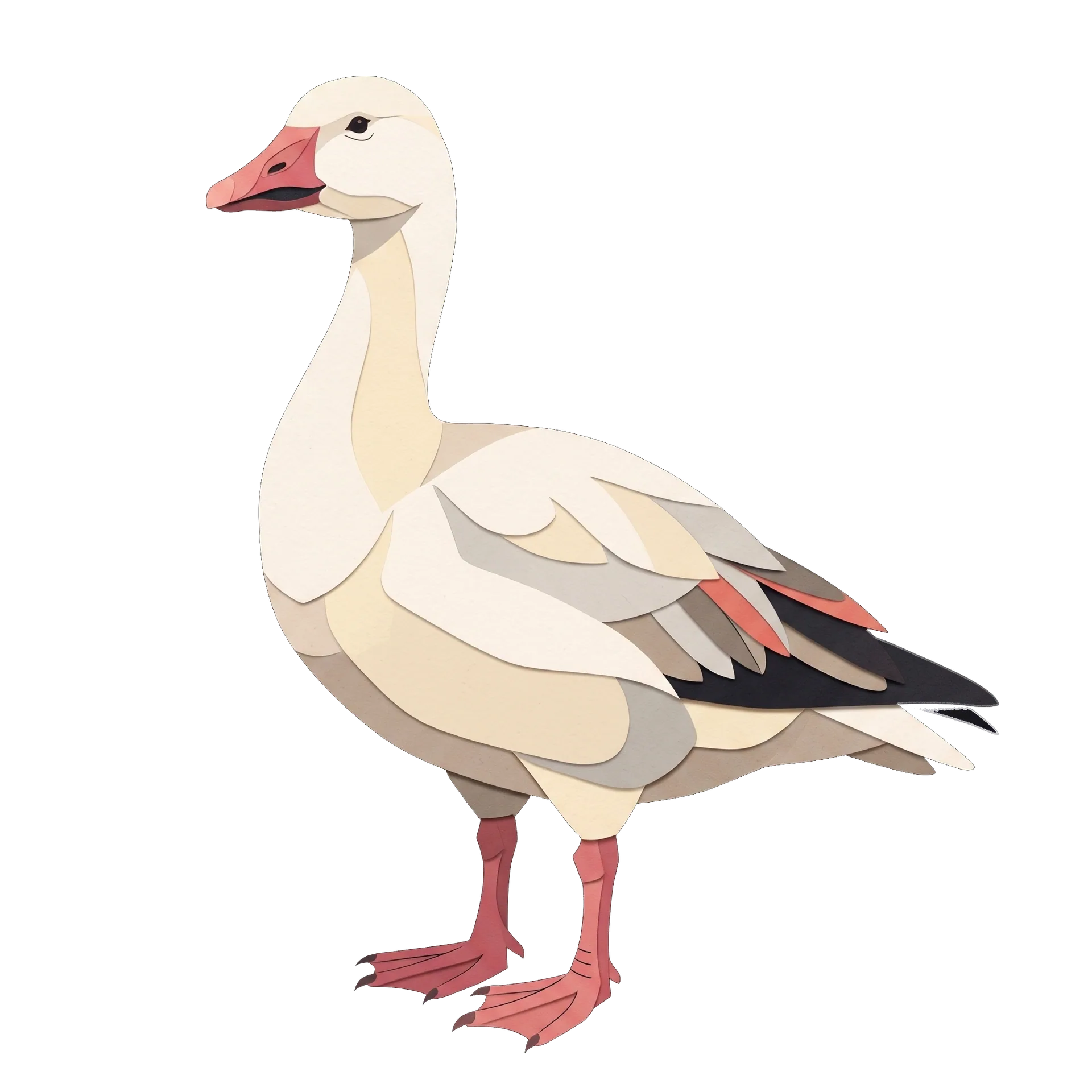
- White morph: a mid-sized goose that is all white except for black wingtips, with a pink bill, dark edges along the bill that give a 'grin patch,' and pink legs.
- Dark ('blue') morph: a gray-brown body with a white head. Both colors mix freely in the same flocks.
- Young birds are grayer, and white-morph heads can be stained by soil minerals.
- Flocks often fly very high in formation, giving numerous nasal honks.
- Ross's Goose, often mixed into the same flocks, is smaller and has a stubbier bill without the bold dark grin patch.
Voice
A loud, high-pitched, nasal bark, often written howk-howk or bow-wow; a big flock produces a cacophony of honking.
Recording: Denis Provencher, XC1051615, xeno-canto.org (CC-BY-NC-SA 4.0)
At a glance
- Family
- Anatidae (ducks, geese & swans)
- Range
- Arctic North America and northeastern Siberia; winters across the U.S. and northern Mexico
- Habitat
- Arctic tundra to nest; coastal marshes, wetlands, and farm fields on migration and in winter
- Diet
- Grasses, sedges, and roots; waste grain from farm fields in winter and on migration
Where it lives
How big is it?
How is it doing?
Field notes
- The Greater Snow Goose, the larger Atlantic race, fell to roughly 2,000–3,000 birds around 1900 before recovering.
- Goslings leave the nest within a few hours of hatching and find their own food with both parents in attendance. They fledge at 42–50 days.
- Pairs may mate for life, and most first breed at age three. In courtship the pair faces each other and stretches their necks upward in unison.
Go deeper
The daily email
Get tomorrow's bird in your inbox
One bird at 5:30am ET, every day. Free, no password, one-click unsubscribe — and your life list syncs across devices.
You're in. Your first bird arrives with the next morning email (5:30am ET) — and your life list now syncs.Your account →