Somewhere above you, on every continent but Antarctica, a Peregrine Falcon is watching other birds fly. The peregrine's hunt begins high, often as an invisible speck, and ends in the stoop: wings folded to a teardrop, the falcon falls onto its prey at speeds beyond 300 km/h, the fastest movement any animal achieves under its own power. The strike, delivered with clenched talons, is usually decisive before the prey knows the sky held anything at all.
The species name means 'wanderer,' and peregrines have earned it, breeding from Arctic cliffs to tropical islands and migrating, in some populations, from the far north of Canada to Argentina. Yet the modern peregrine story is urban: cities turned out to be artificial cliff country, complete with ledge nest sites and an inexhaustible supply of pigeons. Falcons now raise chicks on cathedrals, bridges, and bank towers, often with their own webcams and devoted local followings.
The comeback wasn't gentle. DDT moving up the food chain thinned peregrine eggshells until they cracked under the incubating parents, and by the 1960s not one breeding pair remained in the eastern United States. Recovery took the 1972 pesticide ban plus two decades of biologists hand-rearing chicks and releasing them from towers and bridges, after which the falcons handled the rest, trading cliffs for skyscrapers.
Like this? Get one bird every morning, by email.
You're in. Your first bird arrives with the next morning email (5:30am ET) — and your life list now syncs.Your account →
How to identify
- A crow-sized falcon with long, pointed wings and quick, stiff, powerful wingbeats — built like a fighter jet, not a soaring hawk.
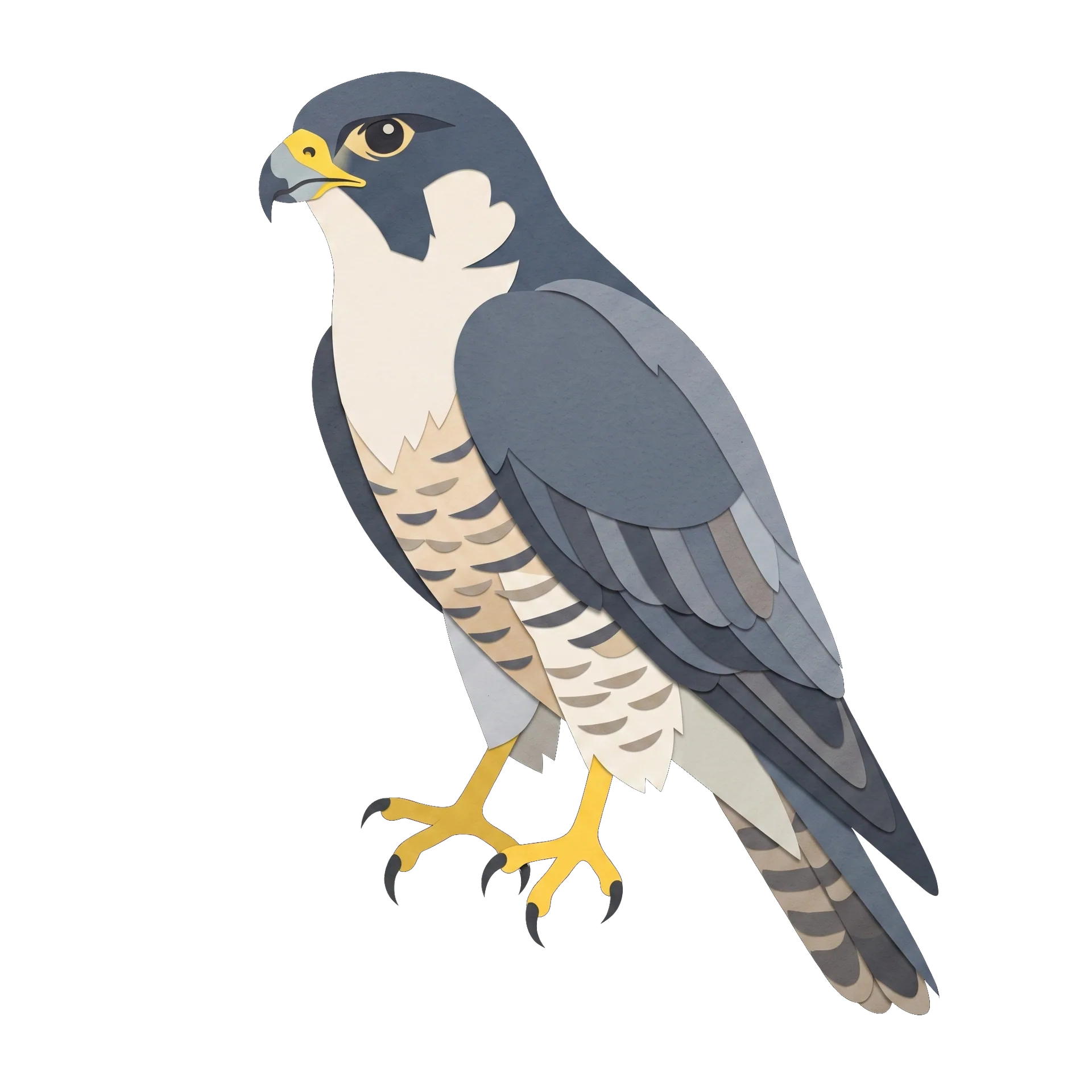
- The dark 'helmet' with a heavy mustache-like malar stripe against white cheeks is the signature head pattern.
- Adults are slate-gray above with fine dark barring across pale underparts; juveniles are browner with vertical streaking instead.
- City sightings are real: check ledges of tall buildings, bridges, and cathedral towers, often with panicked pigeon flocks as the tell.
- Compare the much smaller Merlin (no strong helmet) and the paler, desert-dwelling Prairie Falcon (dark 'armpits').
Voice
A harsh, insistent kak-kak-kak around the nest cliff; mostly silent on the hunt — you hear the stoop as wind, if you hear it at all.
Recording: Jarek Matusiak, XC213533, xeno-canto.org (CC-BY-NC-SA 4.0)
Lore
The name is a leftover from how falconers used to get their birds. Most hawks were taken as eyasses, downy chicks lifted straight from a nest the falconer had located; peregrines nest on cliffs nobody could find or reach, so trainers instead trapped grown birds during migration. A falcon caught mid-journey like that was called 'peregrine,' medieval Latin for a traveler or pilgrim. The species name is essentially an old falconer's shrug: the falcon whose nest nobody has ever seen.
England's 1486 Book of Saint Albans ranked hawks by the social class allowed to fly them: an emperor got an eagle, a king a gyrfalcon, and a prince the 'falcon gentle,' the era's term for a female peregrine (an earl, one rung down, got the same species listed under its plain, unqualified name). It reads like a tidy caste system until the same list hands an emperor a vulture and a baron a bustard, neither of which anyone has ever flown at prey. The falconer Phillip Glasier called it 'a formalised and rather fanciful listing.' No court record or falconry manual describes anyone enforcing it; it survived mostly as a tidy line for later writers to quote.
At a glance
- Family
- Falconidae (falcons)
- Range
- Every continent except Antarctica — the world's most widespread raptor
- Habitat
- Sea cliffs, river gorges, and, increasingly, skyscraper ledges
- Diet
- Other birds, caught mid-air — from songbirds to ducks and pigeons
Where it lives
How big is it?
How is it doing?
Field notes
- The peregrine is the fastest animal on Earth. In a hunting dive — the stoop — it exceeds 300 km/h (186 mph), with trained birds clocked well beyond that.
- A bony baffle in each nostril manages the hurricane of air pressure during the stoop, letting the falcon keep breathing at speeds that would harm an unprotected lung.
- Peregrines nearly vanished from North America when DDT thinned their eggshells. After the pesticide ban and decades of reintroduction, they recovered so fully they came off the U.S. endangered species list in 1999.
Go deeper
The daily email
Get tomorrow's bird in your inbox
One bird at 5:30am ET, every day. Free, no password, one-click unsubscribe — and your life list syncs across devices.
You're in. Your first bird arrives with the next morning email (5:30am ET) — and your life list now syncs.Your account →