Everything about the Gyrfalcon is scaled up. It's the largest falcon in the world, with females weighing as much as 2.1 kg, and it hunts on a different plan from a Peregrine's: instead of a high stoop, it usually works in horizontal pursuit, flying low and fast and chasing until the quarry tires. On the tundra that quarry is mostly ptarmigan; along coasts it's often seabirds. It builds no nest of its own, either. A pair takes a bare cliff ledge or an old stick nest left by a Common Raven or a Golden Eagle, sometimes claiming it in late winter.
Many adults stay near the breeding grounds all year, even above the Arctic Circle in the dark of winter, while many young birds move south. A 2011 study using satellite tracking showed Gyrfalcons spending long stretches of winter out on sea ice, far from land. A few drift as far as southern Canada and the northern United States, where one along a coast or over open country is a prized sighting.
Like this? Get one bird every morning, by email.
You're in. Your first bird arrives with the next morning email (5:30am ET) — and your life list now syncs.Your account →
How to identify
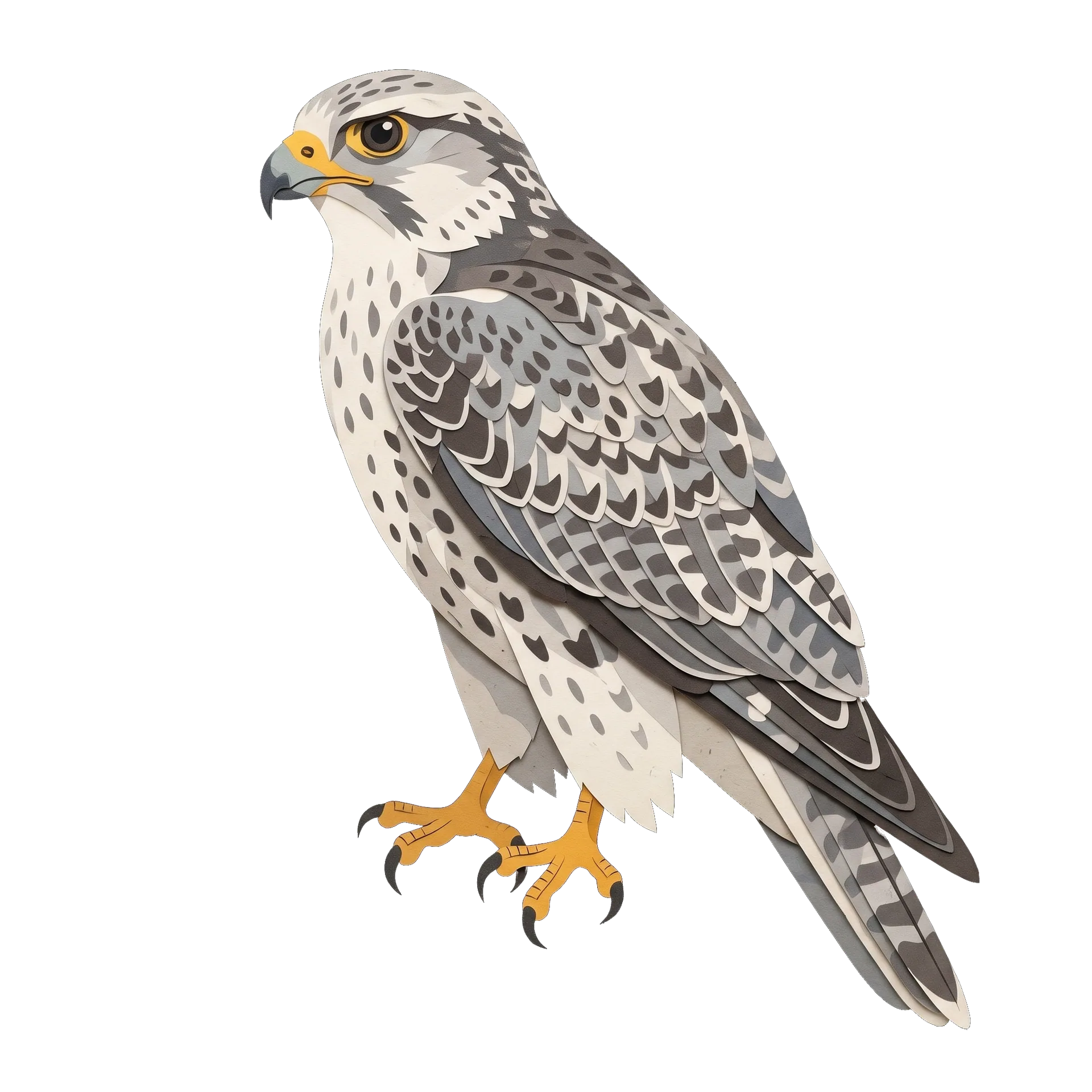
- The largest falcon in the world, with females about the size of a Red-tailed Hawk, a heavy body, and a long tail.
- Most in North America are gray, with white birds speckled with black and rarer dark brown ones also occurring.
- Very broad-winged for a falcon, more often approaching fast and low than diving from height.
- All but the darkest birds lack the Peregrine's dark hooded look, and unlike a Prairie Falcon none has black armpits.
- Watches from a high perch or hunts by cruising low and surprising prey, then chasing it relentlessly.
Voice
A harsh, chattering scream, kak-kak-kak-kak.
Recording: Andrew Spencer, XC189210, xeno-canto.org (CC-BY-NC-SA 4.0)
Lore
The Boke of St Albans, an English compendium of hawking, hunting, and heraldry printed in 1486, assigns its hawks and falcons to social ranks. Its hawking section gives the gyrfalcon and its smaller male, the tercel, to a king. An eagle belongs to an emperor, a peregrine to an earl, a goshawk to a yeoman, and a sparrowhawk to a priest, and the list runs on down to a musket for a holy-water clerk.
The price fit the rank. The geographer Ibn Sa'id al-Maghribi, who died in 1286, wrote that the sultan of Egypt paid 1,000 dinars for each gyrfalcon, or 500 if it arrived dead, and he described the northern Atlantic islands the birds came from.
At a glance
- Family
- Falconidae (falcons)
- Range
- Arctic North America, Greenland, Iceland, Scandinavia, and Siberia; some winter south into southern Canada and the northern U.S.
- Habitat
- Arctic tundra, sea coasts, and open mountains; in winter, coasts and open country
- Diet
- Mostly ptarmigan and other medium to large birds, plus lemmings, ground squirrels, and hares
Where it lives
How big is it?
How is it doing?
Field notes
- The species name rusticolus is Latin for 'countryside-dweller,' an odd label for a bird of the open Arctic.
- Females are the larger sex, averaging roughly 1.6 kg to a male's 1.1 kg.
- It's the official bird of Canada's Northwest Territories, and white gyrfalcons have served as live mascots of the U.S. Air Force Academy.
Go deeper
The daily email
Get tomorrow's bird in your inbox
One bird at 5:30am ET, every day. Free, no password, one-click unsubscribe — and your life list syncs across devices.
You're in. Your first bird arrives with the next morning email (5:30am ET) — and your life list now syncs.Your account →