Despite the name, the American Tree Sparrow rarely nests in trees. It breeds on and near the ground, in grass clumps under shrubs near the northern edge of the tree line, and the rest of the year it feeds on the ground or low in bushes. The name is shared with the Eurasian Tree Sparrow, which really does nest in tree holes; the two are not closely related.
Across most of the continent, this is a bird of winter. It breeds in Alaska and northern Canada and comes south late in the fall, traveling mostly at night, to southern Canada and much of the United States. Through the cold months its diet is almost entirely the seeds of grasses and weeds, so it turns up along brushy roadsides and weedy field edges, and at feeders, where it commonly sits with Dark-eyed Juncos. Males start singing in late winter, before the flocks head north.
The Arctic summer is short, and the nesting schedule shows it. Pairs form soon after the birds arrive, the female builds the nest in about a week, and she incubates the clutch (usually five eggs) for 11 to 13 days. The chicks leave the nest at 8 to 10 days and can fly at 14 or 15 days, and the parents keep feeding them for roughly two more weeks. There is one brood a season, though a failed nest may be replaced.
Like this? Get one bird every morning, by email.
You're in. Your first bird arrives with the next morning email (5:30am ET) — and your life list now syncs.Your account →
How to identify
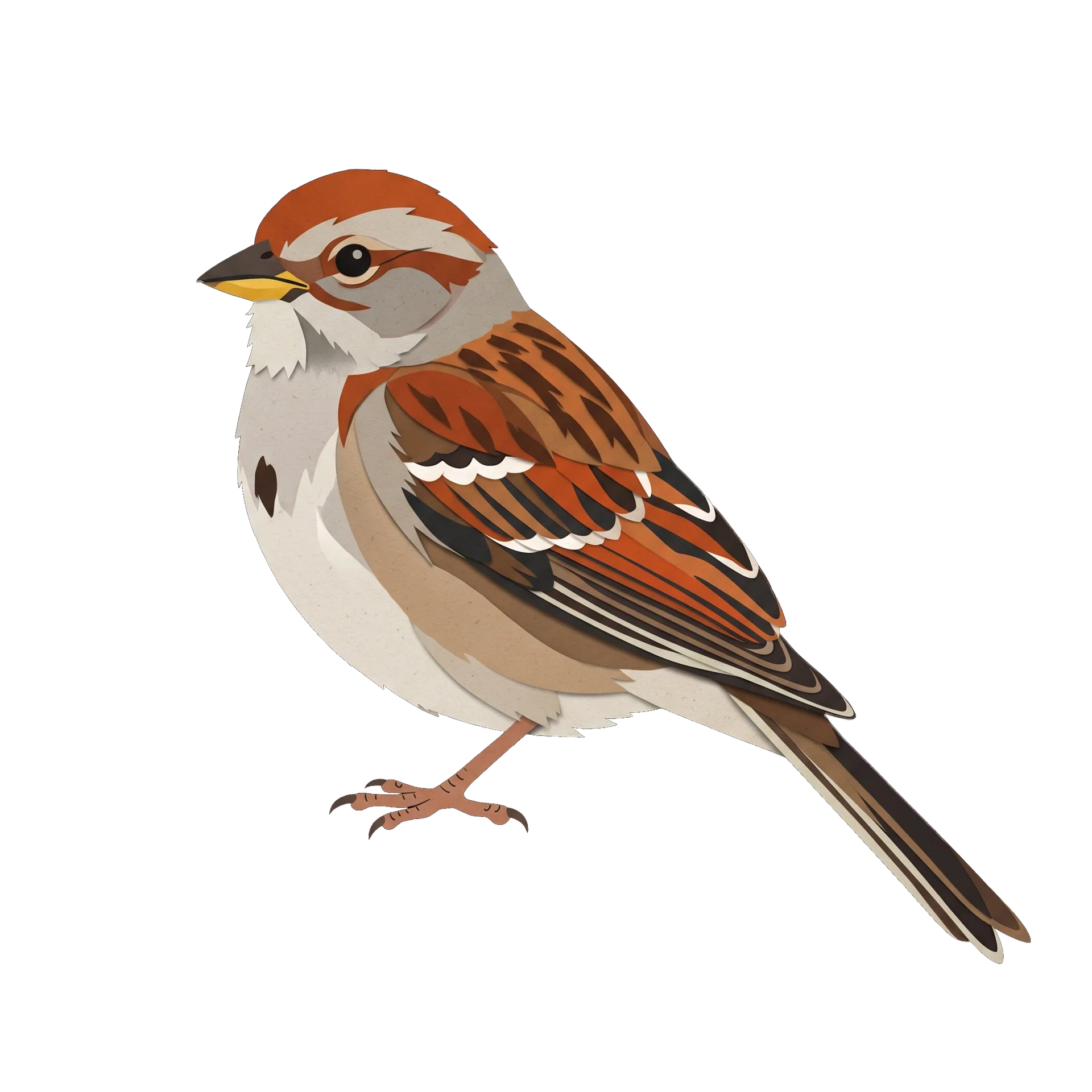
- A small sparrow with a rusty cap, a gray face crossed by a rusty line through the eye, and a pale gray breast.
- The mark to find: a small, dark spot in the middle of that clear breast.
- A two-toned bill and two white wing bars on rusty-brown wings.
- Forages on the ground or low in bushes in small flocks, often alongside Dark-eyed Juncos at feeders.
- A Chipping Sparrow has a similar rusty cap but lacks the breast spot.
Voice
A silvery, musical tsee-ler as a winter feeding call; in late winter, males begin a sweet, high warble that falls in pitch and turns a little buzzy at the end.
Recording: Doug Hynes, XC568655, xeno-canto.org (CC-BY-SA 4.0)
At a glance
- Family
- Passerellidae (New World sparrows)
- Range
- Breeds in Alaska and northern Canada; winters across southern Canada and much of the U.S.
- Habitat
- Arctic scrub and tundra near the tree line to breed; brushy roadsides, weedy fields, marsh edges, and feeders in winter
- Diet
- Seeds of grasses and weeds in winter; insects in summer
Where it lives
How big is it?
How is it doing?
Field notes
- Females winter a bit farther south than males, on average.
- The nest cup is lined with feathers, usually those of ptarmigan.
- For years it was placed in Spizella, the genus of the Chipping Sparrow. In 2014 it was moved to a genus of its own, Spizelloides, after genetic work showed that Spizella was not a natural group.
- Alexander Wilson described the species in 1810, and the octavo edition of John James Audubon's Birds of America called it the 'Canada bunting.' Birders sometimes call it the 'winter chippy.'
Go deeper
The daily email
Get tomorrow's bird in your inbox
One bird at 5:30am ET, every day. Free, no password, one-click unsubscribe — and your life list syncs across devices.
You're in. Your first bird arrives with the next morning email (5:30am ET) — and your life list now syncs.Your account →