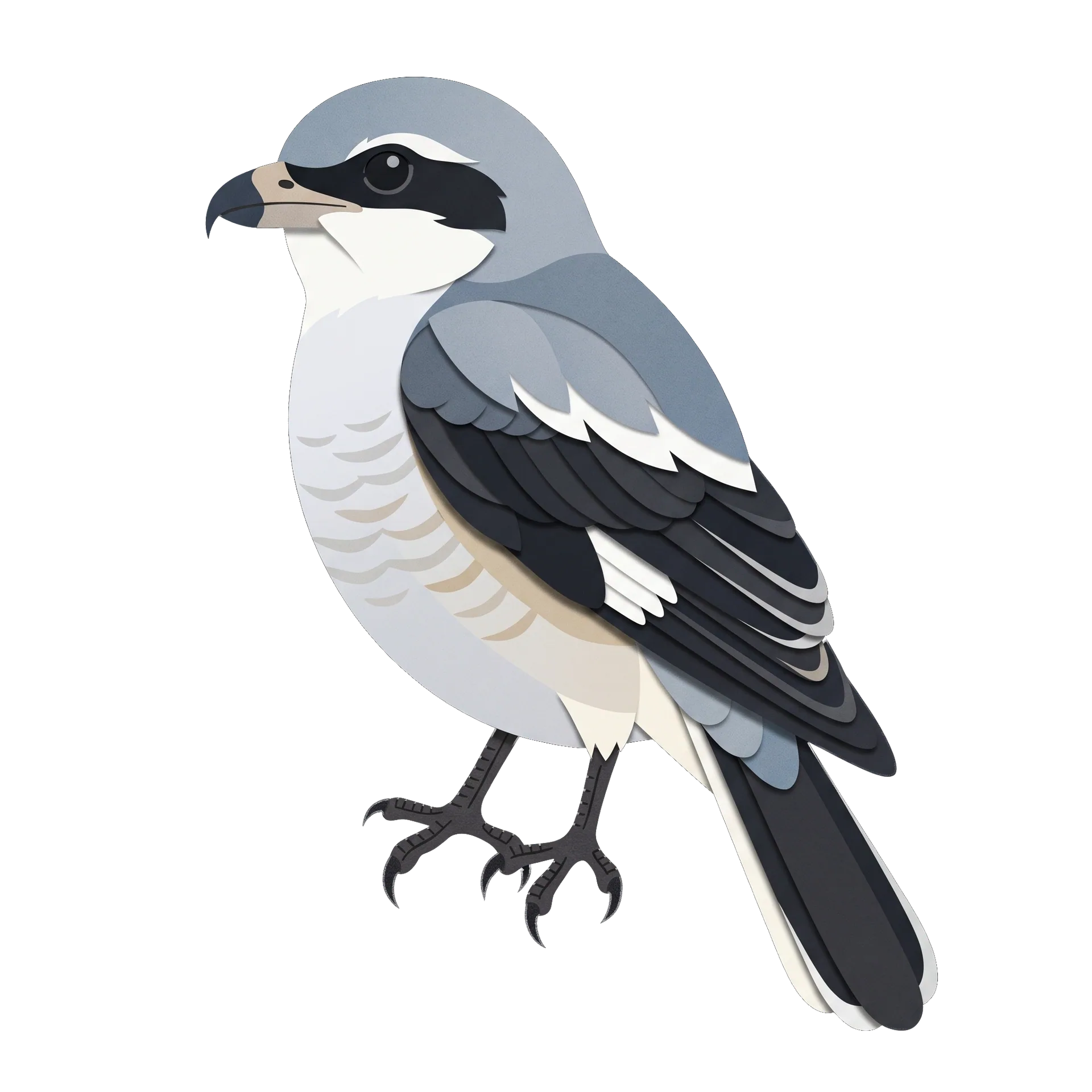
The Northern Shrike is a songbird doing a small hawk's job. It has a raptor's hooked bill but, as a perching bird, no talons, so it kills with the bill. From an exposed perch it watches open ground, then darts out in swift, powerful flight for small songbirds, voles, and mice, and it will take finches and House Sparrows at feeders. It breeds across the taiga and tundra edge, moves south late in fall, and returns north early in spring. Numbers vary from year to year, with many more birds coming south in 'invasion winters,' and in some years individuals turn up as far south as New Mexico or Oklahoma.
North American shrikes are nicknamed butcherbirds for their larders: dead prey hung on a thorn or a barb of wire, or wedged into the fork of a branch. A larder stores surplus food, and with no talons to pin a meal down, a shrike also uses the spike like a vise to tear it into bite-sized pieces. In the breeding season, a male Northern Shrike caches prey around the nesting territory as a display of his hunting prowess.
Like this? Get one bird every morning, by email.
You're in. Your first bird arrives with the next morning email (5:30am ET) — and your life list now syncs.Your account →
How to identify
- A burly, big-headed songbird about the size of a robin, with a heavy hooked bill and white flashes in the wings and tail.
- Adults are pale gray above and whitish below with faint gray barring, and a black mask through the eye that is distinctly reduced in front of the eye.
- First-winter birds are browner, with a narrow, dusky mask and barring across the chest.
- Solitary and wary, it perches in plain view on top of a lone tree or on a utility wire to scan the open ground.
- The smaller Loggerhead Shrike has a fuller black mask, and the Northern has a longer bill with a more prominent hook.
Voice
A long, complex song of warbles and harsh notes with a robin-like quality; imitations of other birds are often worked in.
Recording: Andrew Spencer, XC91967, xeno-canto.org (CC-BY-NC-ND 2.5)
At a glance
- Family
- Laniidae (shrikes)
- Range
- Northern North America and Siberia; winters in southern Canada and the northern U.S.
- Habitat
- Open boreal forest edge and tundra scrub to breed; open country with scattered perches and brushy cover in winter
- Diet
- Insects in summer; small songbirds and rodents such as voles and mice the rest of the year
Where it lives
How big is it?
How is it doing?
Field notes
- For a long time the bird was treated as a subspecies of the Great Gray Shrike of Eurasia. It was recognized as its own species in 2017.
- The northern edge of its breeding range tracks shrubby willows 1–2 m (3–7 ft) tall.
- Nests sit 6–15 ft (2–5 m) up in a low tree or big shrub, a bulky cup of twigs, grass, bark, and moss lined with feathers and animal hair. Clutches usually run 4 to 7 eggs, and up to 9 in Alaska.
Go deeper
The daily email
Get tomorrow's bird in your inbox
One bird at 5:30am ET, every day. Free, no password, one-click unsubscribe — and your life list syncs across devices.
You're in. Your first bird arrives with the next morning email (5:30am ET) — and your life list now syncs.Your account →