A Golden Eagle folds into a hunting stoop and gets tracked well past 240 km/h — in the same range as the Peregrine Falcon's famous speed record, from a bird many times heavier. That combination of size and speed makes it a serious predator of jackrabbits and ground squirrels across the open country of the American West, and occasionally of prey as large as young deer.
A breeding pair's territory can stretch from tens to well over a hundred square kilometers of canyon and grassland depending on habitat and prey (a bigger home range than almost any other North American raptor holds), anchored by a cliff nest the pair returns to and rebuilds year after year; radiocarbon dating on one western nest showed construction material more than 500 years old.
That same size once made the species a target instead of a marvel. Ranchers convinced Golden Eagles preyed heavily on lambs pushed for control efforts that, in parts of the western U.S., included shooting eagles from small aircraft — roughly 20,000 birds killed this way between 1941 and 1961 alone, before a 1962 amendment to the Bald and Golden Eagle Protection Act made the practice illegal, even though scattered illegal killing continued for years afterward.
Like this? Get one bird every morning, by email.
You're in. Your first bird arrives with the next morning email (5:30am ET) — and your life list now syncs.Your account →
How to identify
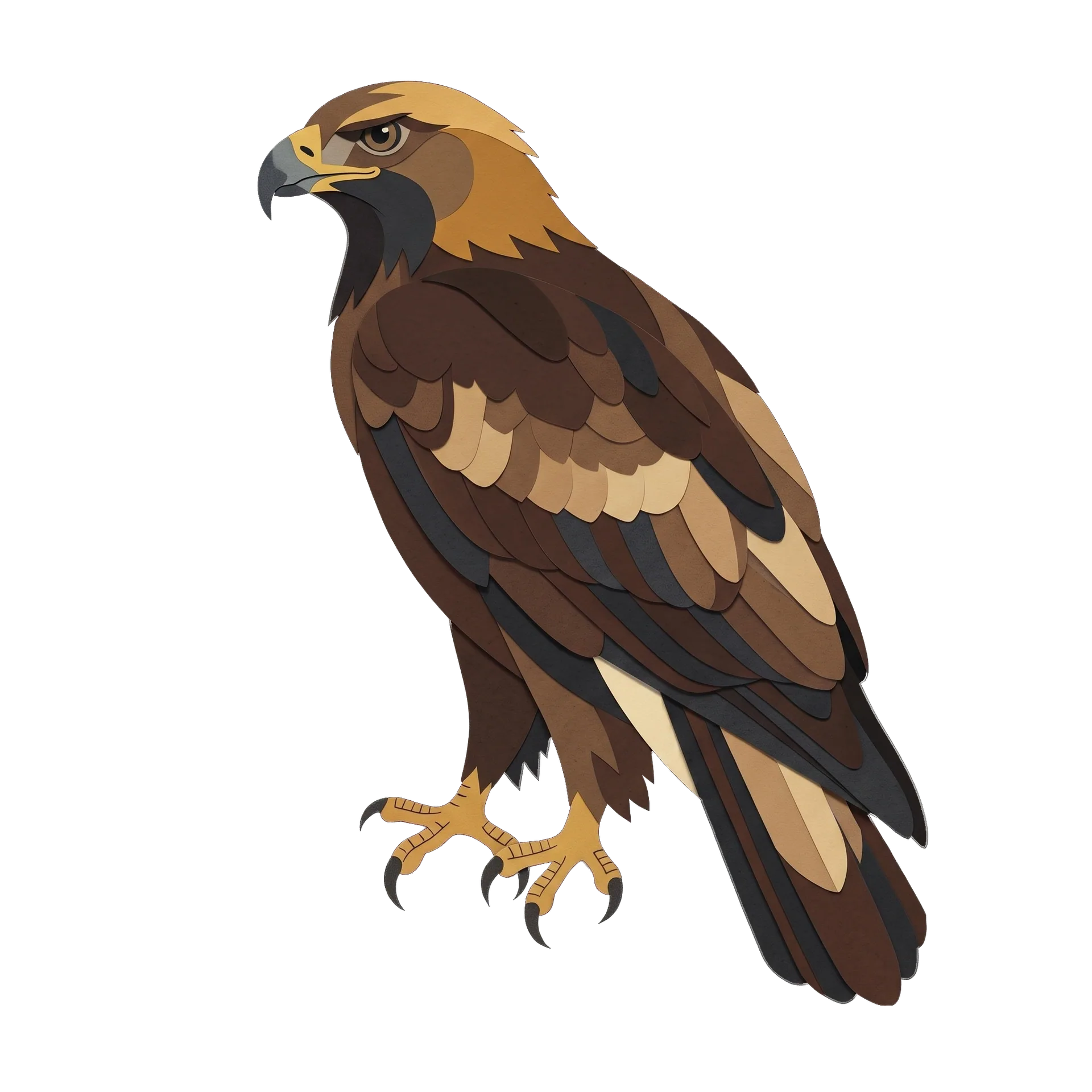
- A huge, dark brown eagle with golden-tawny feathering across the nape and back of the head, visible at a distance in good light.
- Legs are feathered all the way to the toes, distinguishing it from the bare-legged Bald Eagle even in immature plumage.
- Soars on flat or slightly raised wings, unlike the flatter, plank-like profile of a Bald Eagle.
- Immatures show bold white patches at the base of the tail and in the wings, lost gradually over several years.
Voice
A weak, high-pitched yelping or chirping, rarely heard and inconsistent with the bird's imposing size.
Recording: Daniel Lane, XC70431, xeno-canto.org (CC-BY-NC-SA 3.0)
Lore
Bürkitshi, Kazakh eagle hunters of the Altai, have trained golden eagles for hunting on the steppe for centuries: a hunter takes a female eaglet from the nest, raises and flies her against foxes and hares, then after several seasons releases her back into the wild to breed. In Bayan-Ölgii Province, Mongolia, home to the country's ethnic Kazakh minority, that partnership is now also a public spectacle. The Golden Eagle Festival, founded in 2000 to help revive a practice that had faded under Soviet rule, brings hunters into Ölgii each October on horseback, eagles on the arm, for competitions in speed, accuracy, and traditional dress.
Mongolia's falconry, bürkitshi included, has held a place on UNESCO's Representative List of the Intangible Cultural Heritage of Humanity since the list's first inscriptions in 2010; Kazakhstan's own falconry tradition joined the same multinational listing in 2021.
At a glance
- Family
- Accipitridae (hawks, eagles & kites)
- Range
- Western North America, and widely across Europe and Asia
- Habitat
- Open mountains, grasslands, and canyon country with cliffs for nesting
- Diet
- Rabbits, hares, and ground squirrels, plus carrion
Where it lives
How big is it?
How is it doing?
Field notes
- Golden Eagles are among the fastest birds in a dive, with some tracking studies clocking hunting stoops well over 240 km/h (150 mph), rivaling the more famous Peregrine Falcon.
- A breeding pair's territory can run from tens to well over a hundred square kilometers depending on habitat and prey density, among the largest of any North American raptor, and pairs reuse the same nest (added to year after year) for decades; radiocarbon dating on one western nest showed construction material going back more than 500 years.
- Historically persecuted as a supposed threat to livestock, Golden Eagles were shot from aircraft in parts of the western U.S. well into the 20th century: roughly 20,000 birds between 1941 and 1961 alone, before a 1962 federal law made the practice illegal, though scattered illegal shooting and poisoning continued for decades after.
Go deeper
The daily email
Get tomorrow's bird in your inbox
One bird at 5:30am ET, every day. Free, no password, one-click unsubscribe — and your life list syncs across devices.
You're in. Your first bird arrives with the next morning email (5:30am ET) — and your life list now syncs.Your account →