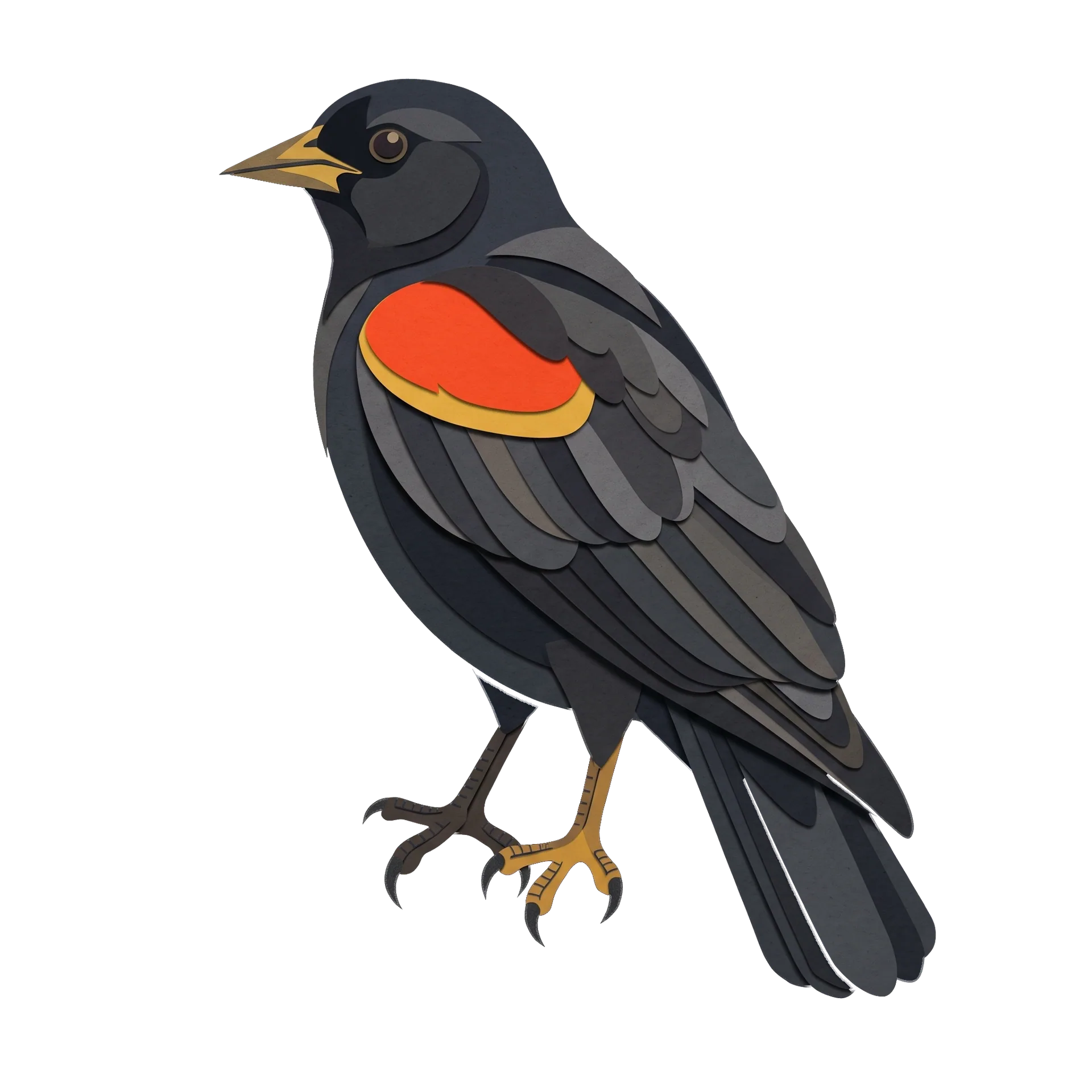
A male Red-winged Blackbird announces a marsh from a hundred meters off: perched high on a cattail, wings flared to flash red-and-yellow shoulder patches, delivering a liquid conk-la-ree that carries across open wetland. The patch itself is closer to a switch than a permanent badge — males can flatten covering feathers to hide it almost completely, and researchers who experimentally blackened the epaulets on territorial males found they lost their turf to rivals dramatically faster than birds left alone.
Numbers alone make the case: population estimates run into the hundreds of millions, among the most numerous native species in North America, and winter flocks can mix Red-winged Blackbirds with grackles, cowbirds, and starlings into swirling masses numbering in the thousands.
Genetic testing complicates the tidy picture of that marsh. A single territory can host several females nesting at once, but the resulting broods regularly turn up chicks fathered by a male from an entirely different territory — the showy defense advertises the marsh, but doesn't guarantee exclusive rights to what happens in it.
Like this? Get one bird every morning, by email.
You're in. Your first bird arrives with the next morning email (5:30am ET) — and your life list now syncs.Your account →
How to identify
- Males are glossy black with a bold red-and-yellow shoulder patch (epaulet), flared open during display and often hidden when at rest.
- Females are streaky brown all over, closely resembling a large sparrow — a frequent source of misidentification.
- Males sing from an exposed cattail or wire, wings spread to show the epaulet, one of the most conspicuous marsh displays in North America.
- Among the earliest and most numerous migrants back in spring across much of the continent.
Voice
A liquid, gurgling conk-la-ree, delivered with wings flared from an exposed perch.
Recording: Killian Sullivan, XC821130, xeno-canto.org (CC0 1.0)
Lore
The red-winged blackbird's shoulder patches have their own origin story among the Chitimacha people of coastal Louisiana, recorded by ethnographer Katharine Berry Judson in her 1914 collection Myths and Legends of the Mississippi Valley and the Great Lakes. In it, a man grows so angry that he sets the marshes on fire, meaning to burn up the world. A blackbird spots the flames, flies into a tree, and shouts a warning: 'Ku nam wi cu! Ku nam wi cu! The world and all is going to burn.' The man threatens to kill it if it doesn't stop; the bird keeps shouting anyway, so he throws a shell that strikes its wings and draws blood. Red-winged blackbirds have carried the mark ever since.
The story doesn't end with the bird. Neighbors who saw the smoke rushed in and killed the deer, bear, and other game the fire had driven into the open, thanking the angry man for the unplanned help. Judson recorded that people of her day still heard the same warning around the house: 'Ku nam wi cu,' called out by every red-winged blackbird since.
At a glance
- Family
- Icteridae (blackbirds & orioles)
- Range
- Throughout North America; northern populations winter into Mexico and Central America
- Habitat
- Marshes, wet meadows, and roadside ditches with cattails or tall grass
- Diet
- Seeds and insects, with more insects taken during the breeding season
Where it lives
How big is it?
How is it doing?
Field notes
- The male's red shoulder patch can be almost entirely hidden by covering feathers at will, and researchers found that males with experimentally blackened epaulets lost their territories far faster than birds left alone — a rare case of a specific plumage patch shown to directly control real-world outcomes.
- One of the most numerous native birds in North America, with a breeding population estimated in the hundreds of millions, and often forming enormous mixed winter flocks with other blackbird species.
- A single male's territory can include multiple female nesting on it at once, but genetic studies show many of the resulting chicks are fathered by a different male entirely, from a neighboring territory.
Go deeper
The daily email
Get tomorrow's bird in your inbox
One bird at 5:30am ET, every day. Free, no password, one-click unsubscribe — and your life list syncs across devices.
You're in. Your first bird arrives with the next morning email (5:30am ET) — and your life list now syncs.Your account →