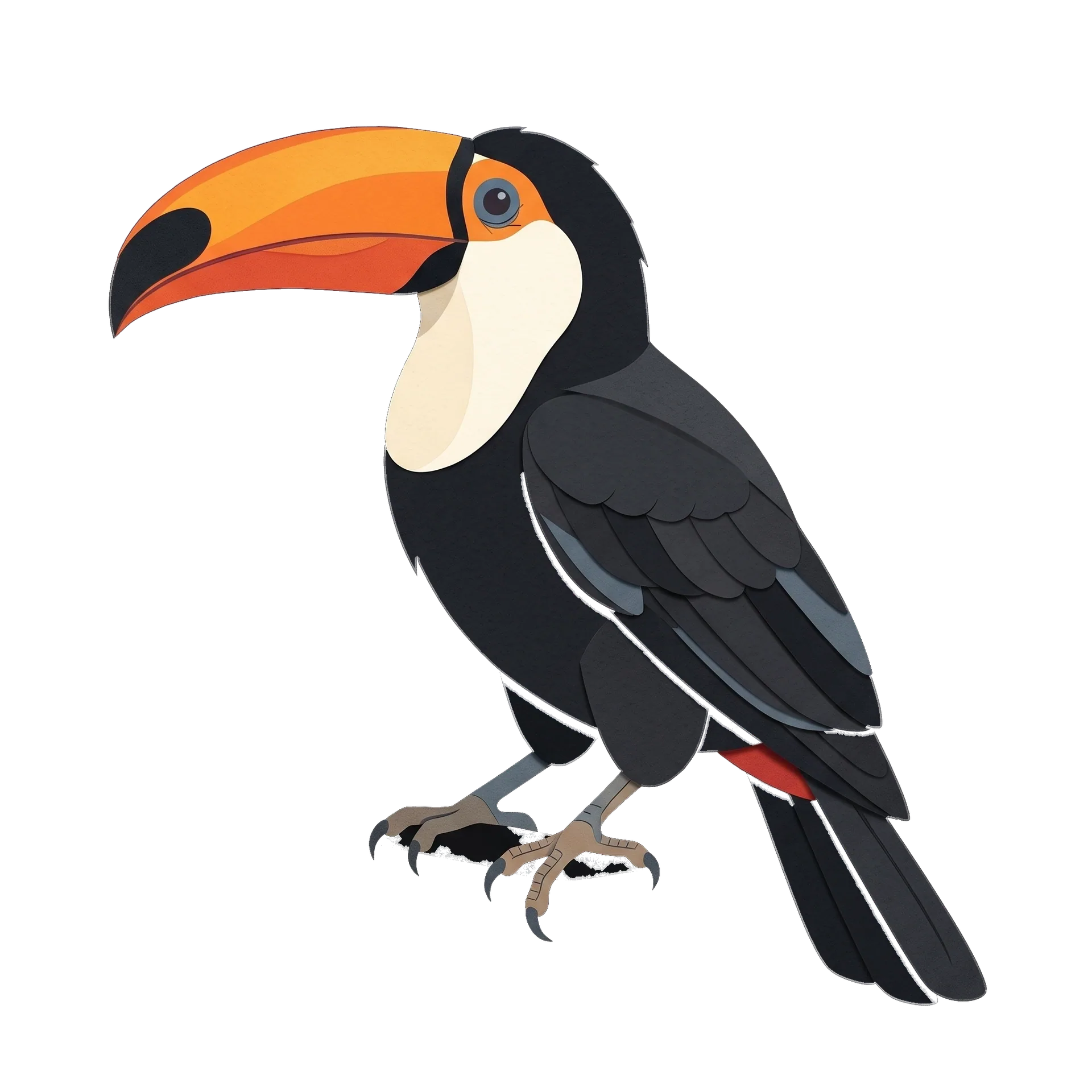
The Toco Toucan's bill looks like it should be too heavy to fly with, and in a sense the bird agrees — it flies in a labored, undulating bounce, wingbeats shallow and frequent, the enormous orange bill carried out in front like ballast. The size is deceptive: strip away the keratin covering and the bill is mostly a lightweight bony lattice, closer in construction to a honeycomb than solid bone.
The lattice does more than keep the bill light, too. Blood vessels near the bill's surface let the toucan dump excess body heat on demand, working almost like a built-in radiator — thermal imaging studies have shown a toucan's bill glowing hot on camera as the bird cools itself down after activity or in warm weather.
The fruit-forward diet that toucans are known for is only part of the story. That long reach makes an excellent tool for raiding other birds' nests, and Toco Toucans regularly take eggs and nestlings from nests built specifically out of a predator's reach.
Like this? Get one bird every morning, by email.
You're in. Your first bird arrives with the next morning email (5:30am ET) — and your life list now syncs.Your account →
How to identify
- Unmistakable: an enormous, bright orange-yellow bill nearly as long as the rest of the body, tipped in black.
- Otherwise mostly glossy black with a white throat and bib and a patch of red under the tail.
- Bare blue skin rings the eye, adding another bright color to an already vivid face.
- Flies in a labored, undulating pattern with shallow wingbeats, the huge bill trailing like a weight it's used to carrying.
Voice
A harsh, croaking, frog-like grunt, repeated in a rattling series and carrying well through open woodland.
Recording: Fabrício Grigolin, XC1054733, xeno-canto.org (CC-BY-NC-SA 4.0)
Lore
Brazilian folklore has never been kind to the toucan. In one telling, birds encountering the toucan hidden inside a tree hole caught sight of its enormous bill and, impressed, crowned it king on the spot. Only once it stepped out into the open and its full, top-heavy shape was visible did the same birds turn on it, deciding the whole bird amounted to 'nothing but nose' and mocking it accordingly. It's a fitting bit of ridicule for a bird whose defining feature still looks like it belongs to something else entirely.
At a glance
- Family
- Ramphastidae (toucans)
- Range
- South America, from the Amazon basin south into Argentina
- Habitat
- Savanna woodland, forest edges, and palm groves — more open country than most toucans prefer
- Diet
- Fruit mainly, plus insects, eggs, and small vertebrates raided from other birds' nests
Where it lives
How big is it?
How is it doing?
Field notes
- The bill, though huge, is mostly a lightweight lattice of bone covered in keratin, and it also works as a radiator — the toucan can dump excess body heat through blood vessels near the surface of the bill to help regulate its temperature in hot climates.
- Toco Toucans nest in tree cavities they don't excavate themselves, relying on holes already made by woodpeckers or natural decay.
- Despite the fruit-heavy reputation, Toco Toucans are opportunistic nest predators, using that long bill to reach into other birds' nests and take eggs or chicks that a shorter-billed bird couldn't.
Go deeper
The daily email
Get tomorrow's bird in your inbox
One bird at 5:30am ET, every day. Free, no password, one-click unsubscribe — and your life list syncs across devices.
You're in. Your first bird arrives with the next morning email (5:30am ET) — and your life list now syncs.Your account →