If you have ever driven a highway in North America, you have almost certainly passed a Red-tailed Hawk without knowing it. They sit sentinel on light poles and fence posts, broad-shouldered and stone-still, watching the median grass for the small movements of voles. This is one of the continent's most widespread and adaptable raptors, equally at home over Sonoran desert, Vermont farmland, and Central Park, where individual red-tails have become minor celebrities.
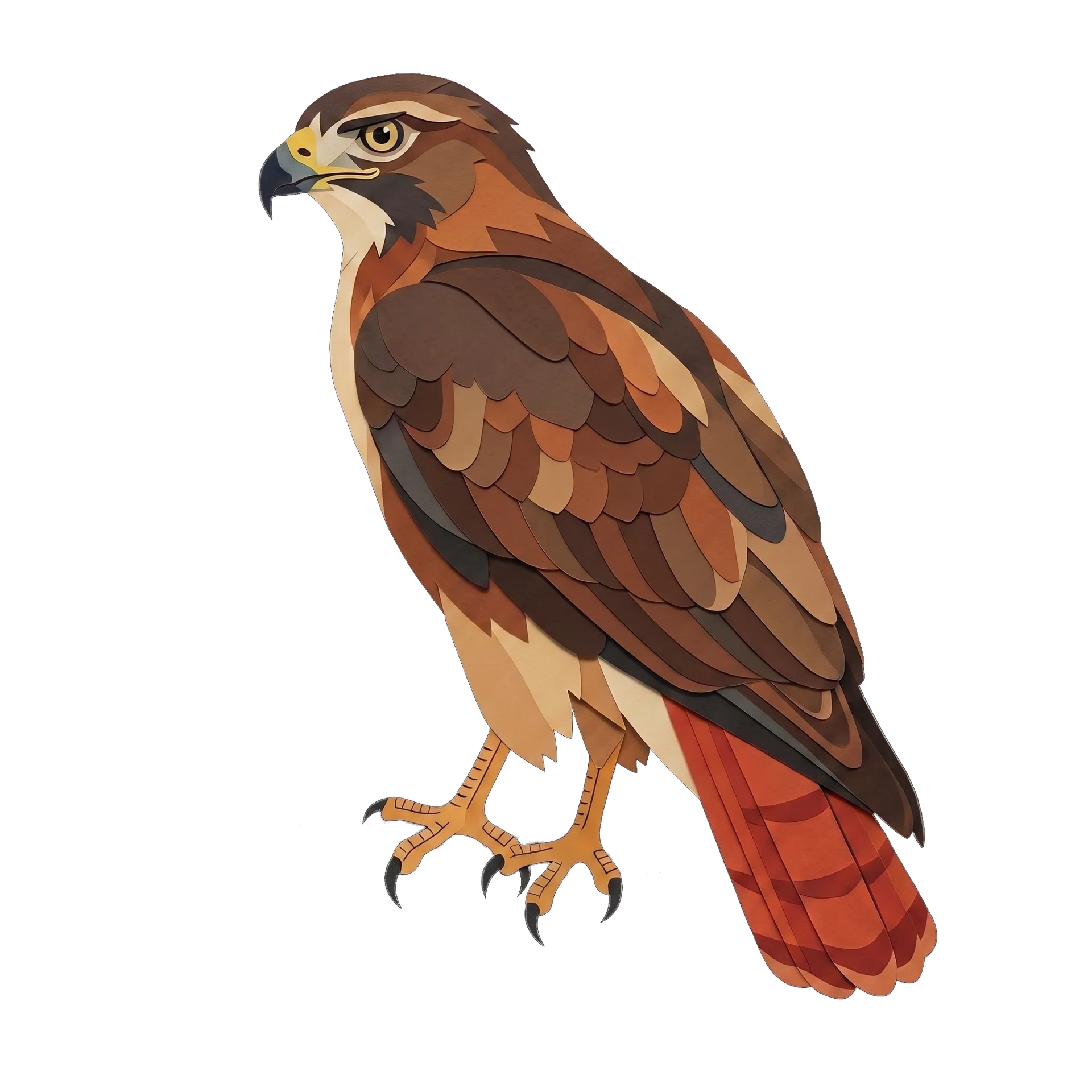
The name tells you what to look for, but only on adults: a brick-red tail that lights up like stained glass when the bird banks through sunlight. Nearly everything else about a red-tail's plumage is negotiable; this species comes in more regional shades than almost any other North American hawk. What stays constant is the silhouette: wide rounded wings, a stocky chest, and an unhurried, circling flight that says the owner of this territory is not worried about anything.
Pairs often stay together year after year, returning to the same stretch of country and stacking new sticks onto nests that can grow for decades. And you already know the voice: you've heard the scream in a hundred movies before ever tracing it to a hawk on a light pole.
Like this? Get one bird every morning, by email.
You're in. Your first bird arrives with the next morning email (5:30am ET) — and your life list now syncs.Your account →
How to identify
- A bulky, broad-winged hawk with a stocky chest — the classic soaring-raptor silhouette over open country.
- Adults flash the brick-red tail, easiest to catch from above or when the bird banks in sunlight; young birds have a brown, banded tail.
- From below, look for the dark 'patagial' bars on the leading edge of each inner wing — present in nearly every plumage and the most reliable single mark.
- Most show a band of dark streaking across an otherwise pale belly.
- Habitat is a clue in itself: the big hawk perched upright on a highway pole or lone fence post is a red-tail until proven otherwise.
Voice
A hoarse, screaming kee-eeeee-arr that slices downward for two or three seconds — the sound of wild places, even when it's coming from a highway light pole.
Lore
New York City had its own red-tail celebrity. In 1993 a hawk built a nest on the twelfth-floor stonework of 927 Fifth Avenue, looking straight across at Central Park, and stayed for three decades. Birdwatchers named him Pale Male; by the early 2000s he and his mate Lola had the most-watched nest in the city, the subject of Frederic Lilien's documentary 'Pale Male,' which aired on PBS's Nature in 2004. That December the co-op board quietly stripped the nest, spikes and all. The backlash was immediate: protests outside the building, national news coverage, and a campaign joined by resident Mary Tyler Moore and New York City Audubon that had the board negotiating a replacement nest cradle within two weeks. The hawks were rebuilding before the month was out.
At a glance
- Family
- Accipitridae (hawks & eagles)
- Range
- North & Central America
- Habitat
- Open country, roadsides, deserts, and woodland edges
- Diet
- Small mammals — voles, rabbits, squirrels — plus birds and reptiles
Where it lives
How big is it?
How is it doing?
Field notes
- That piercing scream in nearly every movie with an eagle in it? Almost always a Red-tailed Hawk. Hollywood decided the bald eagle's real voice (a thin chitter) wasn't dramatic enough.
- Red-tails can 'kite,' hanging motionless in a headwind like a kestrel on invisible strings, scanning the grass below without a single wingbeat.
- Their plumage is famously variable: pale prairie birds, chocolate-dark western morphs, and the smoky Harlan's hawk of the far north are all the same species.
Go deeper
The daily email
Get tomorrow's bird in your inbox
One bird at 5:30am ET, every day. Free, no password, one-click unsubscribe — and your life list syncs across devices.
You're in. Your first bird arrives with the next morning email (5:30am ET) — and your life list now syncs.Your account →