A Cooper's Hawk threads a chase through trunks and low branches at speed, adjusting its line by the half-second, and the pursuit ends in seconds or not at all. The short, rounded wings and long tail that make this possible cost it something — X-rays of museum specimens turned up a striking number of old, healed fractures in the chest bones, evidence of a life spent colliding with obstacles at speed in pursuit of prey.
Suburbia turned out to suit that same aggressive style. Cooper's Hawks now hunt bird feeders across much of North America, treating a backyard full of chickadees and sparrows as a concentrated food source — productive enough in some cities that the urban population reliably exports young hawks back out to the surrounding countryside. It's not a clean win, though: urban hawks eating heavily on doves also pick up more of the parasitic disease those doves carry, and nestling survival in some city populations actually runs lower than in nearby rural ones.
Telling one from a Sharp-shinned Hawk still stumps plenty of experienced hawk-watchers: same coloring, same basic shape, and only subtle differences in size, head proportion, and tail shape to go on. Some let a bird go unidentified rather than commit.
Like this? Get one bird every morning, by email.
You're in. Your first bird arrives with the next morning email (5:30am ET) — and your life list now syncs.Your account →
How to identify
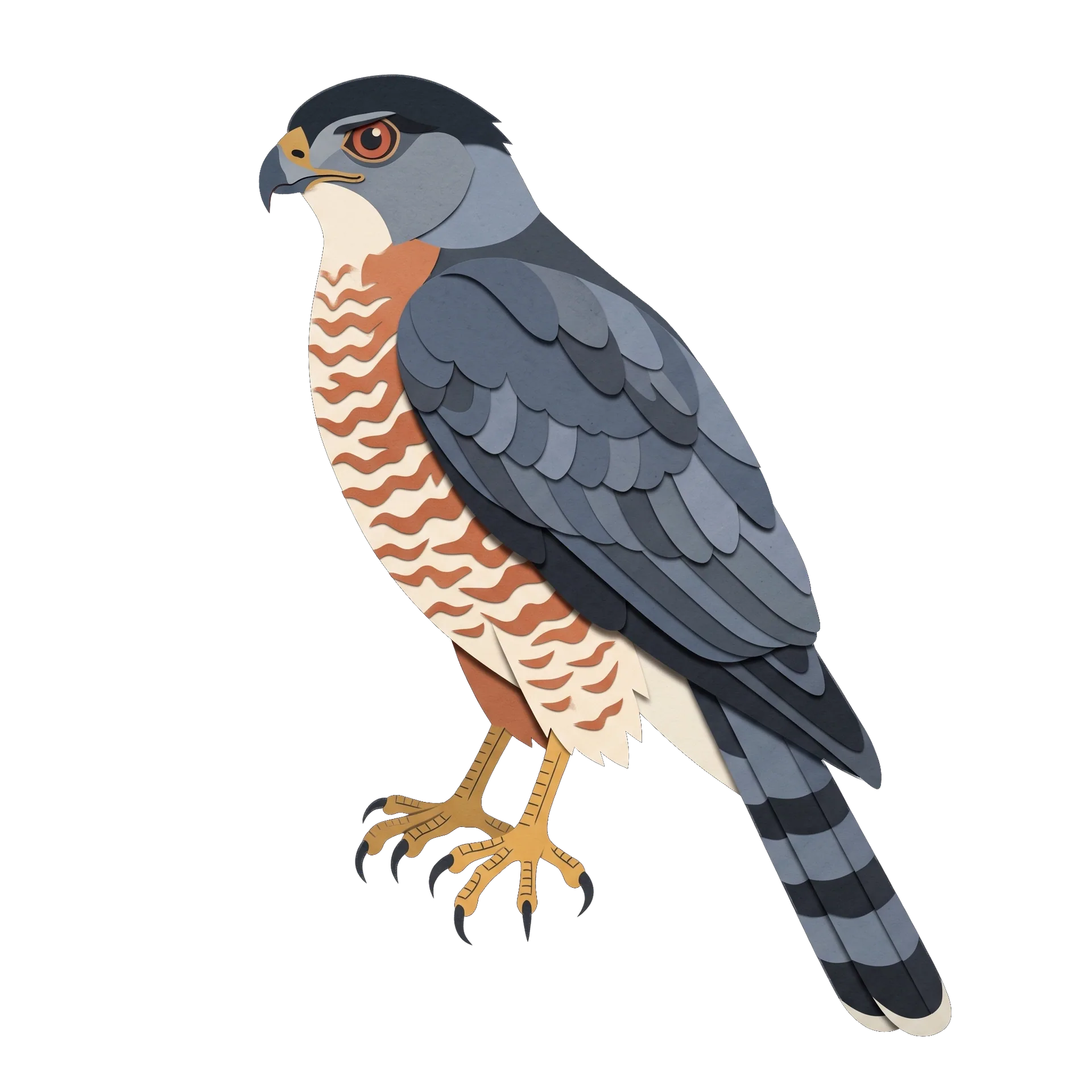
- A mid-sized hawk with short, rounded wings and a long, rudder-like tail built for tight maneuvering through trees.
- Adults are slate blue-gray above with fine rust barring below; a dark cap contrasts with a paler nape.
- Flies with a distinctive flap-flap-glide rhythm, low and fast, often just above a hedge or fence line.
- Compare the smaller, nearly identical Sharp-shinned Hawk — a genuinely difficult separation based mainly on size and head shape.
Voice
A sharp, rapid kek-kek-kek-kek near the nest; otherwise usually silent.
At a glance
- Family
- Accipitridae (hawks, eagles & kites)
- Range
- Throughout the U.S. and southern Canada; winters into Mexico
- Habitat
- Woodlands, forest edges, and — increasingly — suburban yards with bird feeders
- Diet
- Mostly other birds, ambushed in a fast, low chase through cover
Where it lives
How big is it?
How is it doing?
Field notes
- Backyard bird feeders have become a reliable hunting ground for Cooper's Hawks, and in some cities the urban population has become productive enough to export young birds back out into the surrounding countryside.
- Researchers X-raying museum specimens found a strikingly high rate of healed chest-bone fractures, evidence of routine high-speed collisions with branches and other obstacles during pursuit — an occupational hazard of hunting through dense cover at speed.
- Females are noticeably larger than males, a size gap wide enough that some observers mistake a big female for a different species entirely.
Go deeper
The daily email
Get tomorrow's bird in your inbox
One bird at 5:30am ET, every day. Free, no password, one-click unsubscribe — and your life list syncs across devices.
You're in. Your first bird arrives with the next morning email (5:30am ET) — and your life list now syncs.Your account →