The small black-and-white duck diving again and again in a sheltered bay in November has probably just arrived from the north. Buffleheads breed in the boreal forests of Alaska and Canada, are among the last waterfowl to leave, and turn up on their wintering water within a narrow window of dates. In winter they work coastal bays and estuaries, lakes, and slow rivers, taking snails and crustaceans underwater. Males start courting in early winter, bobbing their heads, lifting their wings, and making short display flights with the crest fully raised, although most pairs don't form until spring.
The nest is the improbable part. A Bufflehead is small enough to use an old Northern Flicker hole, which larger cavity-nesting ducks such as goldeneyes can't manage. In aspen and poplar groves near water, the female picks a flicker cavity, lines it with nothing but her own down, lays about eight to ten eggs, and sits for roughly a month. A day or two after the ducklings hatch they leap from the entrance to the ground, and she leads them to the water. They feed themselves and begin diving within days.
Like this? Get one bird every morning, by email.
You're in. Your first bird arrives with the next morning email (5:30am ET) — and your life list now syncs.Your account →
How to identify
- A tiny, compact diving duck with a big round head and a short bill, among the smallest ducks on the continent.
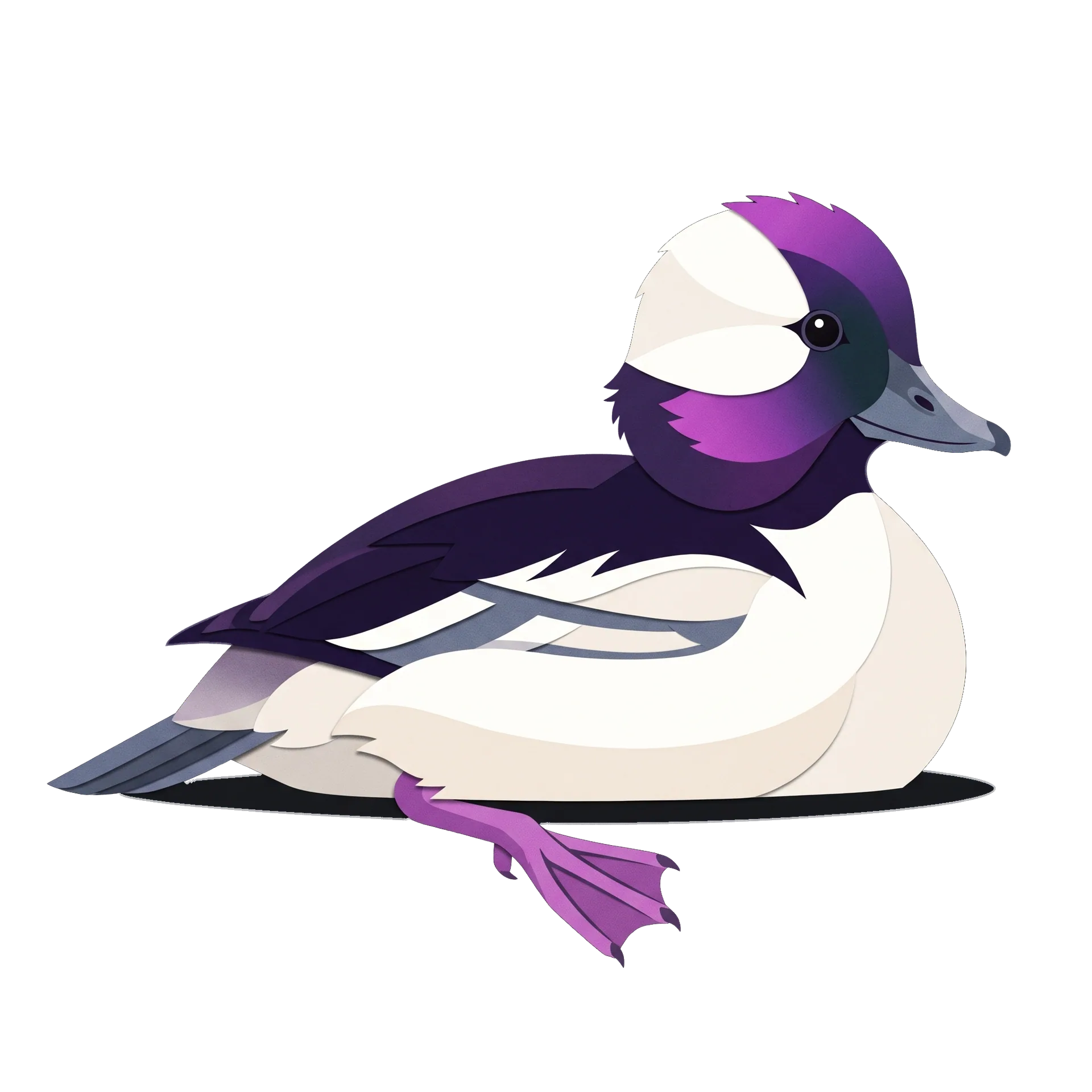
- Males are bright white below with a black back, and a large white patch sweeping back from the eye across a puffy head that glows green and purple in good light.
- Females are gray-brown with a small white patch behind the eye and a paler belly.
- Dives over and over, in pairs or small groups rather than big flocks, takes off easily from the water, and flies on rapid wingbeats.
- Compare the Hooded Merganser, which has a thin bill and a white crest outlined in black.
Voice
Quieter than the goldeneyes; males give a squeaky whistle and females a soft, hoarse quack.
Recording: Richard E. Webster, XC710475, xeno-canto.org (CC-BY-NC-SA 4.0)
At a glance
- Family
- Anatidae (ducks, geese & swans)
- Range
- Breeds in boreal Canada and Alaska; winters on coasts, bays, and inland waters from southern Canada across the U.S. to northern Mexico
- Habitat
- Wooded ponds and small lakes in the boreal forest to breed; sheltered bays, estuaries, lakes, and slow rivers in winter
- Diet
- Aquatic insects on fresh water; crustaceans and snails in salt water
Where it lives
How big is it?
How is it doing?
Field notes
- The name combines 'buffle,' an old word for buffalo, with 'head,' for the male's big, puffy head. The genus name, Bucephala, is Greek for 'bull-headed.'
- Buffleheads were far more numerous historically, before unrestricted shooting in the early 1900s and the loss of nesting habitat cut their numbers. They have since recovered, and Breeding Bird Survey data show a rise of more than 3 percent a year from 1966 to 2019.
- Clearing aspen parkland for farms and clearcutting in the boreal forest both reduce nesting habitat, but Buffleheads will take to nest boxes, and a box with a small 2.5-inch opening can help.
- A typical dive lasts about 12 seconds and rarely more than 25, followed by about 12 seconds at the surface, and they usually swallow their food underwater.
Go deeper
The daily email
Get tomorrow's bird in your inbox
One bird at 5:30am ET, every day. Free, no password, one-click unsubscribe — and your life list syncs across devices.
You're in. Your first bird arrives with the next morning email (5:30am ET) — and your life list now syncs.Your account →