Watch a titmouse at a feeder in November and you'll notice it never settles in. It takes one sunflower seed at a time, carries it off to a branch, and either pins it under its toes and hammers it open or stashes it for later. In fall and winter the bird is hoarding, tucking seeds away, usually within 130 feet (40 m) of the feeder. It doesn't migrate, so the larder is for a winter spent on the same few acres, often in company: titmice travel in mixed flocks with chickadees, nuthatches, and woodpeckers, and they're quick to join in mobbing a predator.
Then there's the nest lining. The cup of moss and grass is lined with something soft, often hair, and the bird isn't fussy about the source. Titmice have been recorded plucking it from living dogs, from people, and from a sleeping raccoon that never woke up. A 2021 paper in Ecology by University of Illinois researchers collected documented cases from the literature and online videos and named the habit kleptotrichy, from Greek roots for 'steal' and 'hair'; in almost all the videos, the thief was a titmouse. Warmth is one explanation for why the hair matters; deterring nest predators or parasites is another.
The species is also a quiet range-shifter. Over the last half-century it has been working north, and it has reached Ontario and Quebec. Breeding Bird Survey counts rose between 1966 and 2019. Possible reasons for the spread include a warming climate, farmland reverting to forest, and the growing popularity of backyard feeders.
Like this? Get one bird every morning, by email.
You're in. Your first bird arrives with the next morning email (5:30am ET) — and your life list now syncs.Your account →
How to identify
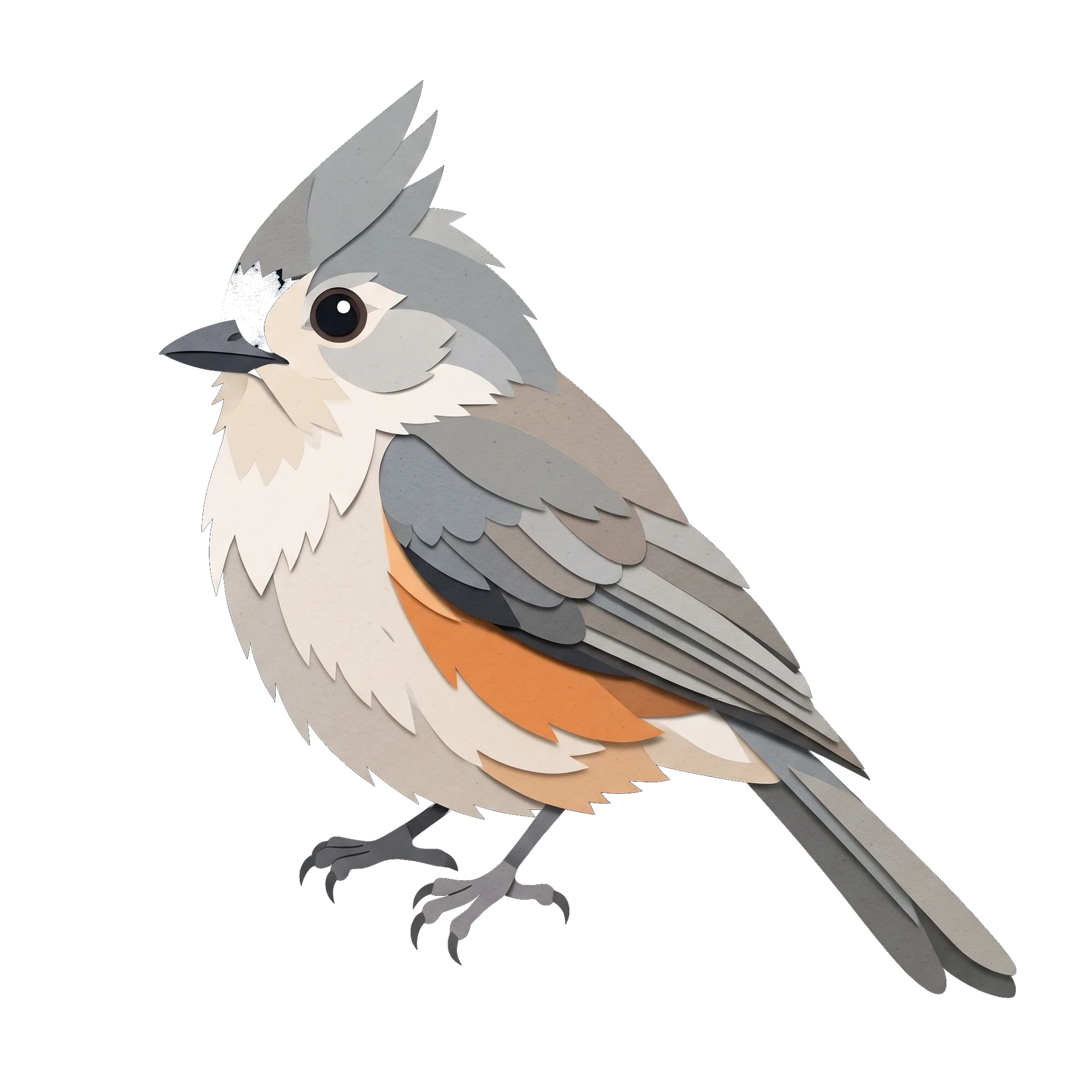
- A small gray songbird with a pointed crest, a large dark eye in a pale face, and a black patch just above the bill. The crest and stout bill give it away even in silhouette.
- Gray above and white below, with a rusty peach wash along the flanks.
- Chunkier than a chickadee, with a thick neck and a big head.
- Forages by hopping through twigs, often hanging upside down, and visits feeders in grab-and-go trips: one seed, then gone.
- In Texas, check the crest: the Black-crested Titmouse has a black one, and the two species hybridize in a narrow zone.
Voice
A clear, whistled peter-peter-peter in runs of roughly four to eight notes, sung even on mild days in midwinter, plus buzzy and chip-like call notes.
Recording: Rory Nefdt, XC1146764, xeno-canto.org (CC-BY-NC-SA 4.0)
At a glance
- Family
- Paridae (tits & chickadees)
- Range
- Eastern North America
- Habitat
- Deciduous and mixed woods, wooded suburbs, parks, and backyard feeders
- Diet
- Insects, especially caterpillars, in summer; seeds, nuts, berries, and suet in winter
Where it lives
How big is it?
How is it doing?
Field notes
- Titmouse has nothing to do with mice. 'Tit' means something small, and 'mase' was the Old English name for the bird; the spelling slid toward 'mouse' in the 1500s.
- A bird hatched the previous year occasionally stays with its parents and helps feed the next brood. One youngster from the year often stays on with the pair through the winter.
- It can't excavate a nest hole of its own, so it relies on natural cavities, old woodpecker holes, and nest boxes.
- The oldest known wild titmouse was at least 13 years, 3 months old, banded in Virginia in 1962 and found in the same state in 1974.
Go deeper
The daily email
Get tomorrow's bird in your inbox
One bird at 5:30am ET, every day. Free, no password, one-click unsubscribe — and your life list syncs across devices.
You're in. Your first bird arrives with the next morning email (5:30am ET) — and your life list now syncs.Your account →