A skein of Canada Geese crossing overhead in a ragged V, honking the whole way, is a familiar sound of a North American fall — and a misleading one, because a huge share of the geese people see day to day never migrate at all. Wildlife agencies established resident, non-migratory flocks in cities and suburbs decades ago for hunting and viewing programs, and those populations have since grown large enough to make the species a fixture, and a frequent nuisance, on golf courses, retention ponds, and office park lawns everywhere.
The V-formation itself is a real aerodynamic trick. Each bird gets a small lift boost from the wingtip vortex of the goose ahead of it, and the workload is uneven: the lead position is the most tiring, and geese rotate through it over a long flight rather than leaving one bird to do all the work.
Family structure runs deeper than it looks from a distance, too. Goslings can swim within a day of hatching, and the family (both parents and that year's brood) typically stays together through the fall migration and into the following spring, one of the longer periods of parental care among North American waterfowl.
Like this? Get one bird every morning, by email.
You're in. Your first bird arrives with the next morning email (5:30am ET) — and your life list now syncs.Your account →
How to identify
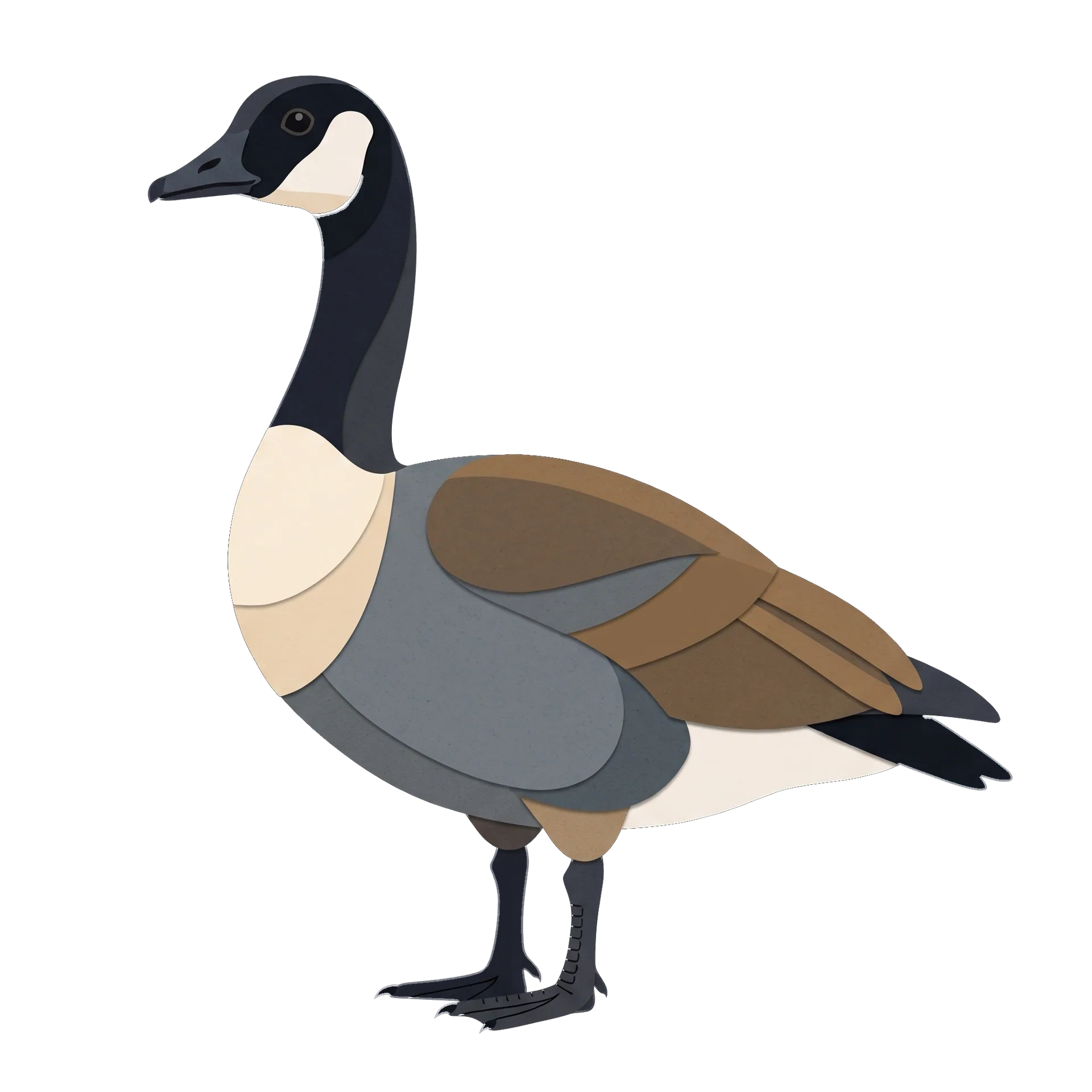
- A large goose with a black head and neck marked by a bold white chinstrap, brown body, and black legs.
- Flies in tight V-formation flocks, honking loudly — one of the most recognizable sights and sounds of migration.
- Highly adaptable: forms year-round, non-migratory flocks on golf courses, retention ponds, and city parks across much of the U.S.
- Compare the much smaller Cackling Goose, nearly identical in pattern but with a stubby bill and a noticeably tinier body.
Voice
A loud, resonant honking, classically rendered as ah-honk, given both on the ground and in flight.
Recording: Camille Vacher, XC703957, xeno-canto.org (CC-BY 4.0)
Lore
Wenebojo, the trickster hero of Ojibwe oral tradition, turns a hungry afternoon into one of the best-known Ojibwe animal stories: tricking a flock of geese into dancing themselves to death. He calls the geese ashore promising to teach them new songs, first having them hop on one leg with necks stretched skyward, then having them close their eyes and keep dancing while he moves quietly through the flock, breaking necks one by one. The Loon, dancing along with the others, opens its eyes at the wrong moment, sees what Wenebojo is doing, and cries out a warning that lets the surviving geese scatter to safety. Furious at losing the rest of his meal, Wenebojo kicks the Loon so hard in the back that, in the story's telling, it's carried that curve in its spine ever since.
At a glance
- Family
- Anatidae (ducks, geese & swans)
- Range
- Throughout North America; some populations year-round, others migratory
- Habitat
- Lakes, ponds, rivers, farm fields, parks, and golf courses
- Diet
- Grasses, grains, and aquatic plants, grazed from lawns, fields, and shallow water
Where it lives
How big is it?
How is it doing?
Field notes
- Pairs bond for life and don't typically pair up until they're at least two years old, then tend to choose a partner close to their own size, a pattern known as assortative mating.
- By midsummer, unrelated families sometimes merge broods into what biologists call a gang brood, a single group that can top 100 goslings, with just a few adults on watch while the rest feed. The behavior is learned: only about three in ten first-time parents form one, compared with eight in ten pairs with five or more years of experience.
- Adults are flightless for three to five weeks in late summer while they molt all their wing feathers at once. Non-breeders and geese that lost a nest early often don't wait it out at home: many make a dedicated molt migration north first, sometimes more than 900 miles, to reach remote lakes where they're safer while grounded.
Go deeper
The daily email
Get tomorrow's bird in your inbox
One bird at 5:30am ET, every day. Free, no password, one-click unsubscribe — and your life list syncs across devices.
You're in. Your first bird arrives with the next morning email (5:30am ET) — and your life list now syncs.Your account →