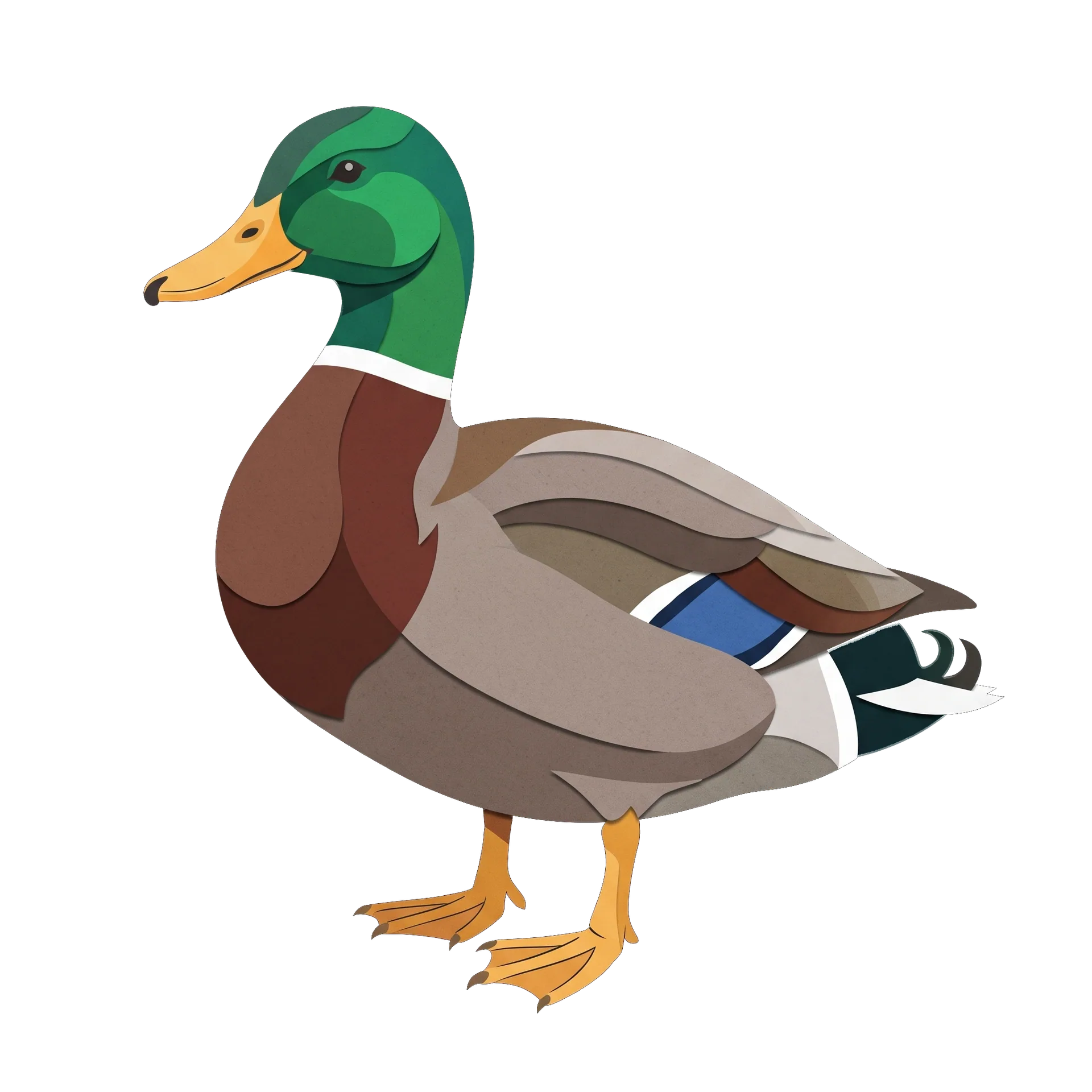
Mallards breed from Arctic tundra to Mediterranean marshes, eat nearly anything, nest in reed beds, planter boxes, and rooftop gardens, and tolerate humans to the point of taking bread from toddlers. That go-anywhere flexibility made them the raw material for domestication (nearly every farm duck in the world is a remodeled Mallard), and the wild birds themselves now live on six continents once introductions are counted. A drake in low sun, iridescent green head over chestnut chest, finished with that perfect curl of black tail feathers, remains one of the best-dressed animals on any pond.
Flock-edge birds sleep with one eye open, resting half the brain while the exposed-side half keeps watch: unihemispheric sleep, first demonstrated rigorously in Mallards. Then, in mid-summer, the drakes seem to vanish: they molt every flight feather at once, spend a few weeks unable to fly, and wait it out disguised in hen-brown eclipse plumage until new quills come in. The scruffy brown ducks loafing at the August pond are the same dazzlers from April, lying low.
Like this? Get one bird every morning, by email.
You're in. Your first bird arrives with the next morning email (5:30am ET) — and your life list now syncs.Your account →
How to identify
- The drake's bottle-green head, white neck ring, and chestnut breast are the most recognized duck pattern on Earth.
- Hens are streaky brown with an orange-and-black bill; the safest mark for both sexes is the blue wing patch (speculum) framed in white.
- Feeds by tipping up, tail in the air, rather than diving; a duck that vanishes completely underwater is something else.
- Mid-summer drakes molt into hen-like 'eclipse' plumage and briefly can't fly — that scruffy brown park duck with a yellowish bill may still be a male Mallard.
- Beware barnyard hybrids around ponds: oversized, patchy birds with odd white blotches usually have Mallard genes plus domestic ancestry.
Voice
The classic descending quack-quack-quack belongs to the hen alone; drakes manage only a quieter, raspy rhaeb.
Recording: Barry Edmonston, XC692779, xeno-canto.org (CC-BY-NC-SA 4.0)
At a glance
- Family
- Anatidae (ducks, geese & swans)
- Range
- Across the Northern Hemisphere; introduced far beyond
- Habitat
- Any calm fresh water, from tundra ponds to city park fountains
- Diet
- Seeds, aquatic plants, and invertebrates, tipped-up for in the shallows
Where it lives
How big is it?
How is it doing?
Field notes
- Nearly every domestic duck on Earth, from the white Pekin to the barnyard mutt, descends from the Mallard. This is the wild original behind millennia of duck farming.
- Only the female quacks. The sound every child learns as 'the duck noise' belongs to hens alone; drakes make a rasping note you'd never write as 'quack.'
- Mallards at the edge of a sleeping flock keep one eye open and half the brain awake: the exposed-side eye literally stands watch while the sheltered half sleeps.
Go deeper
The daily email
Get tomorrow's bird in your inbox
One bird at 5:30am ET, every day. Free, no password, one-click unsubscribe — and your life list syncs across devices.
You're in. Your first bird arrives with the next morning email (5:30am ET) — and your life list now syncs.Your account →