At dusk in late fall and winter, European Starlings pour into their roosts, and for a few minutes the flock does what no single bird can: it ripples, balloons, folds back on itself, and then drops into the reeds, trees, or onto a bridge. In a study of flocks over Rome, researchers found that each starling responded to its nearest six or seven neighbors rather than to every bird within a set distance, a rule that helps flocks of thousands hold together. In North America, northern populations vacate much of Canada for the winter, eastern birds heading south and western birds to the western U.S.
There's a story about how they got here: a wealthy New Yorker named Eugene Schieffelin, so devoted to Shakespeare that he wanted every bird in the plays flying over America, let starlings loose in Central Park in 1890. The release is documented. The motive is not. Literary scholars Lauren Fugate and John MacNeill Miller (2021) found no mention of Schieffelin's interest in Shakespeare until the late 1940s, decades after his death in 1906. One 1906 obituary credits him with importing English sparrows to kill the caterpillars in Madison Square, lists the starling among many other birds he liberated, and says nothing of Shakespeare. He belonged to the American Acclimatization Society, which existed to introduce foreign plants and animals to North America, and that is the likelier motive behind the release.
The legend lingers because it makes a tidy cautionary tale about invasive species. Starlings nest in cavities, and in North America they readily take over holes dug by woodpeckers and used by native birds, yet a 2003 study of 27 native species found declines potentially attributable to starlings only in sapsuckers. Fugate and Miller argue that the Shakespeare tale has helped distract from the thin evidence for how much harm starlings actually do.
Like this? Get one bird every morning, by email.
You're in. Your first bird arrives with the next morning email (5:30am ET) — and your life list now syncs.Your account →
How to identify
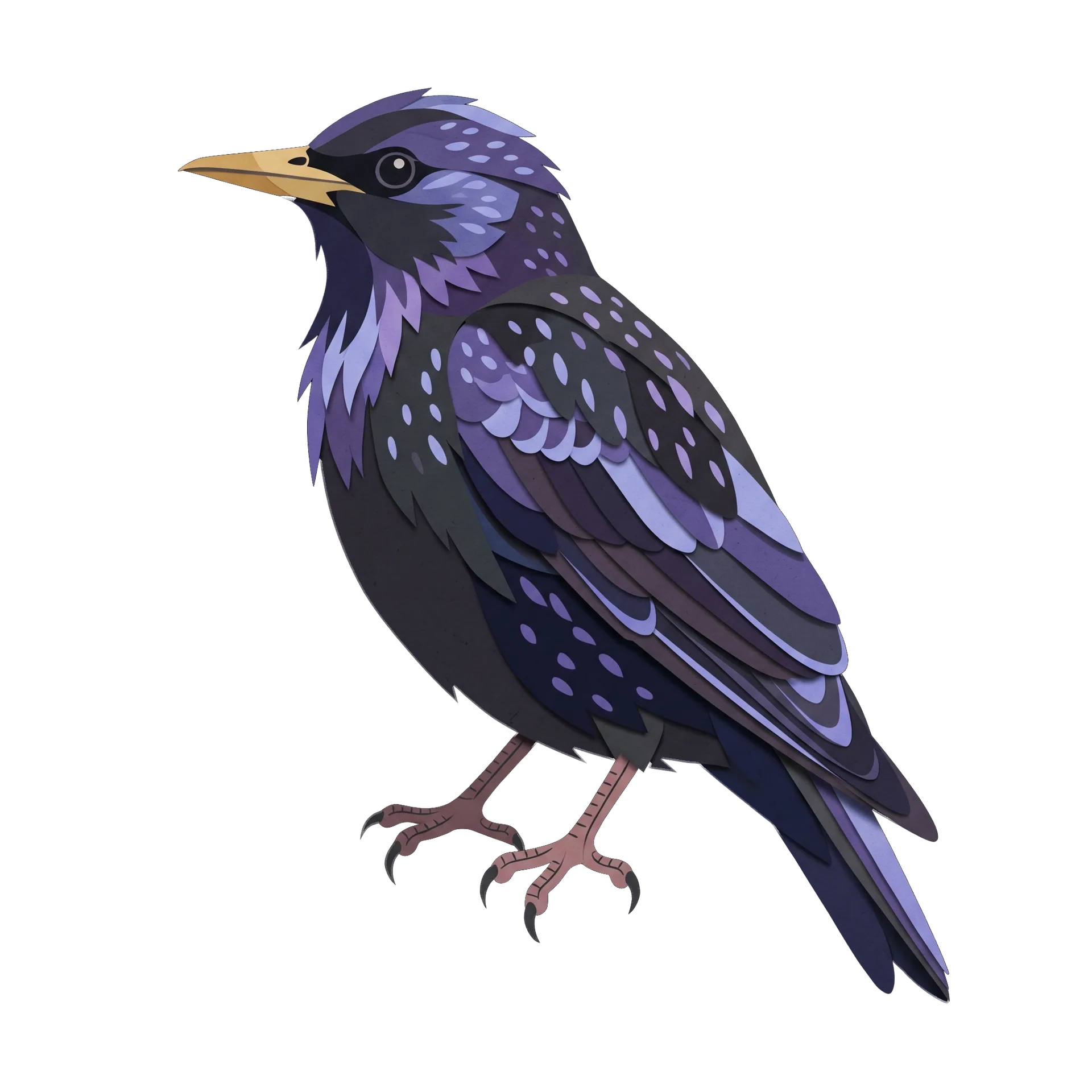
- Blackbird-sized but chunky and short-tailed, with a long, slender, pointed bill. In flight, look for pointed, triangular wings and a stubby tail.
- Winter birds are dark with a dense spangle of pale-tipped feathers and a dark bill; by spring the spots wear off, leaving glossy black with a purple-green sheen and a yellow bill.
- Forages in flocks on lawns and fields, walking with quick steps and probing the turf.
- Compare the blackbirds and grackles, which have longer tails and thicker, more conical bills.
Voice
A jumble of whistles, clicks, rattles, and trills, laced with imitations of other birds and everyday sounds.
Recording: Manuel Grosselet, XC1101346, xeno-canto.org (CC-BY-NC-SA 4.0)
Lore
On 27 May 1784, a line in Mozart's Vienna household account book records the purchase of a starling for 34 kreuzer. The entry copies out a tune the bird sang: nearly the opening of the finale theme from his Piano Concerto No. 17 in G major (K. 453), finished only weeks earlier, except that the starling sang a G sharp where Mozart had a G and held a note too long. Beside it Mozart wrote 'Das war schön' ('That was beautiful'). How the bird picked up the tune is unknown.
The starling lived with him for about three years and died on 4 June 1787. Mozart buried it in his garden and wrote a humorous verse epitaph dated that day. In a 1990 paper, the researchers Meredith West and Andrew King argued that starlings bond closely with the people who keep them, so the grief behind the joking was probably real.
At a glance
- Family
- Sturnidae (starlings)
- Range
- Native to Europe and western Asia; introduced and now widespread across North America, Australia, New Zealand, and southern Africa
- Habitat
- Farmland, lawns, parks, and towns; roosts in trees, reedbeds, and on buildings and bridges
- Diet
- Insects and grubs probed from turf, plus fruit, seeds, and scraps
Where it lives
How big is it?
How is it doing?
Field notes
- Winter roosts can number over a million birds.
- Central Park was not the first release. Starlings were let go in Cincinnati in the early 1870s and in Central Park in 1877, and in Portland, Oregon, around the same time as the 1890 birds.
- In the UK, where the species is native, the breeding population fell by 61 percent between 1995 and 2024, and it is now on the UK Red List. Worldwide it's still rated Least Concern, with an estimated 150 million mature individuals.
- A starling that reaches breeding age typically lives about five years; the European ringing record is nearly 23.
Go deeper
The daily email
Get tomorrow's bird in your inbox
One bird at 5:30am ET, every day. Free, no password, one-click unsubscribe — and your life list syncs across devices.
You're in. Your first bird arrives with the next morning email (5:30am ET) — and your life list now syncs.Your account →