In the winter of 1941–42, the entire wild population of Whooping Cranes numbered somewhere between 15 and 21 birds, all of them wintering on one stretch of Texas coastline. That a species this large and this visible (the tallest bird in North America, snow white with a bugling call that carries for miles) came that close to disappearing entirely says as much about how thoroughly wetlands were drained and hunted across the continent as it does about the cranes themselves.
Recovery has been slow and deliberate rather than dramatic. The original flock still breeds in a remote patch of Canada's Wood Buffalo National Park and winters on the Texas Gulf Coast, its numbers protected and monitored closely for decades. Additional populations were established using odder methods: young cranes raised by handlers in crane costumes were taught a migration route to the eastern U.S. by following an ultralight aircraft shaped and painted like an adult bird, while a separate non-migratory flock released onto Louisiana marshland has since grown large enough to raise its own wild-hatched chicks.
Even with all that effort, Whooping Cranes remain Endangered, and the total population is still small enough that a single bad storm or disease outbreak on the wintering grounds could matter. Spotting one today, gray Sandhill Cranes suddenly interrupted by one unmistakably white, red-capped giant, is a reminder of how narrow the margin still is.
Like this? Get one bird every morning, by email.
You're in. Your first bird arrives with the next morning email (5:30am ET) — and your life list now syncs.Your account →
How to identify
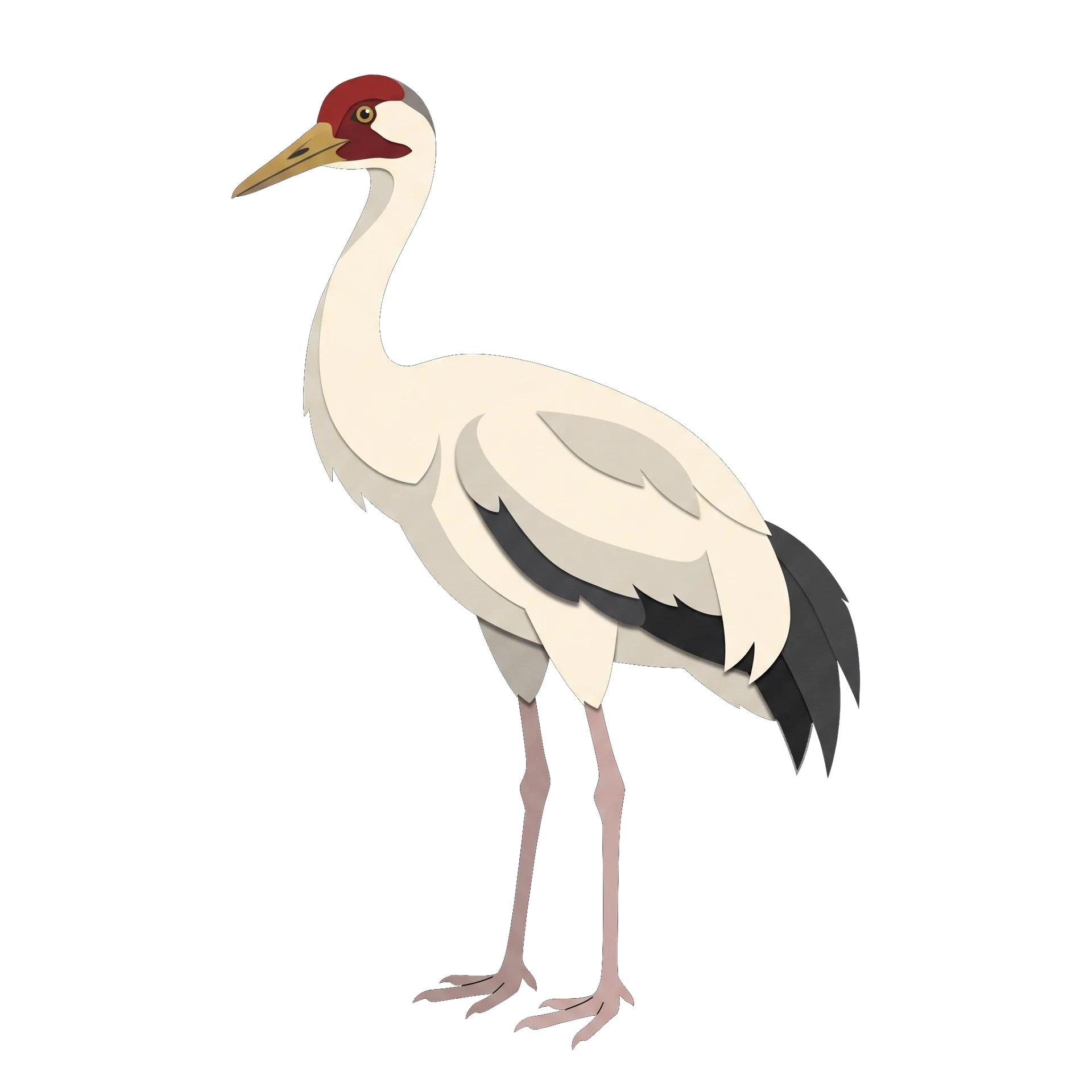
- The tallest bird in North America — snow white overall, with black wingtips visible only in flight and bare red skin on the crown and face.
- Long black legs and a long, straight bill; flies with the neck fully extended, not tucked.
- Compare the smaller, all-gray Sandhill Crane, which often flocks with wintering Whooping Cranes, and the Snow Goose, much smaller with a different silhouette.
- A loud, far-carrying bugled call is often the first clue a crane is nearby, long before it's in view.
Voice
A loud, resonant, bugled whoop that can carry for miles across open marsh — the source of the name.
Recording: Sue Riffe, XC533637, xeno-canto.org (CC-BY-NC-SA 4.0)
Lore
Whooping cranes carried real ceremonial weight on the upper Texas Gulf Coast, part of the species' historic wintering range. At the Mitchell Ridge site on Galveston Island, archaeologist Robert Ricklis documented eleven whistles carved from whooping crane wing bones, four of them finely engraved with geometric patterns and, separately, four holding a triangular asphaltum plug that shaped the note; the engraved whistles date to roughly A.D. 1400 to 1750, the plainer ones later, into the early 1800s. No whooping crane bones turn up in the era's ordinary food refuse nearby, so archaeologists read the birds as taken specifically for the whistles, not the table.
The people who made them were Atakapa speakers, most likely Akokisa, and the tradition has a real edge to its map: whooping crane bone whistles turn up across the Galveston Bay area and into southeastern Louisiana but stop at the border of Karankawa territory just to the south, marking one coastal people's practice apart from their neighbors'. Whether that reflects belief, taboo, or simple access to wintering cranes isn't recorded, but the whistles, recovered as grave goods alongside shell ornaments and stone tools, show these birds were buried with people the community wanted to honor.
At a glance
- Family
- Gruidae (cranes)
- Range
- Breeds in Canada's Wood Buffalo National Park; winters on the Texas Gulf Coast, plus small reintroduced populations
- Habitat
- Wetlands, marshes, and coastal flats
- Diet
- Omnivorous — blue crabs, fish, frogs, and grain, gleaned while wading or walking
Where it lives
How big is it?
How is it doing?
Field notes
- The wild population bottomed out at around 15 to 21 birds in the winter of 1941–42, making it one of the rarest birds in North America; careful protection of the wintering grounds and breeding site since then has grown it into the hundreds.
- Several reintroduction efforts have tried to establish flocks beyond the original one — most visibly an eastern migratory population taught its route by literally following an ultralight aircraft painted to resemble an adult crane, and more recently a non-migratory Louisiana flock that has grown large enough to hatch its own wild chicks.
- Pairs perform 'unison calling,' a coordinated duet with matched postures — a display researchers use, along with genetics and behavior, to help confirm a bonded pair.
Go deeper
The daily email
Get tomorrow's bird in your inbox
One bird at 5:30am ET, every day. Free, no password, one-click unsubscribe — and your life list syncs across devices.
You're in. Your first bird arrives with the next morning email (5:30am ET) — and your life list now syncs.Your account →