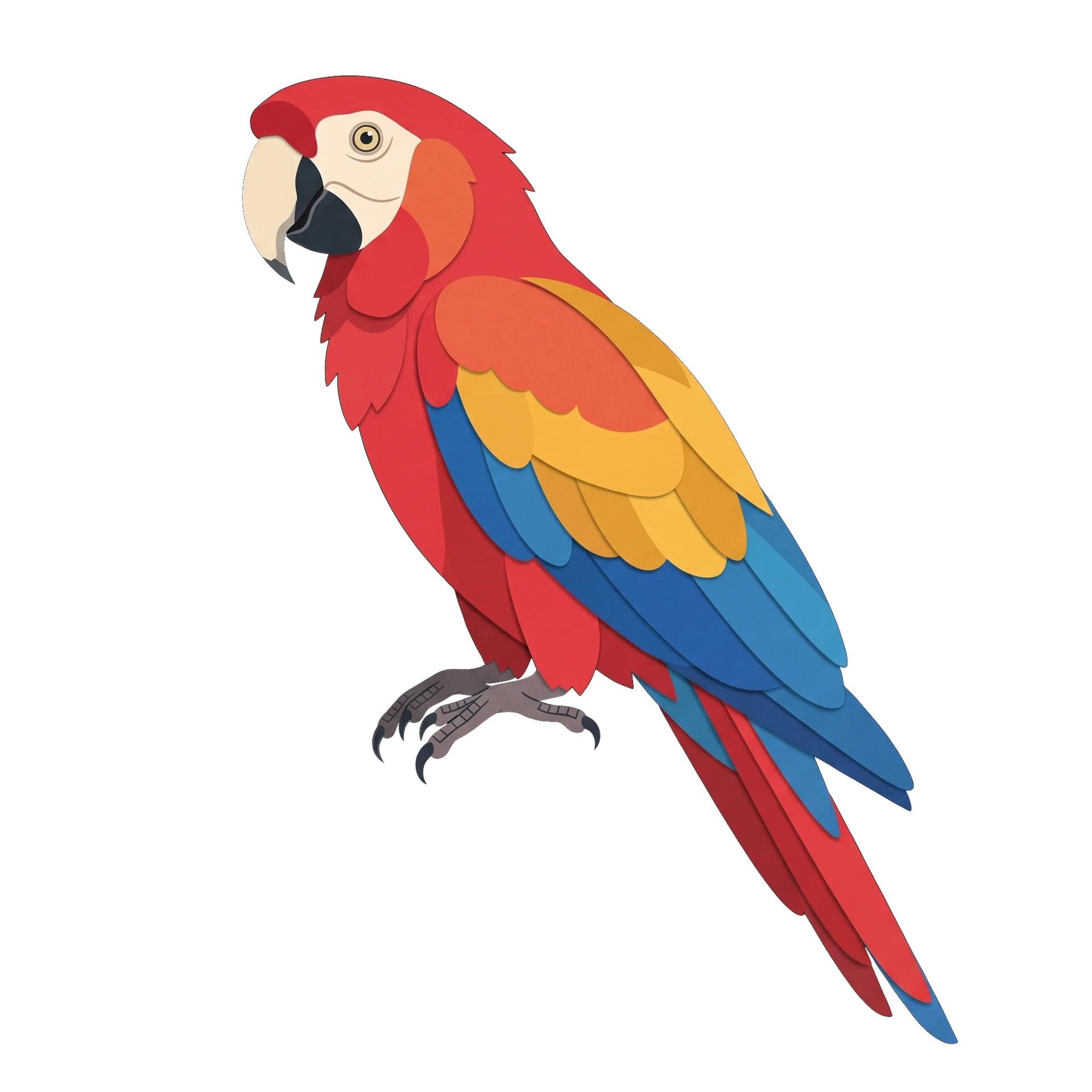
A single Scarlet Macaw crossing open sky is a startling thing for a rainforest to show you: solid red body, blue-and-yellow wings, a tail as long as the rest of the bird, all of it loud in both color and voice. They're almost never alone. Pairs mate for life and fly wingtip to wingtip through the canopy, keeping in touch with harsh calls whenever foliage breaks the line of sight between them.
Diet explains one of the odder sights in macaw country: riverbank clay licks where dozens of birds gather at once, chewing at exposed earth. Researchers still debate how much of the draw is binding toxins from the unripe fruit and seeds in a macaw's diet versus simply topping up on sodium, but a lick in full use (red, blue, and green macaws all crowded onto the same bank) is one of the signature spectacles of Central and South American birding.
Raising a chick takes a long time by parrot standards (around three months in the nest and up to a year of continued dependence afterward), which pairs with a long lifespan; wild birds live for decades, and well-documented captive individuals have reached 60 to 75 years. That slow reproductive pace is also part of why habitat loss and the wild-caught pet trade have hit some regional populations hard, even though the species as a whole remains widespread enough to be classified as Least Concern.
Like this? Get one bird every morning, by email.
You're in. Your first bird arrives with the next morning email (5:30am ET) — and your life list now syncs.Your account →
How to identify
- Large, long-tailed parrot in brilliant scarlet red, with blue and yellow patches across the wings and a bare white face.
- Nearly half the bird's length is tail. The silhouette in flight is unmistakable even at a distance.
- Loud, harsh squawks usually announce a pair before they're visible, typically flying together or in small family groups.
- A massive, powerful hooked bill can crack nuts and unripe fruit most other rainforest animals can't get into.
Voice
Loud, harsh, far-carrying squawks and screeches, most often given in flight.
Recording: Richard Borrmann, XC1005554, xeno-canto.org (CC-BY 4.0)
Lore
In the Popol Vuh, the K'iche' Maya's sacred origin text, Vucub-Caquix (Seven Macaw) rises to power in the twilight age after the wooden people are wiped out in a flood, before the true sun exists. Covered in jewels and gleaming metal, he proclaims himself both sun and moon, boasting that his light alone guides humanity. The Hero Twins Hunahpu and Xbalanque see through him: Hunahpu shoots him from a nance tree with a blowgun, though the wounded bird tears off his arm before falling. The twins regroup and disguise themselves as elderly healers, offering to treat his shattered jaw; instead, they pull his jeweled teeth and swap them for plain white corn kernels, then replace his shining metal eyes with dull ones, leaving Seven Macaw stripped of the borrowed light he'd mistaken for power.
At a glance
- Family
- Psittacidae (parrots)
- Range
- Southern Mexico through Central America to the Amazon basin
- Habitat
- Lowland tropical rainforest, especially near rivers and exposed clay banks
- Diet
- Fruit, nuts, and seeds, plus mineral-rich clay eaten at riverbank licks
Where it lives
How big is it?
How is it doing?
Field notes
- Pairs mate for life and are frequently seen flying wingtip to wingtip, staying in close contact with calls even when the forest canopy blocks the view between them.
- Macaws gather at exposed riverbank clay licks, sometimes dozens at once, to eat mineral-rich clay; researchers debate how much of the draw is neutralizing toxins in their unripe-fruit diet versus simply topping up on sodium, but either way the clay is clearly worth the trip.
- Chicks stay in the nest for around three months and remain dependent on their parents for up to a year afterward, one of the longest childhoods of any parrot, a slow pace that matches a genuinely long lifespan, with wild birds living decades and well-documented captive birds reaching 60 to 75 years or more.
Go deeper
The daily email
Get tomorrow's bird in your inbox
One bird at 5:30am ET, every day. Free, no password, one-click unsubscribe — and your life list syncs across devices.
You're in. Your first bird arrives with the next morning email (5:30am ET) — and your life list now syncs.Your account →