A Northern Mockingbird's song is really a lifetime's worth of eavesdropping, replayed on demand. Each male builds a repertoire that can top 150 distinct phrases, copied from cardinals, jays, and anything else loud enough to be worth stealing, then strings them together in a loop where each phrase gets repeated two or three times before he switches to the next. Stand under a singing male long enough and you can often name the birds he's impersonating faster than you can name him.
That vocal range comes with a temperament to match. Mockingbirds are notorious backyard enforcers, chasing off cats, dogs, and other birds that stray too close to a nest, and a study at a Florida university found they go further than generic vigilance: birds there learned to recognize the specific person who had approached their nest on a previous visit and target that individual with repeated dive-bombing, even when that person walked past in a crowd of strangers.
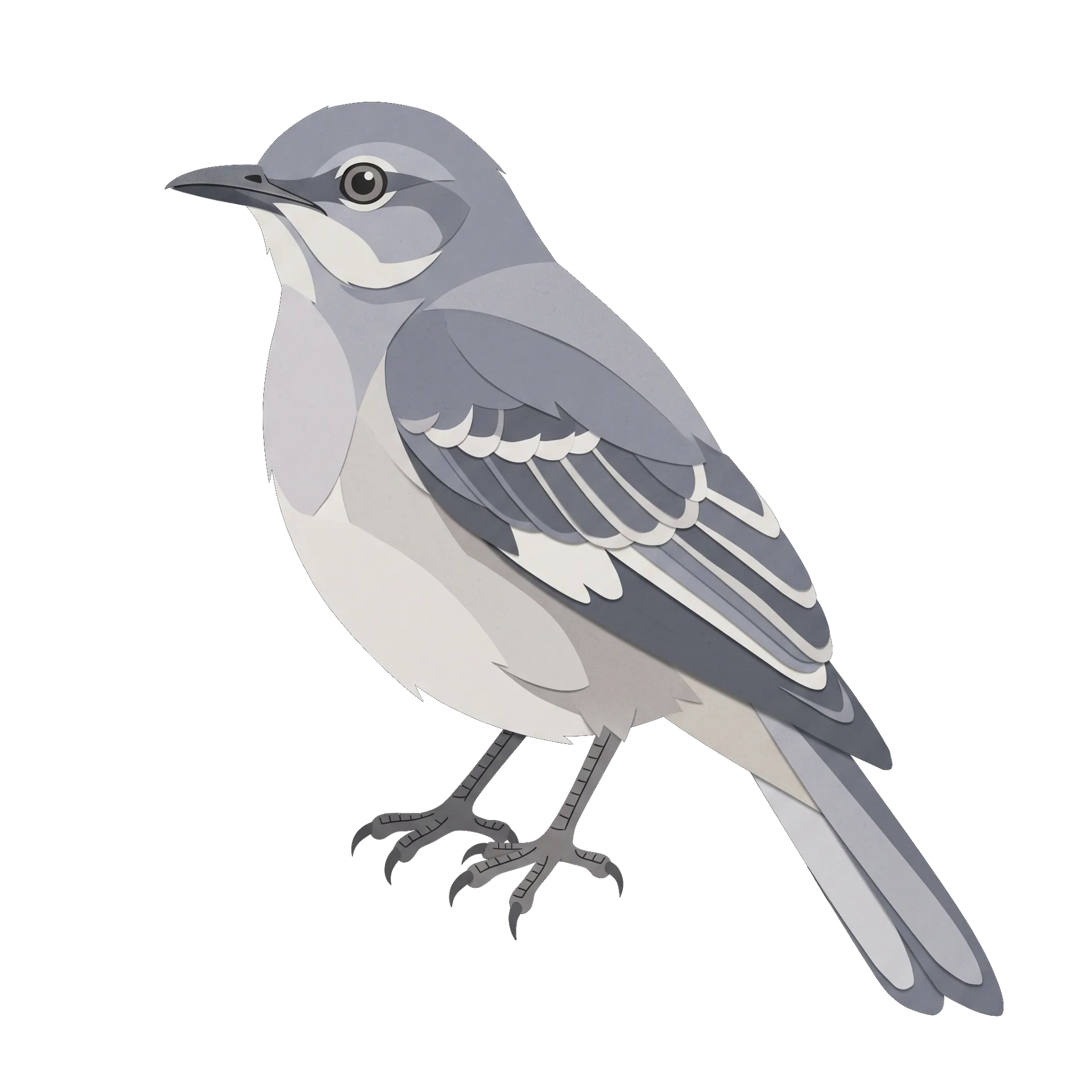
Gray above, paler below, with white wing patches that flash only in flight, it's the drabbest bird in a lot of yards — until it opens its beak and becomes, briefly, every other bird in the neighborhood at once.
Like this? Get one bird every morning, by email.
You're in. Your first bird arrives with the next morning email (5:30am ET) — and your life list now syncs.Your account →
How to identify
- A slim gray songbird with a long tail, often carried cocked upward, and bold white wing patches that flash open in flight.
- Pale gray above, whiter below, with no bold markings besides the wing and tail white; plainness is itself a field mark.
- Sings an extraordinarily varied, borrowed repertoire, typically repeating each phrase two or three times before switching to the next.
- Compare the stockier Loggerhead Shrike, which shares gray-and-white plumage but has a black mask and a hooked bill.
Voice
An endless string of mimicked phrases (other birds' songs, car alarms, mechanical sounds), each repeated a few times before the bird moves to the next.
Recording: XC917982, xeno-canto.org (CC0 1.0)
Lore
Mimus polyglottos translates as 'many-tongued mimic': Mimus is Latin for mimic, polyglottos Greek for many-tongued. English speakers arrived at the same idea from the opposite direction, calling the bird a mock-bird by the 1640s and a mockingbird by the 1670s, for its habit of mocking, meaning imitating, nearly any sound around it, from other birds' songs to frogs, car alarms, and creaking gates.
A Hopi tradition recorded two centuries later reaches the same idea through myth rather than word history. Ethnographer Alexander M. Stephen, who lived among the Hopi in the 1880s, collected an emergence story in which Mockingbird, described as one 'who can talk every way,' gives each group of people climbing up from the underworld into this world its own separate language. Hattie Greene Lockett published Stephen's account in her 1933 study, The Unwritten Literature of the Hopi.
In the United States that same voice made the bird an unusually popular civic symbol: it's the state bird of five states, itself unusual for a single species. Texas adopted it in 1927 at the request of the Texas Federation of Women's Clubs, Florida chose it the same year, Arkansas followed in 1929, Tennessee in 1933 by a public vote of the Tennessee Ornithological Society, and Mississippi in 1944. Harper Lee gave it more lasting weight later, in To Kill a Mockingbird (1960): Atticus tells his son Jem he can shoot all the blue jays he wants but warns that killing a mockingbird is a sin, and Miss Maudie explains why, that mockingbirds 'don't do one thing but sing their hearts out for us. That's why it's a sin to kill a mockingbird.' The line made the bird a lasting symbol of harmless innocence destroyed for no reason.
At a glance
- Family
- Mimidae (mockingbirds & thrashers)
- Range
- United States, Mexico, and the Caribbean; largely year-round resident
- Habitat
- Suburban yards, hedgerows, scrubby fields, and urban parks
- Diet
- Insects, berries, and fruit, taken opportunistically year-round
Where it lives
How big is it?
How is it doing?
Field notes
- A single male can learn upward of 150 to 200 distinct song types over its lifetime, adding new ones by copying other birds, and occasionally machines, well into adulthood.
- Unmated males sometimes sing through the night, especially under a full moon or a bright streetlight: a habit that has cost more than one mockingbird its neighborhood popularity.
- Mockingbirds recognize individual humans who have disturbed their nest before and will target that specific person with dive-bombing on later visits, even in a crowd, according to controlled studies on a university campus.
Go deeper
The daily email
Get tomorrow's bird in your inbox
One bird at 5:30am ET, every day. Free, no password, one-click unsubscribe — and your life list syncs across devices.
You're in. Your first bird arrives with the next morning email (5:30am ET) — and your life list now syncs.Your account →