A flock of Sandhill Cranes can be two kilometers up, invisible against the glare, and still fill a whole county with rolling, prehistoric bugling: a call powered by a windpipe so long it coils inside the bird's breastbone like a French horn. The voice suits the lineage: the oldest unequivocal Sandhill Crane fossil is about 2.5 million years old, an extraordinary run for a species still walking around. Cranes very much like it were striding through these wetlands millions of years before that.
Twice a year they stage one of the hemisphere's great gatherings. Northbound birds from Texas and Mexico converge each March on the Platte River in Nebraska, where several hundred thousand cranes (the bulk of the world's population) feed in the cornfields by day and pack the river's sandbars by night. Wherever they pause, watch for the dancing: bows, leaps, wing-flares, grass tossed in the air. It starts as courtship, but cranes of every age do it in every season — and once one pair begins, the dancing tends to ripple outward through the flock like applause.
Like this? Get one bird every morning, by email.
You're in. Your first bird arrives with the next morning email (5:30am ET) — and your life list now syncs.Your account →
How to identify
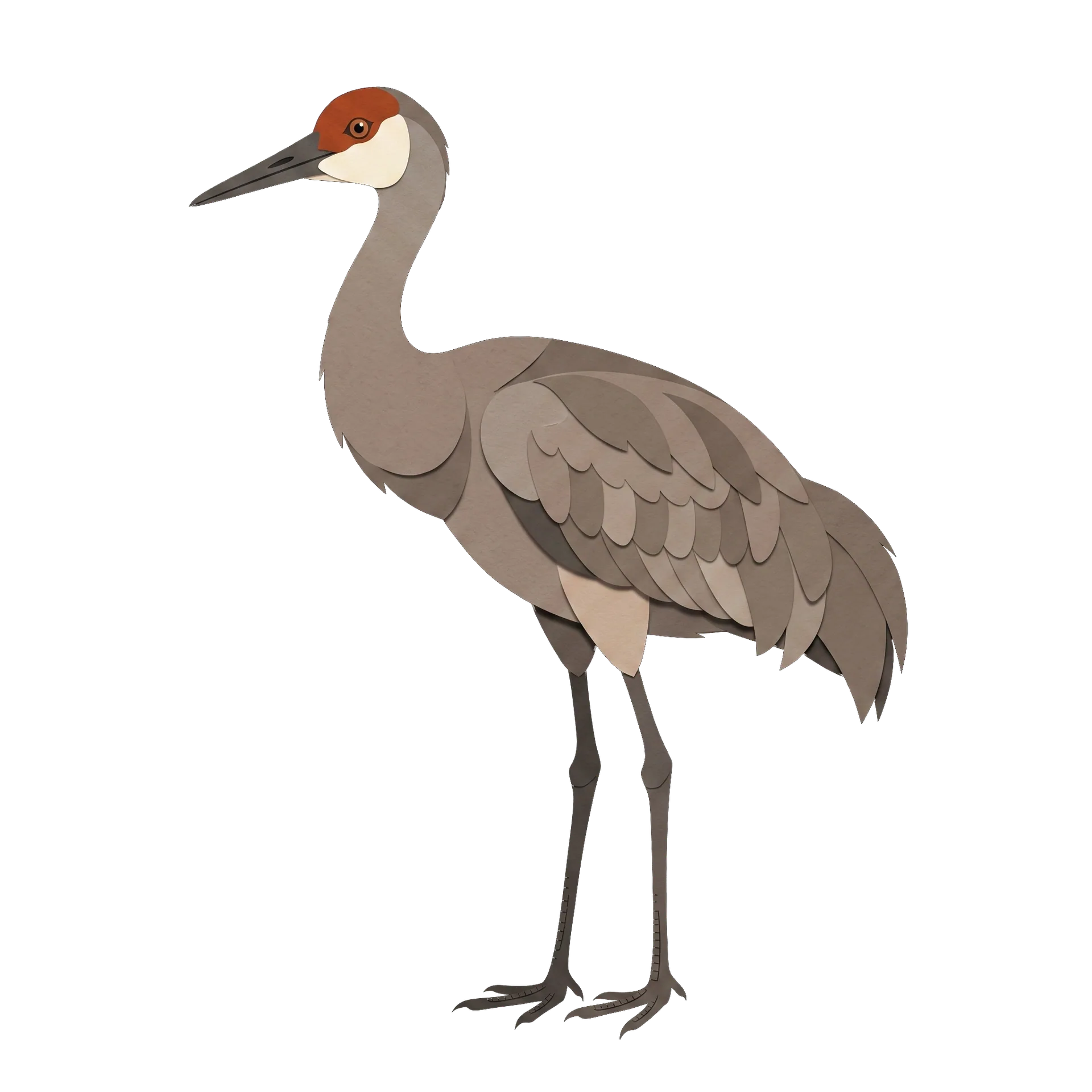
- A very tall, long-necked gray bird with a bare crimson crown, walking, not wading, through fields and shallow marsh.
- Flies with neck fully extended and slow upstrokes ending in a quick flick; herons fly with the neck tucked.
- The bugling, rolling call carries for kilometers and usually announces a flock long before it's visible.
- Adults often look rusty-stained rather than gray in summer: that's mud they've preened into their feathers.
- In Florida and Georgia, resident cranes stroll suburban roadsides; elsewhere, look up during migration.
Voice
A rolling, wooden bugle (part trumpet, part creaking gate), thrown a surprising distance by a windpipe that coils inside the breastbone.
Recording: Will Sweet, XC565249, xeno-canto.org (CC-BY-NC-SA 4.0)
Lore
The Myaamia (Miami) people's old English name, Twightwee, comes from a battle story recorded from tribal leader Meehcikilita in the 1820s. Cherokee warriors pursuing Myaamia fighters onto open prairie startled two sandhill cranes, which burst upward calling 'twau, twau, twau, twau.' A surviving Cherokee warrior reportedly told his people they had been beaten not by men but by 'the Twau twau's who could fly off at will,' and the name stuck, applied by outsiders to the Myaamia themselves.
The connection didn't end there. The Myaamia still name the third month of their traditional lunar calendar cecaahkwa kiilhswa, Sandhill Crane Moon, for the birds' migration and nesting during that stretch of spring, and the official seal of the Miami Tribe of Oklahoma shows a sandhill crane flying over a turtle, the crane for the people and the turtle for their homelands.
At a glance
- Family
- Gruidae (cranes)
- Range
- North America and far northeastern Siberia; winters to Mexico
- Habitat
- Wet meadows, prairie marshes, river shallows, and grain fields
- Diet
- Grain, tubers, insects, small vertebrates — gleaned while walking
Where it lives
How big is it?
How is it doing?
Field notes
- Each March, most of the world's Sandhill Cranes (hundreds of thousands of birds) funnel through one stretch of Nebraska's Platte River, one of the great wildlife spectacles on the continent.
- Cranes dance year-round: bowing, leaping, and tossing tufts of grass. It cements pair bonds, but young birds and whole flocks break into it too, sometimes for no occasion anyone can detect.
- The oldest unequivocal Sandhill Crane fossil, from a Florida shell pit, is about 2.5 million years old; a strikingly similar Nebraska crane fossil reaches back nearly ten million years, though that older bird may be an ancestor rather than the species itself.
- Pairs perform 'unison calling,' a synchronized duet with coordinated postures — the crane equivalent of renewing vows loudly enough for the whole marsh to hear.
Go deeper
The daily email
Get tomorrow's bird in your inbox
One bird at 5:30am ET, every day. Free, no password, one-click unsubscribe — and your life list syncs across devices.
You're in. Your first bird arrives with the next morning email (5:30am ET) — and your life list now syncs.Your account →