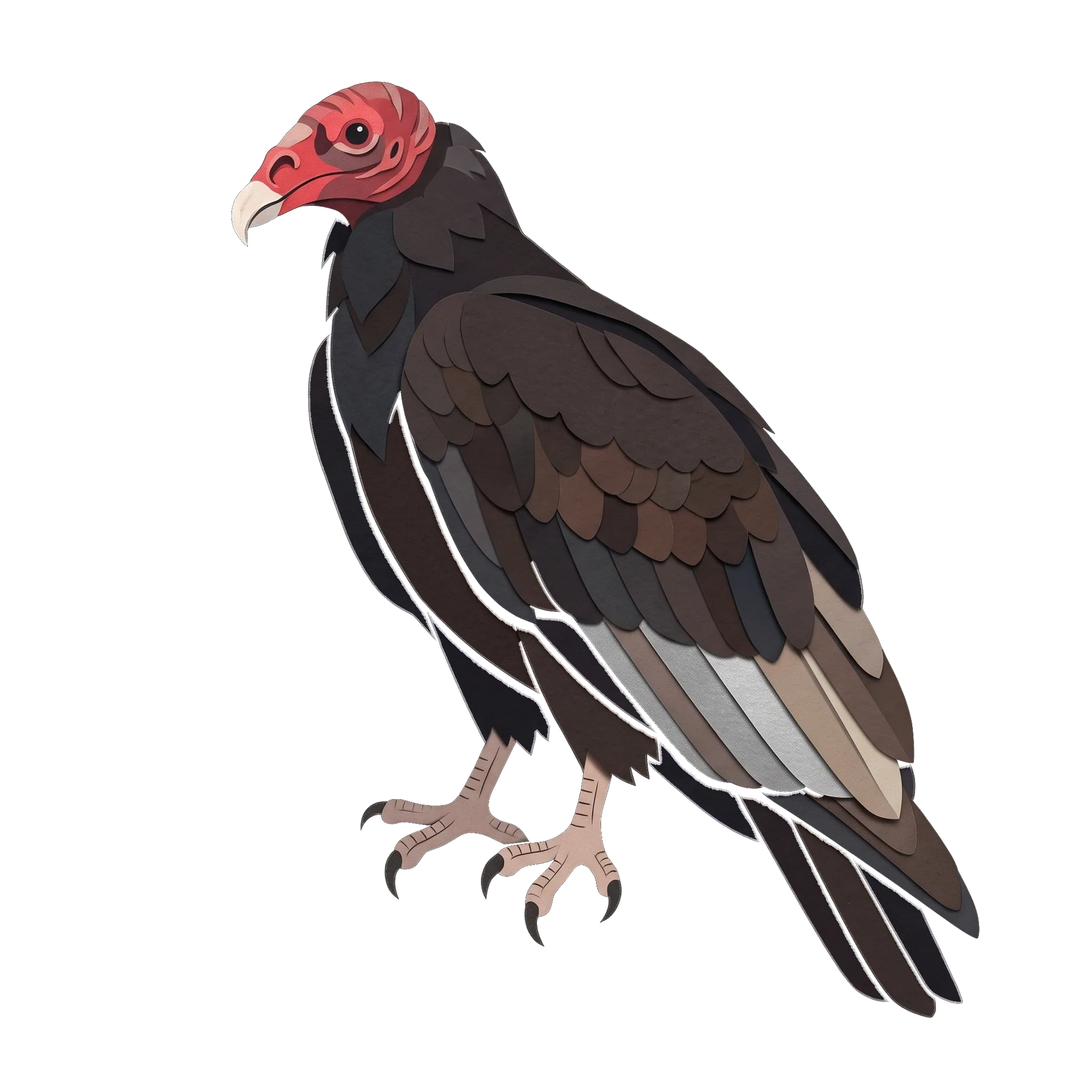
Birds have a reputation for a poor sense of smell, and the Turkey Vulture is the famous exception. It cruises low over the ground and picks up ethyl mercaptan, a gas released as animals begin to decay, which lets it find a carcass hidden under a forest canopy where a bird hunting by eyesight would see nothing. That makes it a kind of scout, since Black Vultures, which rely far more on eyesight, often find carrion by watching where other vultures go.
In the southern United States Turkey Vultures stay all year, while birds from the northern part of the range migrate, some as far as South America. Where they remain, they roost together in groups of dozens and sometimes several hundred, often with Black Vultures, on dead trees and towers. You'll often see one standing with its wings spread wide, especially in the morning, a posture thought to help it warm up, cool off, or dry its feathers. In the air they ride rising thermals with hardly a wingbeat.
Like this? Get one bird every morning, by email.
You're in. Your first bird arrives with the next morning email (5:30am ET) — and your life list now syncs.Your account →
How to identify
- A very large, dark bird soaring with its wings held in a shallow V, tipping from side to side and rarely flapping.
- The adult's small head is bare red skin with an ivory bill; juveniles have an ashy-gray head.
- From below the wings are two-toned: black wing linings with silvery-gray flight feathers along the rear edge.
- The tail is long, and on the ground it's awkward, with an ungainly hopping walk.
- Compare the Black Vulture, which has a black head, a shorter tail, pale patches at the wingtips, and quicker, flappier flight.
Voice
Nearly silent: low hisses and grunts at carcasses and nests, since it has no syrinx to sing with.
Recording: Andrew Spencer, XC381486, xeno-canto.org (CC-BY-NC-ND 4.0)
Lore
In Cherokee stories collected by James Mooney from Eastern Cherokee storytellers, chiefly in the field seasons of 1887 to 1890, the earth began as a soft, wet island, and the animals living in the sky vault sent out birds to see whether it was dry. Last they sent the Buzzard, the Great Buzzard, father of all the buzzards. Mooney's account, published in 1900 in 'Myths of the Cherokee', says he flew low over the ground; when he reached Cherokee country he was tired, his wings began to strike the earth, and wherever they struck there was a valley, and where they turned up again there was a mountain. The animals above feared the whole world would turn to mountains and called him back, but the Cherokee country is still full of mountains.
Mooney obtained his version of the genesis story chiefly from Swimmer and John Ax, whom he called the two most competent authorities of the Eastern Band, and notes that the buzzard shaping the mountains also appears in Creek and Yuchi creation stories. He adds that the buzzard (suli') was thought of as a doctor among birds. Its flesh, or soup used as a wash, was believed to prevent smallpox and was used for that purpose during the 1866 epidemic among the Eastern Cherokee, and, according to the Wahnenauhi manuscript, a buzzard feather over the cabin door keeps witches out.
Mooney writes 'buzzard,' the word many North Americans use for vultures, without naming a species, and both Turkey and Black Vultures soar over Cherokee country. A bird flying low over the ground, as the Great Buzzard does in the story, is at least a good description of how a Turkey Vulture hunts.
At a glance
- Family
- Cathartidae (New World vultures)
- Range
- Southern Canada to the tip of South America; northern birds migrate south for winter
- Habitat
- Open and semi-open country next to woodland, hills, farmland, and roadsides; avoids dense forest
- Diet
- Carrion, preferably fresh, from mice to livestock; occasionally stranded fish or insects
Where it lives
How big is it?
How is it doing?
Field notes
- In 1938, the Union Oil Company found that by injecting a strong-smelling chemical called mercaptan into its gas lines, it could find leaks by watching for Turkey Vultures gathering above the pipelines.
- Like storks, Turkey Vultures cool off by defecating on their own bare legs and letting it evaporate.
- Cornered, a Turkey Vulture can vomit semi-digested meat at a predator. It will also drop a heavy meal that way to lighten its load for escape.
- The oldest known Turkey Vulture was at least 23 years and 4 months old when it was seen in California in 2019, the same state where it was banded in 1997.
Go deeper
The daily email
Get tomorrow's bird in your inbox
One bird at 5:30am ET, every day. Free, no password, one-click unsubscribe — and your life list syncs across devices.
You're in. Your first bird arrives with the next morning email (5:30am ET) — and your life list now syncs.Your account →