An Andean Condor doesn't so much fly as ride. With a wingspan among the largest of any living bird, it launches from a cliff edge into a mountain updraft and can spend hours circling without a single flap, covering enormous distances across the Andes on thermals and ridge lift alone. Getting off flat ground is the hard part: as the heaviest living bird of prey, it often needs a running start or a series of hops before it can climb into the air.
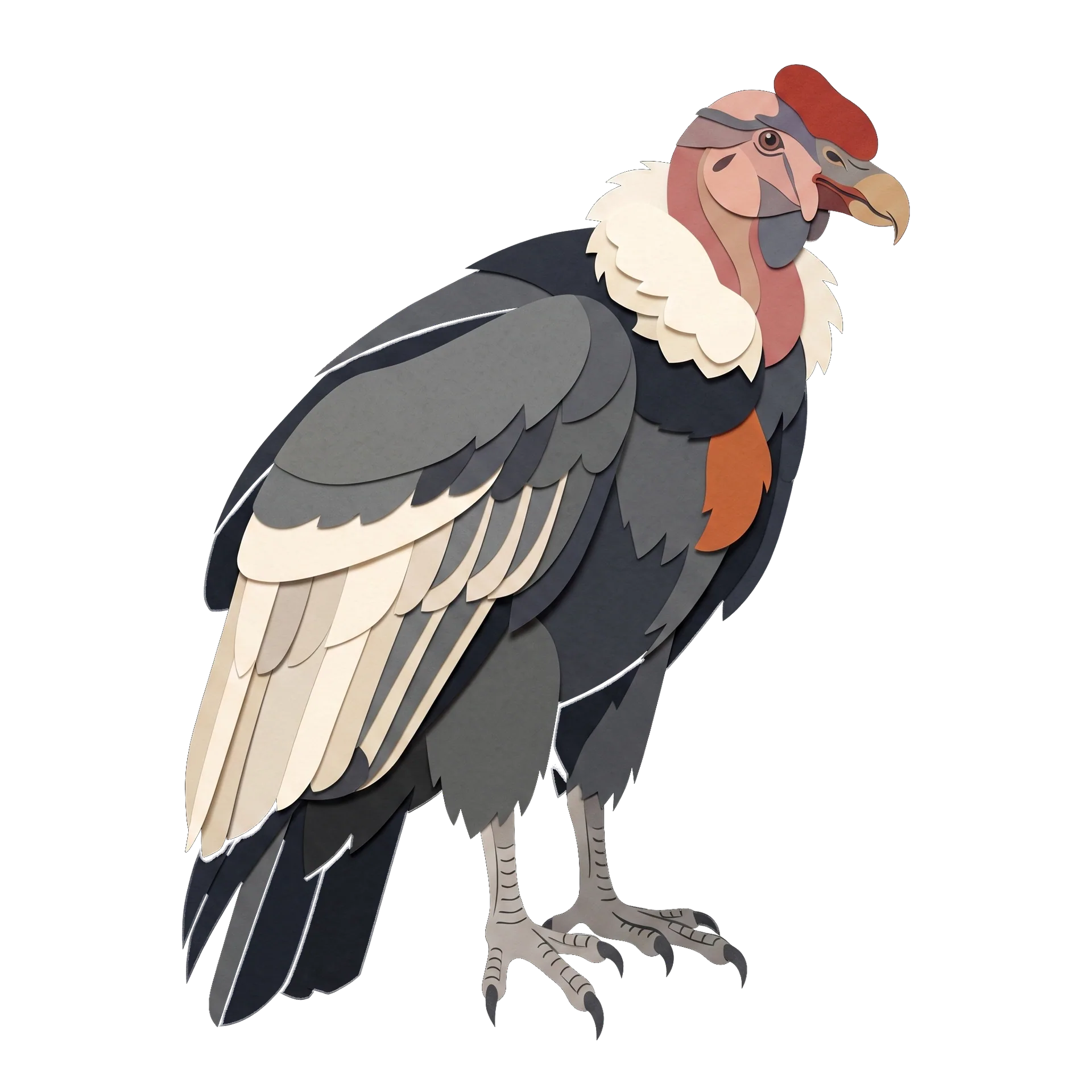
Up close, the appeal is less obvious. The bald head and neck, shared with other vultures, are a practical adaptation for a bird that plunges its head into carcasses to feed; feathers there would foul quickly and be nearly impossible to keep clean. Males carry a fleshy comb on the crown and bare orange-red skin down the neck; females lack the comb entirely and can be told apart at a distance by red rather than brown eyes.
The species has no real voice. Condors lack a syrinx, the vocal organ that lets most birds sing, so beyond hisses and grunts at close range they communicate almost entirely through posture and flight. Wild birds are thought to live roughly 30 to 50 years, with captive individuals recorded living decades longer — a strange kind of silence and a very long life for a bird whose shadow, crossing a mountain slope on a nine-foot wingspan, is often the first sign anyone has that it's there at all.
Like this? Get one bird every morning, by email.
You're in. Your first bird arrives with the next morning email (5:30am ET) — and your life list now syncs.Your account →
How to identify
- The heaviest living bird of prey, with an enormous wingspan and mostly black plumage set off by a white ruff of neck feathers.
- Males show a fleshy comb (caruncle) on the head and bare orange-red skin on the neck; adult females lack the comb and have red eyes rather than brown.
- Soars for hours on broad, deeply fingered wings with almost no flapping, riding thermals and ridge updrafts along mountain slopes.
- Bald head and neck, shared with other vultures, keep feathers clean while feeding on carcasses.
Voice
Almost entirely silent: condors lack a proper voice box, and produce only hisses and low grunts at close range.
Lore
In Inca cosmology, the condor, kuntur in Quechua, ruled Hanan Pacha, the celestial upper world, a status it held alongside the puma (guardian of the earthly middle world) and the serpent (ruler of the world below). Andean societies had already been carving and weaving condor imagery into their art for thousands of years before the Inca state existed, and Inca religion tied the bird closely to Inti, the sun god, treating a creature that could vanish into the peaks on some of the largest wings of any living bird as a natural stand-in for a god who ruled from the sky.
That reverence still gets a yearly, and controversial, reenactment. In the Yawar Fiesta ('Blood Festival'), held every July in Cotabambas, a mountain province in Peru's Apurímac region, a live Andean condor is tied to the back of a bull and released into a ring, where the two animals struggle in front of the whole town. The condor stands for the indigenous Andean world, the bull for the Spanish crown that colonized it, and the timing (Peru's Independence Day falls the same week) makes the symbolism explicit. Documented in its present form since at least the nineteenth century, the ritual is now illegal under Peruvian animal-welfare law given the condor's threatened status, and communities that still hold it typically release the bird unharmed afterward, but it persists as one of the most direct living expressions of how central the condor remains to Andean identity.
At a glance
- Family
- Cathartidae (New World vultures)
- Range
- Andes Mountains, from Venezuela south to Tierra del Fuego
- Habitat
- High mountain grasslands, cliffs, and coastal areas along the Andes
- Diet
- Carrion almost exclusively, located mainly by sight
Where it lives
How big is it?
How is it doing?
Field notes
- It's the heaviest living bird of prey, and getting airborne can take a real run and a leap from a cliff edge or a series of hops when there isn't enough wind to launch directly.
- Condors have no syrinx, the vocal organ most birds use to sing or call, which is why the species is essentially mute apart from hisses and grunts exchanged at close range.
- A condor can range widely on a single day's thermals, cruising over vast stretches of the Andes while barely beating its wings. Wild birds are thought to live roughly 30 to 50 years, and captive individuals have lived considerably longer — well past 70 in at least one documented case.
Go deeper
The daily email
Get tomorrow's bird in your inbox
One bird at 5:30am ET, every day. Free, no password, one-click unsubscribe — and your life list syncs across devices.
You're in. Your first bird arrives with the next morning email (5:30am ET) — and your life list now syncs.Your account →