Most birds build a nest. The Hamerkop builds a house. A pair starts with a platform of sticks held together with mud, raises walls and a domed roof, and leaves an entrance tunnel up to 60 cm long that opens into a chamber big enough to raise a brood. A finished nest can measure more than 1.5 meters across, and one researcher estimated about 8,000 sticks and bunches of grass in a single nest. Hamerkops build more than they need, too: a pair may put up three to five nests in a year whether or not it breeds, and since breeding runs year-round in East Africa, in any month somewhere a pair is hauling sticks.
The spare rooms get rented. A 2023 review in African Zoology by J. Gula and C. T. Downs of the University of KwaZulu-Natal found at least 20 other bird species breeding in Hamerkop nests across 18 African countries. Ducks, geese, kestrels, and owls move into the inner chamber, while larger birds such as storks and eagles use the roof as a platform. Six of the species have been recorded evicting the owners, including Verreaux's Eagle-Owls and Egyptian Geese.
The builder is a one-off in its own right. It is the only living species in its family, Scopidae, and its closest relatives are thought to be the pelicans and the Shoebill. It hunts by sight in clear water and by probing in muddy water, taking frogs, tadpoles, and fish (clawed frogs are an important food in East and Southern Africa). It will fish from the backs of hippos, follow cattle and buffalo for the grasshoppers they flush, and catch flying termites during their nuptial flights.
Like this? Get one bird every morning, by email.
You're in. Your first bird arrives with the next morning email (5:30am ET) — and your life list now syncs.Your account →
How to identify
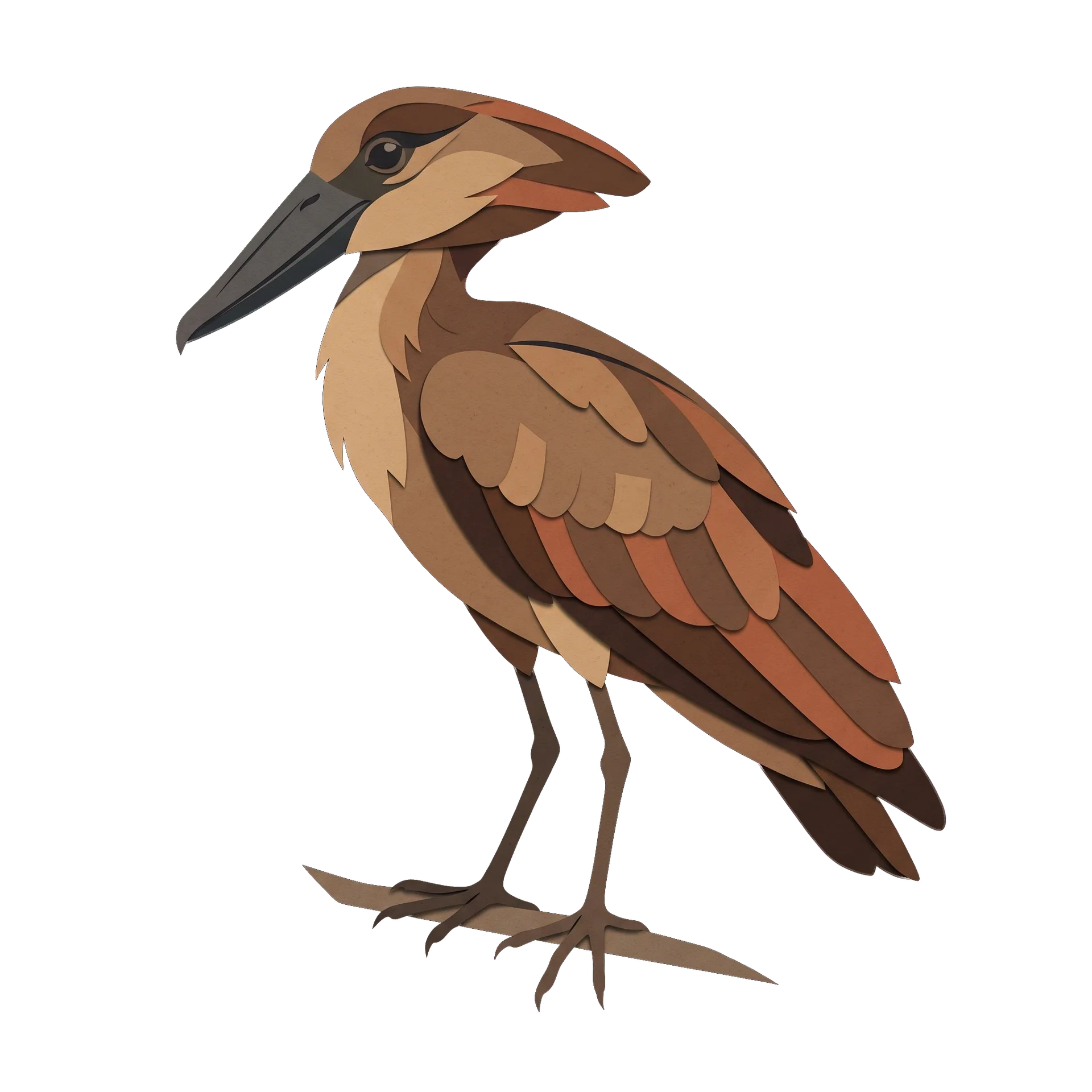
- A hunched, medium-sized, drab-brown wader. The long, slightly hooked bill is balanced by a crest sticking out the back of the head, which makes the hammer-shaped silhouette the Afrikaans name describes.
- Plumage is plain brown with a purple sheen on the back when the light hits it; bill and legs are black, and males and females look alike.
- Look for it standing still at the edge of shallow water, or walking the shallows after frogs. It needs shallow water to forage in.
- The nest gives it away before the bird does: a vast domed heap of sticks, often in a tree fork over water, with a small entrance on one side.
- At a distance its shape can pass for a heron's. The crest and the nest rule that out.
Voice
Usually silent when alone; in flight, a shrill nyip or kek.
Recording: GABRIEL LEITE, XC810779, xeno-canto.org (CC-BY-NC-SA 4.0)
Lore
Among the ǀXam of South Africa's interior, the Hamerkop was a messenger of death. In an account recorded by Lucy Lloyd in January 1876 and published in Bleek and Lloyd's Specimens of Bushman Folklore (1911), the narrator Diaǃkwain (David Hoesar) explained that when a Hamerkop flies over the people, crying, they know that someone belonging to them has died.
Elsewhere the bird is respected and feared in equal parts. The Dictionary of South African English records that the Southern Sotho imagine the mythical lightning bird as a Hamerkop, and quotes the 1937 book Zulu Journey noting that it brings bad luck on a hunter to kill one. In Zulu belief, where the bird is called uThekwane, it carries a 'burning power': the South African National Biodiversity Institute's species account says that anyone who destroys a Hamerkop nest will see their home burn down within a day, which makes the bird highly respected among Zulu hunters. The same dictionary quotes a 1959 study of a related belief, that the bird, finding its nest destroyed, fetches lightning against the culprit.
At a glance
- Family
- Scopidae (hamerkop)
- Range
- Sub-Saharan Africa, Madagascar, and southwestern Arabia
- Habitat
- Shallow water of almost any kind: rivers, estuaries, marshes, dams, and rice paddies
- Diet
- Frogs and tadpoles, small fish, and aquatic invertebrates; flying termites when they swarm
Where it lives
How big is it?
How is it doing?
Field notes
- The nest often ends up decorated with an odd collection of bones, scraps of hide, and human litter.
- When three or more Hamerkops meet, sometimes as many as 20, they hold a noisy gathering: yips that turn into purring notes, necks stretched out, with mutual preening and 'false mounting,' in which one bird appears to mount another without mating.
- Clutches run three to seven eggs. Both parents incubate for about 30 days and both feed the chicks.
Go deeper
The daily email
Get tomorrow's bird in your inbox
One bird at 5:30am ET, every day. Free, no password, one-click unsubscribe — and your life list syncs across devices.
You're in. Your first bird arrives with the next morning email (5:30am ET) — and your life list now syncs.Your account →