Among pigeons, the Victoria Crowned Pigeon is the heavyweight: adults average about 2.4 kg (5.3 lb), and it's generally counted as the largest pigeon alive. It lives on the floor of New Guinea's lowland and swamp forests, walking in pairs or small parties and picking up fallen fruit. When something startles it, it flies straight up to a big horizontal branch with a loud clapping of wings, and may stay there a long while, calling and flicking its tail.
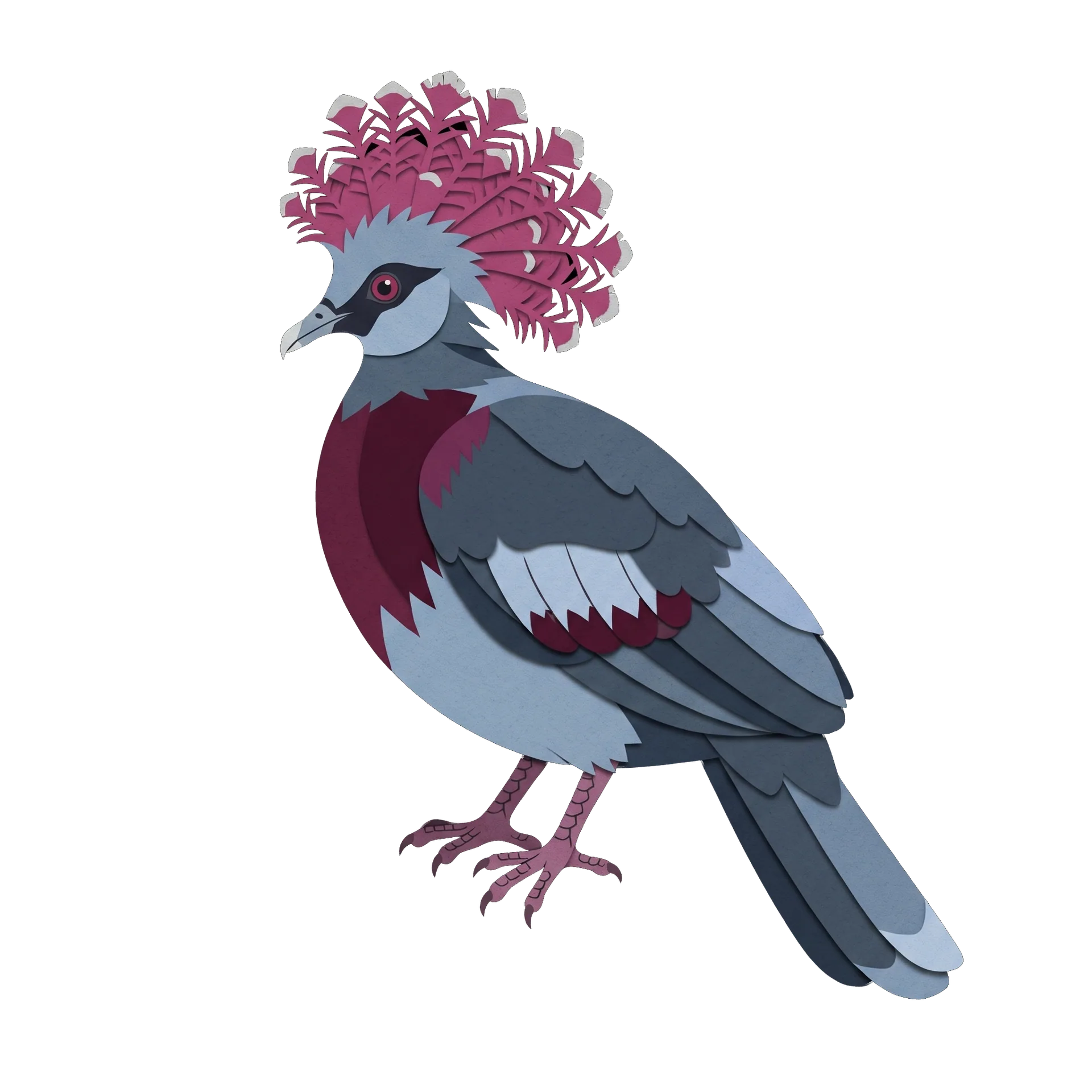
The crest is what people remember: a fan of lace-like feathers tipped in white, over a blue-gray body and a maroon chest. In courtship the male lowers his head, stretches forward, and swings it up and down while wagging his fanned tail, and before laying he brings nest material to the female for a tree nest of stems, sticks, and palm leaves. She usually lays a single white egg and it's incubated for about 30 days.
Logging has been taking away the lowland forest, and the bird is quite uncommon near settlements, where it has been heavily hunted for its plumes and meat. Trapping for captive collections is now illegal but probably continues. The species is rated Near Threatened and is listed on CITES Appendix II.
Like this? Get one bird every morning, by email.
You're in. Your first bird arrives with the next morning email (5:30am ET) — and your life list now syncs.Your account →
How to identify
- A huge, long-legged ground pigeon, about 75 cm (30 in) long, with deep blue-gray plumage and a small black mask around the eye.
- The crest is a fan of lacy feathers held upright, each tipped in white.
- A maroon-purple chest, red eyes, and a row of pale blue-gray wing feathers tipped in maroon that forms a bar across the wing.
- Walks the forest floor at an unhurried pace in pairs or small parties; when startled it flies up to a branch with a loud clap of wings.
- Four crowned pigeons divide up New Guinea, and the Victoria is the northern one. The Western Crowned Pigeon of the northwest has a crest without white tips and a plain blue-gray chest.
Voice
A deep, booming hoota-hoota in courtship, a loud booming call when males defend their territory, and a muffled, almost human ummm to keep in touch.
Recording: Iain Woxvold, XC557682, xeno-canto.org (CC-BY-NC-SA 4.0)
At a glance
- Family
- Columbidae (pigeons & doves)
- Range
- Northern New Guinea and nearby islands (Yapen, Biak, Supiori)
- Habitat
- Lowland and swamp forest, including sago palm stands, mostly near sea level
- Diet
- Fallen fruit, plus seeds and the occasional invertebrate
Where it lives
How big is it?
How is it doing?
Field notes
- The species is named for Queen Victoria and was described scientifically in 1844.
- There are two subspecies: the larger bird of mainland New Guinea, and a markedly smaller one on the islands of Yapen, Biak, and Supiori.
- Like the other crowned pigeons, it has 16 tail feathers instead of the 12 found on most pigeons.
- Both parents help raise the young, which leave the nest while still much smaller than their parents and are tended for a total of 13 weeks.
Go deeper
The daily email
Get tomorrow's bird in your inbox
One bird at 5:30am ET, every day. Free, no password, one-click unsubscribe — and your life list syncs across devices.
You're in. Your first bird arrives with the next morning email (5:30am ET) — and your life list now syncs.Your account →