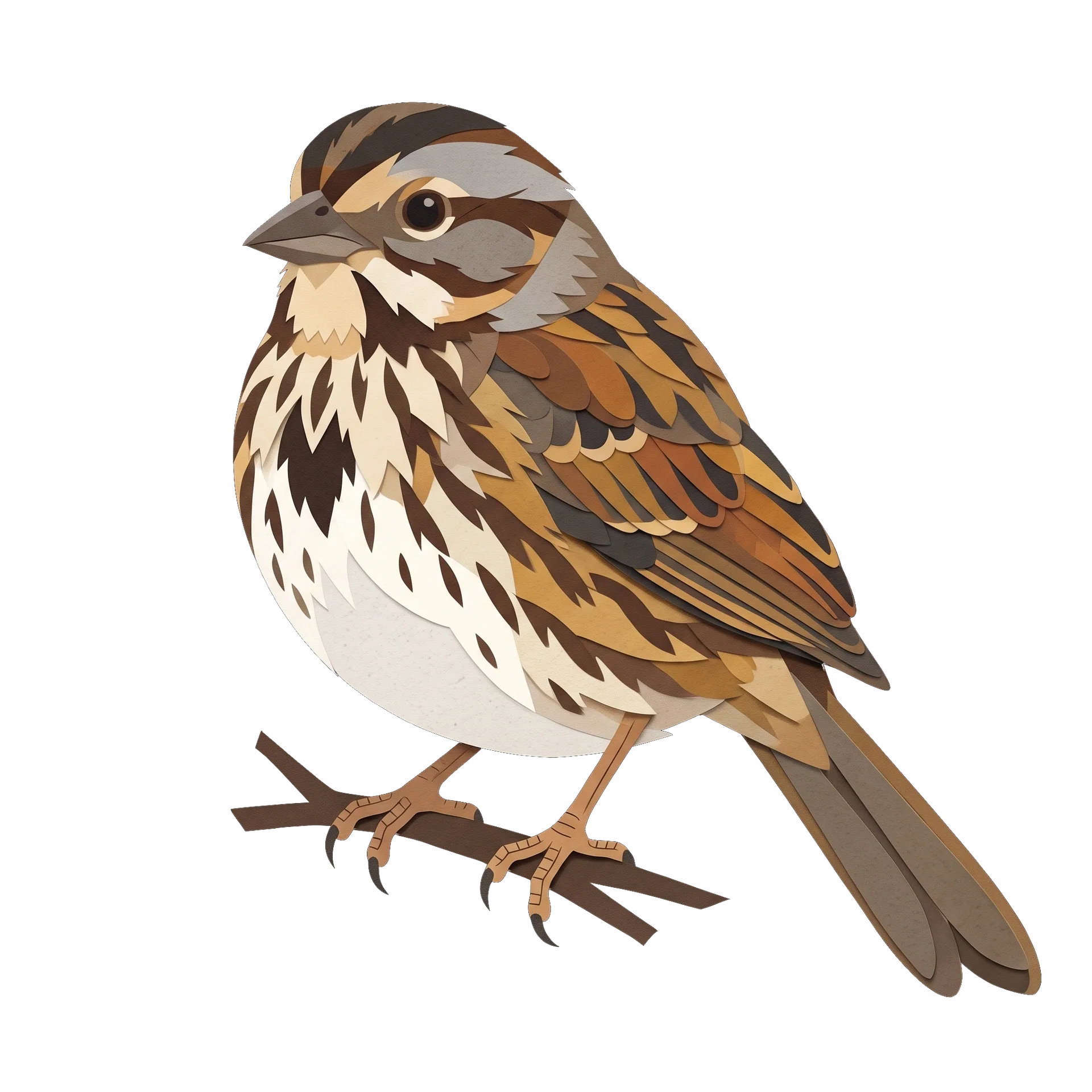
A Song Sparrow rarely hides its singing. Where many small sparrows retreat into cover to call, this one climbs to an exposed twig or fence wire and delivers its whole song in the open — a few clear opening notes followed by a buzzy trill, varied enough between individuals that researchers have used it for decades to study how birds learn and share song.
What the research found looks close to culture: young males pick up song types by listening to established neighbors, and particular phrases can spread and persist across a whole cluster of territories for years, passed from bird to bird like a local dialect rather than reinvented each generation.
The species looks different almost everywhere you find it. Coastal populations run darker and heavier-billed, desert birds pale and slim, Aleutian Island birds nearly sooty black — more than two dozen recognized subspecies span a range of appearances wide enough that early ornithologists sometimes mistook distant populations for entirely different birds.
Like this? Get one bird every morning, by email.
You're in. Your first bird arrives with the next morning email (5:30am ET) — and your life list now syncs.Your account →
How to identify
- A streaky brown sparrow with a heavily marked breast that converges into a single dark central spot — a key field mark.
- Pumps its long, rounded tail up and down in flight, a habit visible even at a distance.
- Sings from an exposed low perch, unusually persistent and willing to be watched compared to many sparrows.
- Plumage varies widely by region — coastal and desert populations can look strikingly different from one another.
Voice
A variable song of clear opening notes followed by a buzzy trill; a sharp, nasal chimp call note.
Recording: Ed Pandolfino, XC1153739, xeno-canto.org (CC-BY-NC-SA 4.0)
Lore
Henry David Thoreau wrote about the Song Sparrow again and again in his Concord journals, from the "jingle" he heard rising from every part of the meadow on 1 April 1852 to the hedges that "resound" with its song on 6 April 1856. In June of that year he noted a mnemonic from his correspondent Daniel Ricketson of New Bedford: people there, Ricketson said, claimed the bird sang, "Maids, maids, maids, hang on your tea-kettle-ettle-ettle-ettle-ettle." Ricketson was still at it six years later. On 23 March 1862 he wrote to Thoreau that the Song Sparrow had been calling the maids to hang on their teakettles for several weeks.
The species' great chronicler was Margaret Morse Nice, who moved to Columbus, Ohio, in 1927. In 1928 she banded a Song Sparrow near her house and named it Uno, and by 1935 she had banded some 870 Song Sparrows, adults and nestlings, on the Olentangy River floodplain at her door. She gave the adults combinations of colored leg bands so she could tell individuals apart in the field, mapped their territories, and followed their nests and survival. She also counted. On 11 May 1935 a male she called 4M, whose mate had disappeared four days earlier, sang 2,305 songs between 4:45 in the morning and 7:43 at night. Ernst Mayr wrote to her that he considered her Song Sparrow work the finest piece of life-history work ever done, and he offered to arrange its publication. It appeared from the Linnaean Society of New York as Studies in the Life History of the Song Sparrow, in two volumes, in 1937 and 1943.
At a glance
- Family
- Passerellidae (New World sparrows)
- Range
- Throughout most of North America; northern populations winter into Mexico
- Habitat
- Brushy edges, wetland margins, and overgrown gardens
- Diet
- Insects and seeds, foraged low in dense brush
Where it lives
How big is it?
How is it doing?
Field notes
- Song Sparrows show some of the most extreme regional plumage variation of any widespread North American songbird, with over two dozen recognized subspecies ranging from pale desert forms to nearly black birds on the Aleutian Islands.
- Males learn their songs by listening to neighboring birds as juveniles, and some song types get passed down and shared across a whole neighborhood of territories, like a local dialect.
- Individual Song Sparrows have been documented living over 11 years in the wild, unusually long for a small songbird facing constant predation pressure.
Go deeper
The daily email
Get tomorrow's bird in your inbox
One bird at 5:30am ET, every day. Free, no password, one-click unsubscribe — and your life list syncs across devices.
You're in. Your first bird arrives with the next morning email (5:30am ET) — and your life list now syncs.Your account →