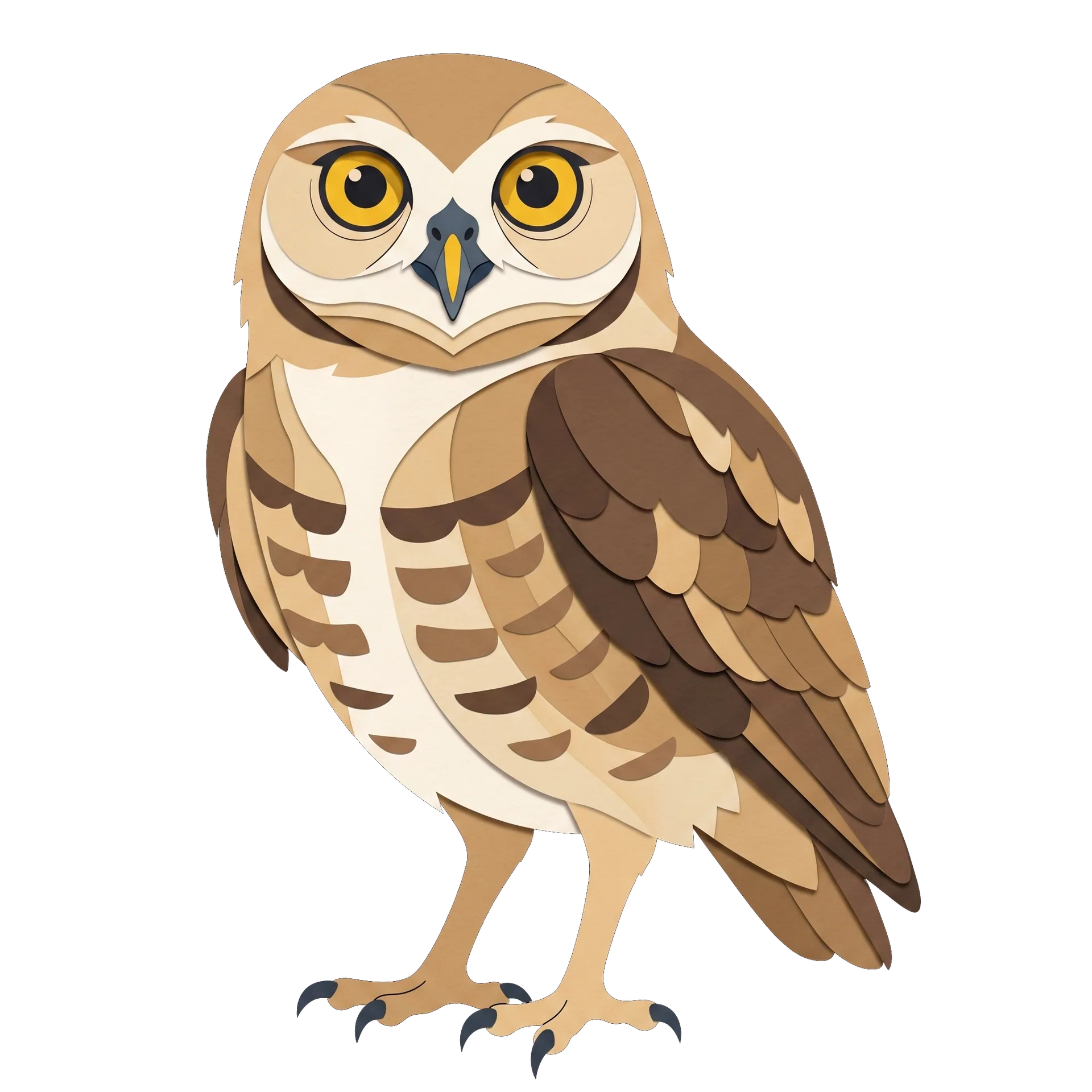
A Burrowing Owl standing at the mouth of its tunnel in the middle of the day looks like it's broken some unwritten owl rule, and in a sense it has — most owls hide until dusk, while this one hunts insects and rodents in full sunlight, bobbing on long legs at the entrance to a burrow it usually didn't even dig itself. Across most of its range it depends on holes abandoned by prairie dogs, ground squirrels, or tortoises, making it a species tied closely to whatever digs the holes it can't make on its own.
Prairie dog colonies across the American West have been poisoned and paved over for decades, and Burrowing Owl numbers have tracked the decline closely enough to make the species a conservation priority in several states, even while it remains globally common.
Inside the burrow, young owls have a defense that borrows from a much more dangerous neighbor: disturbed chicks produce a hissing rattle that closely mimics a rattlesnake, likely enough to make a digging predator think twice before reaching into the dark. Adults add another trick on the surface, sometimes scattering mammal dung around the entrance — dung beetles and other insects are drawn in, and the owl simply eats what shows up.
Like this? Get one bird every morning, by email.
You're in. Your first bird arrives with the next morning email (5:30am ET) — and your life list now syncs.Your account →
How to identify
- A small, long-legged owl often seen standing at a burrow entrance in broad daylight, bobbing its head when alert.
- Sandy brown overall with heavy white spotting above and barring below; lacks ear tufts entirely.
- Nests underground in burrows, usually ones dug by prairie dogs, ground squirrels, or tortoises rather than by the owl itself.
- Active by day as well as at dusk, unusual among owls, often perched on a fence post or mound near the burrow.
Voice
A soft, two-note coo-coo, plus a rattling hiss given by young owls in the burrow that closely mimics a rattlesnake.
Recording: Manuel Grosselet, XC535647, xeno-canto.org (CC-BY-NC-SA 4.0)
Lore
A Zuni tale recorded by ethnologist Frank Hamilton Cushing in Zuñi Folk Tales (1901) explains why this owl looks the way it does. A curious Coyote stumbles on the Burrowing Owls holding their sacred Foam-dance at the edge of a prairie-dog town, each dancer balancing a bowl of foam on its head without spilling a drop. Talked into joining, Coyote breaks his own legs trying to copy their crooked-legged steps, believing it's part of the initiation, and the dancers laugh so hard at the sight that they spill foam down their own backs and bosoms. Ever since, the story goes, Burrowing Owls have worn that speckled gray-and-white plumage, and Coyotes have kept clear of them.
The species picked up folklore of its own on the American frontier. Nineteenth-century cowboys nicknamed it the 'howdy bird,' for the way it bobs at a burrow mouth as if nodding a greeting to anyone passing through a prairie-dog town, a nickname the National Audubon Society still traces to that habit. The same era produced a tall tale with more staying power than truth, that owls, prairie dogs, and rattlesnakes lived companionably together in one shared burrow. Real Burrowing Owls do move into abandoned prairie-dog tunnels, and rattlesnakes den in them too, just not as roommates: a rattlesnake will eat owl chicks given the chance.
At a glance
- Family
- Strigidae (typical owls)
- Range
- Western North America, Florida, and much of Central and South America
- Habitat
- Open grassland, prairie, and desert scrub with loose, diggable soil
- Diet
- Large insects and small rodents, hunted both on the ground and in flight
Where it lives
How big is it?
How is it doing?
Field notes
- Burrowing Owl chicks produce a rattlesnake-like hissing sound when disturbed in the nest burrow — a well-documented case of a bird's alarm call mimicking a dangerous animal to deter predators from digging in.
- The species relies heavily on burrows dug by other animals, especially prairie dogs, and the decline of prairie dog colonies across the American West through poisoning and habitat loss has driven parallel declines in Burrowing Owl numbers.
- Adults sometimes line the burrow entrance with mammal dung, which appears to attract dung beetles and other insects that the owl then eats — a documented case of a bird apparently using bait to hunt.
Go deeper
The daily email
Get tomorrow's bird in your inbox
One bird at 5:30am ET, every day. Free, no password, one-click unsubscribe — and your life list syncs across devices.
You're in. Your first bird arrives with the next morning email (5:30am ET) — and your life list now syncs.Your account →