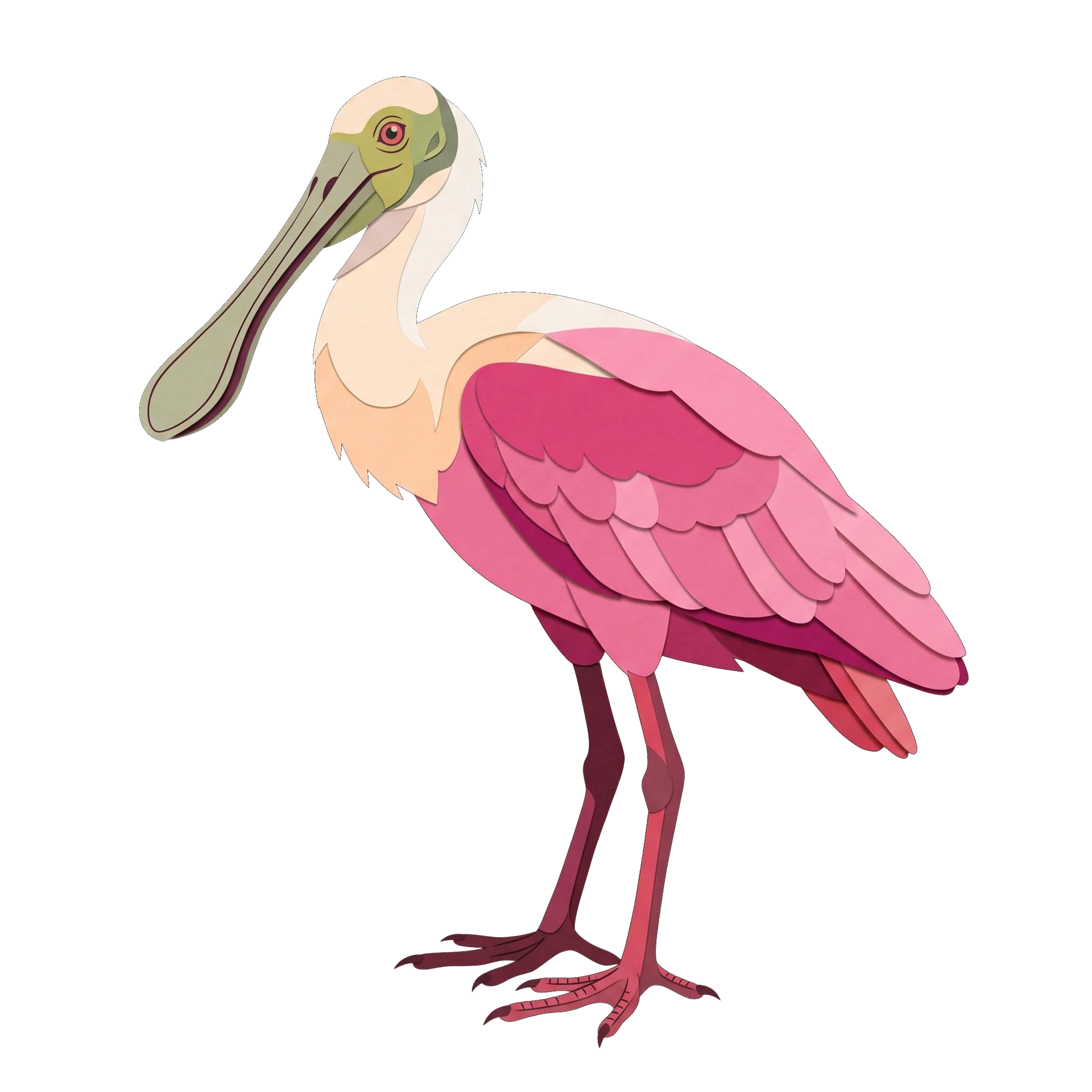
The spoonbill's bill does the seeing that its eyes can't. Submerged and swung side to side through the mud, it snaps shut the instant it brushes something alive — the bird is finding prey entirely by touch, which is why spoonbills happily forage in water too murky for a heron to bother with.
That bill takes time to grow into. Chicks hatch with an ordinary straight bill and only develop the flattened spoon shape as they mature, meaning the tool that defines the species as adults is missing entirely for its first weeks of life.
Spoonbills nest in mixed colonies with herons, egrets, and ibises — a startling sight when a stand of mangroves turns out to be full of bright pink birds among the white and gray. Like those neighbors, they paid for their looks once: plume hunters supplying the hat trade nearly eliminated Florida's population by the early 1900s, and it took decades of protection to bring numbers back.
Like this? Get one bird every morning, by email.
You're in. Your first bird arrives with the next morning email (5:30am ET) — and your life list now syncs.Your account →
How to identify
- A large pink wading bird with a distinctive flat, spoon-shaped gray bill and a bald, greenish head in adults.
- Feeds by wading with the bill submerged, swinging it side to side through shallow water rather than stabbing like a heron.
- Flies with the neck extended, like an ibis, not tucked in an S like a heron.
- The only pink wading bird in the Americas: a much taller, longer-legged American Flamingo is the only bird it could plausibly be confused with at a distance.
Voice
Low, soft grunts and croaking notes, mostly given around the nest colony.
Recording: Guillermo Treboux, XC783800, xeno-canto.org (CC-BY-NC-SA 4.0)
Lore
In 1939, Audubon Society president John Baker asked field biologist Robert Porter Allen to give the spoonbill a dedicated study, the kind already underway for the Ivory-billed Woodpecker and California Condor. Allen moved his family to Key Largo that October and pitched a tent camp on Bottle Key, in Florida Bay, to live among the last colonies and track them nest by nest. His findings, published in 1942 as the Society's second devoted species research report, drew fresh attention to Florida Bay's ecological value in the years before Everglades National Park was established there in 1947.
At a glance
- Family
- Threskiornithidae (ibises & spoonbills)
- Range
- Gulf Coast U.S., Mexico, Central America, the Caribbean, and northern South America
- Habitat
- Shallow coastal lagoons, mangroves, and freshwater marshes
- Diet
- Small fish and crustaceans, detected by touch and swept up with a sideways-sweeping bill
Where it lives
How big is it?
How is it doing?
Field notes
- Chicks hatch with a short, straight bill that only develops its flattened spoon shape as the bird grows — the tool for its feeding style isn't fully formed until well after fledging.
- Nineteenth-century plume hunters targeted Roseate Spoonbills for their wing feathers alongside egrets and other showy wading birds, and Florida's population dropped to a few dozen pairs before early bird-protection laws let it recover.
- Spoonbills often nest in mixed colonies alongside herons, egrets, and ibises, packing hundreds of nests from several species into the same stand of mangroves or trees.
Go deeper
The daily email
Get tomorrow's bird in your inbox
One bird at 5:30am ET, every day. Free, no password, one-click unsubscribe — and your life list syncs across devices.
You're in. Your first bird arrives with the next morning email (5:30am ET) — and your life list now syncs.Your account →