Late summer is when most people notice a Common Nighthawk for the first time, even in the middle of a city. As the light fades, one or two angular shapes appear overhead, flying with a jerky, batlike wingbeat and calling a nasal peent, and by early September that can become dozens, sometimes hundreds, streaming south in loose flocks at dusk on their way to South America.
For a bird so visible at dusk, it's remarkably hard to find by day. Nighthawks roost lengthwise on branches, fence rails, and flat gravel rooftops, holding still with plumage so close to bark and stone that a bird can be a few feet away and go completely unseen. They don't build a nest either — eggs go straight onto bare gravel or rock, protected by nothing but the parent's camouflage and its willingness to sit tight.
The male's courtship dive adds a sound with no voice behind it. He climbs high, then drops in a steep dive and pulls up hard just above the ground, and the rush of air through his wingtips produces a hollow boom that carries surprisingly far — a mechanical sound effect built entirely out of feather and airflow, and one of the odder noises in the summer sky.
Like this? Get one bird every morning, by email.
You're in. Your first bird arrives with the next morning email (5:30am ET) — and your life list now syncs.Your account →
How to identify
- Slim, long-winged, and erratic in flight, cutting across the sky at dusk like a stiff-winged bat.
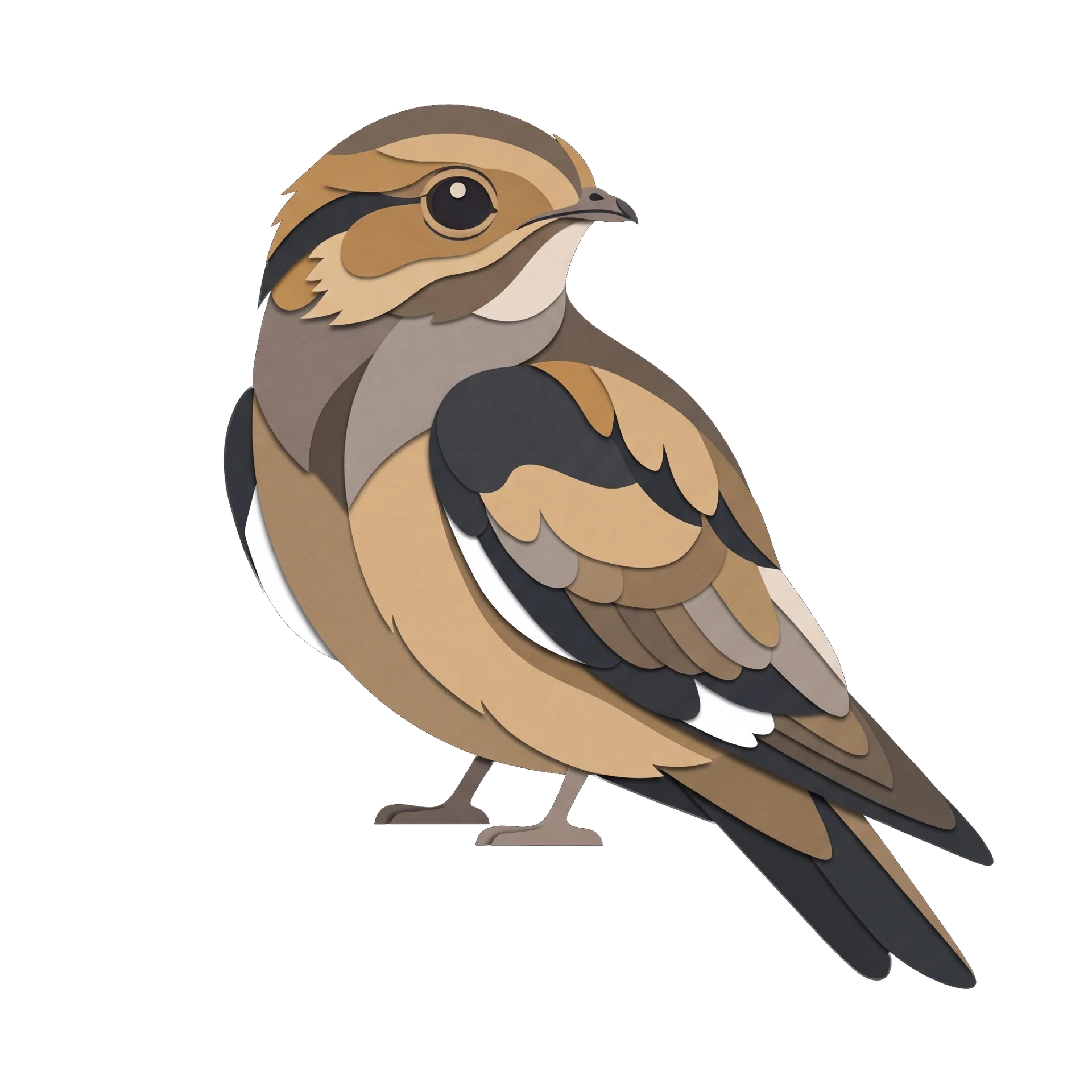
- A bold white bar crosses each pointed wing, visible even in poor light; overall plumage is cryptic gray-brown, bark-like camouflage at rest.
- Regularly seen and heard over cities and towns at dusk in late summer, giving a nasal call in flight.
- By day, roosts flattened lengthwise along a branch, fence rail, or flat gravel roof, nearly invisible until it flushes.
Voice
A nasal, buzzy peent given repeatedly in flight, plus a hollow booming sound made by air rushing through the wings during a diving display.
Recording: Bruce Lagerquist, XC405611, xeno-canto.org (CC-BY-NC-SA 4.0)
Lore
Two names carried across the Atlantic with this bird. 'Bullbat' is homegrown, coined for the erratic, batlike flight and the deep boom of the male's diving display. 'Goatsucker' is older and stranger: Aristotle and Pliny accused the nightjars of Europe of sneaking into pens at night to drink milk straight from goats' udders, when they were really just hunting the insects the goats stirred up. European naturalists exported the myth along with the name: in 1789 Johann Friedrich Gmelin classified this exact species as Caprimulgus virginianus, literally 'Virginia goat-milker,' and it was moved into its own genus, Chordeiles, only in 1832.
Indigenous names for the nighthawk predate any of that European naming. Tribes along the Connecticut River heard the male's booming dive as the voice of the Shad Spirit, warning the shad running upstream of what was coming for them. The Seminole of Florida called the bird Ho-pil-car; the Maliseet of the Northeast, recorded historically as Pik-teis-k wes. The Ojibwe name, Besh-que, is notable for what it got right: unlike the European naturalists who lumped nighthawks and whip-poor-wills together for decades, the Ojibwe had a separate name, Gwen-go-wi-a, all along for the whip-poor-will.
At a glance
- Family
- Caprimulgidae (nightjars)
- Range
- Breeds across most of North America; winters in South America
- Habitat
- Open country, forest clearings, and increasingly gravel rooftops in cities
- Diet
- Flying insects, caught entirely on the wing at dusk and dawn
Where it lives
How big is it?
How is it doing?
Field notes
- The booming sound at the bottom of a male's display dive isn't vocal at all: it's produced by air vibrating through the primary feathers as he pulls up sharply, a purely mechanical sound.
- Nighthawks lay their eggs directly on bare ground, gravel, or flat rooftops without building any nest, relying entirely on camouflage to protect the sitting bird and eggs.
- Late-summer migration produces some of the largest visible bird movements in North America: flocks numbering in the hundreds or low thousands can stream over a single city at dusk in late August and September, headed for South America.
Go deeper
The daily email
Get tomorrow's bird in your inbox
One bird at 5:30am ET, every day. Free, no password, one-click unsubscribe — and your life list syncs across devices.
You're in. Your first bird arrives with the next morning email (5:30am ET) — and your life list now syncs.Your account →