The only hummingbird that breeds in eastern North America runs entirely on extremes. A Ruby-throated Hummingbird's wings beat more than fifty times a second, its heart can pass 1,200 beats a minute, and it can fly backward, sideways, and straight up: the helicopter maneuvers that make it the delight of every garden it visits. Fueling all this takes nectar in industrial quantities, plus a steady side income of gnats and spiders snatched from the air and stolen from webs.
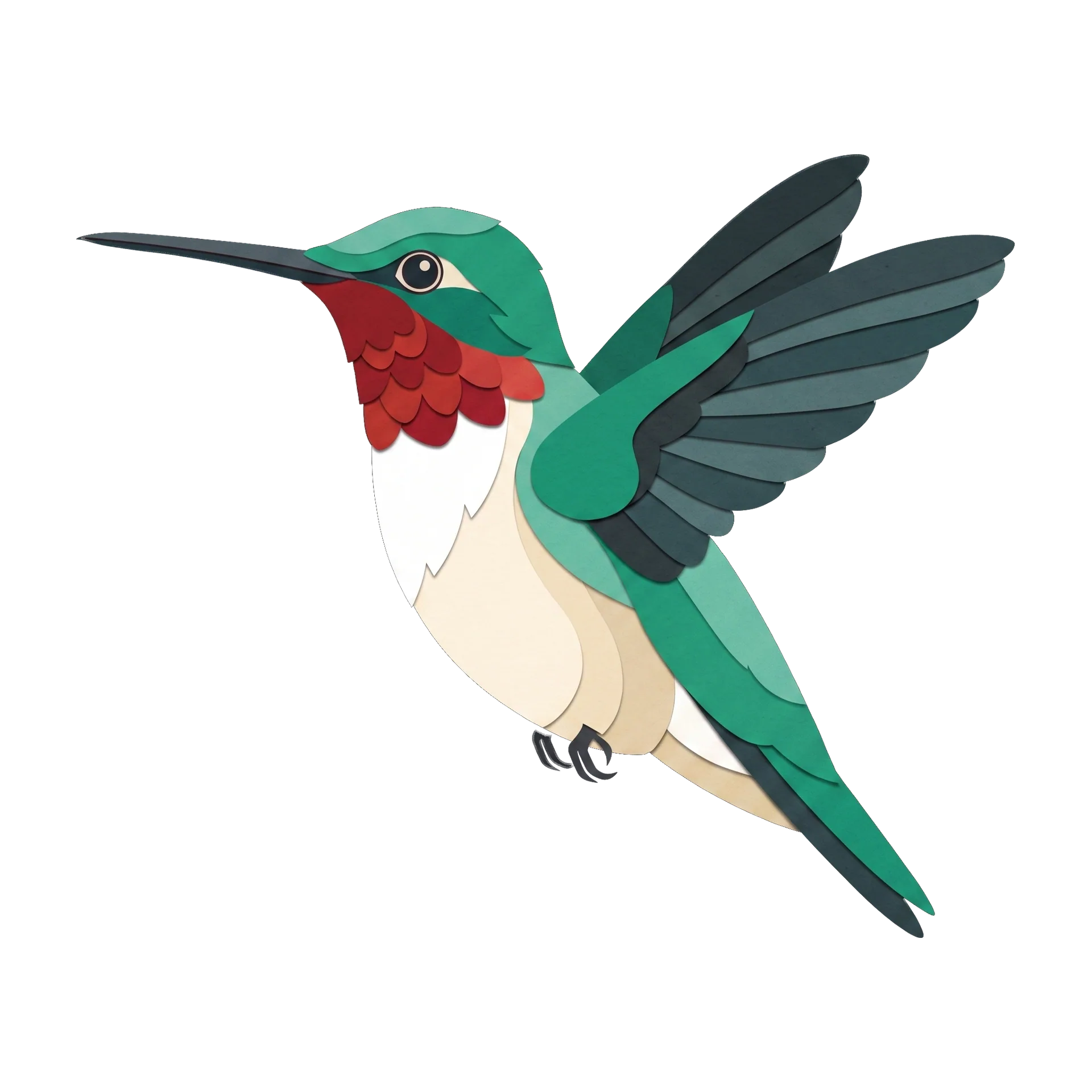
The male's namesake throat patch is a trick of structure rather than pigment: matte black from the side until he pivots toward the sun in his pendulum display flight, then a sudden furnace-red flash, switched on and off at will. Females, dressed in cool green and white, do all the nest-building, weaving a cup the size of a large thimble from plant down and spider silk, camouflaged with lichen and stretchy enough to grow with the chicks.
Then, in September, this three-gram bird does something that still seems impossible: many ruby-throats launch from the Gulf Coast at dusk and fly all night and into the next day, nonstop, across open water to the Yucatán. No landmarks, no rest, no margin. The bird at your August feeder, doubling its weight on sugar, is an athlete in training for one of the most audacious migrations on Earth.
Like this? Get one bird every morning, by email.
You're in. Your first bird arrives with the next morning email (5:30am ET) — and your life list now syncs.Your account →
How to identify
- Tiny even for a hummingbird, emerald-green above, hovering and flying backward at flowers and feeders.
- The male's ruby throat patch looks black until he faces the light — then it ignites. Don't rule him out just because you see a 'dark-throated' bird.
- Females and young birds are white-throated with white tail corners.
- East of the Great Plains in summer, essentially any hummingbird is this species; in migration along the Gulf, other species become possible.
- Listen for the low wing hum and squeaky chips before you spot the bird itself.
Voice
Squeaky, mouse-like chips and chatter, but the signature sound is the hum itself, wings beating more than 50 times each second.
Recording: David A. Brinkman, XC1008057, xeno-canto.org (CC-BY-NC-SA 4.0)
Lore
Hummingbirds carried outsized meaning across the Americas, and nowhere more than for the Aztec, whose war god Huitzilopochtli took his own name from huitzilin, 'hummingbird.' Warriors killed in battle, and women who died in childbirth, were believed to return to the world reborn as hummingbirds, the tiny troops said to accompany Huitzilopochtli himself. Mexico alone is home to dozens of hummingbird species, and Aztec reverence took in the whole family; nothing in the record singles out the ruby-throat by name.
East of the Mississippi, though, the Ruby-throated Hummingbird has no competition: it's the only hummingbird most Cherokee, Creek, and Iroquois communities would ever have seen, which makes it the likely hero of the Cherokee story 'Hummingbird Brings Back Tobacco.' When the Dagul'ku geese stole the people's only tobacco plant and killed every larger animal that tried to reclaim it, Hummingbird succeeded where the rest had failed: too small and fast for the geese to even see coming, he darted in, snapped off a sprig of leaves and seeds, and was gone again before they knew what had happened.
At a glance
- Family
- Trochilidae (hummingbirds)
- Range
- Eastern North America; winters in Mexico & Central America
- Habitat
- Gardens, woodland edges, and anywhere tubular flowers bloom
- Diet
- Flower nectar, tree sap, and surprising numbers of tiny insects
Where it lives
How big is it?
How is it doing?
Field notes
- Each fall, many ruby-throats cross the Gulf of Mexico nonstop: roughly 800 km of open water on a bird that weighs about as much as a penny and a half, having nearly doubled its body weight in fuel first.
- Its heart can exceed 1,200 beats per minute in flight; on cold nights the bird drops into torpor, slowing its metabolism to a fraction of normal to survive until morning.
- Hummingbird legs are so reduced that a ruby-throat can perch and shuffle sideways along a twig, but it cannot walk or hop. For any trip longer than a shuffle, it flies.
Go deeper
The daily email
Get tomorrow's bird in your inbox
One bird at 5:30am ET, every day. Free, no password, one-click unsubscribe — and your life list syncs across devices.
You're in. Your first bird arrives with the next morning email (5:30am ET) — and your life list now syncs.Your account →