The Atlantic Puffin looks like a bird designed by committee (penguin tuxedo, parrot bill, the sad-clown eye makeup) and then it flies, whirring low over the waves at up to 400 wingbeats a minute. Underwater, those same stubby wings become flippers: puffins literally fly through the sea, steering with their feet, chasing sand eels through the green light below the surface.
For most of the year, nobody sees a puffin at all. They scatter alone across the open North Atlantic, riding out winter storms far from any coast. Then in spring they gather at traditional colonies (sea-stack islands off Iceland, Norway, Britain, and Maine), where pairs reunite at the same burrow dug into the clifftop turf, often with the same mate, year after year. The single chick, called a puffling, fledges alone at night, walking to the cliff edge and heading out to sea for years before it first returns.
The species is listed as Vulnerable: warming seas have shifted the small fish that puffin colonies depend on, and some famous colonies have had chains of failed breeding years. When the sand eels move, the burrows empty, which is why seabird biologists now track puffin chicks about as closely as they track the fisheries themselves.
Like this? Get one bird every morning, by email.
You're in. Your first bird arrives with the next morning email (5:30am ET) — and your life list now syncs.Your account →
How to identify
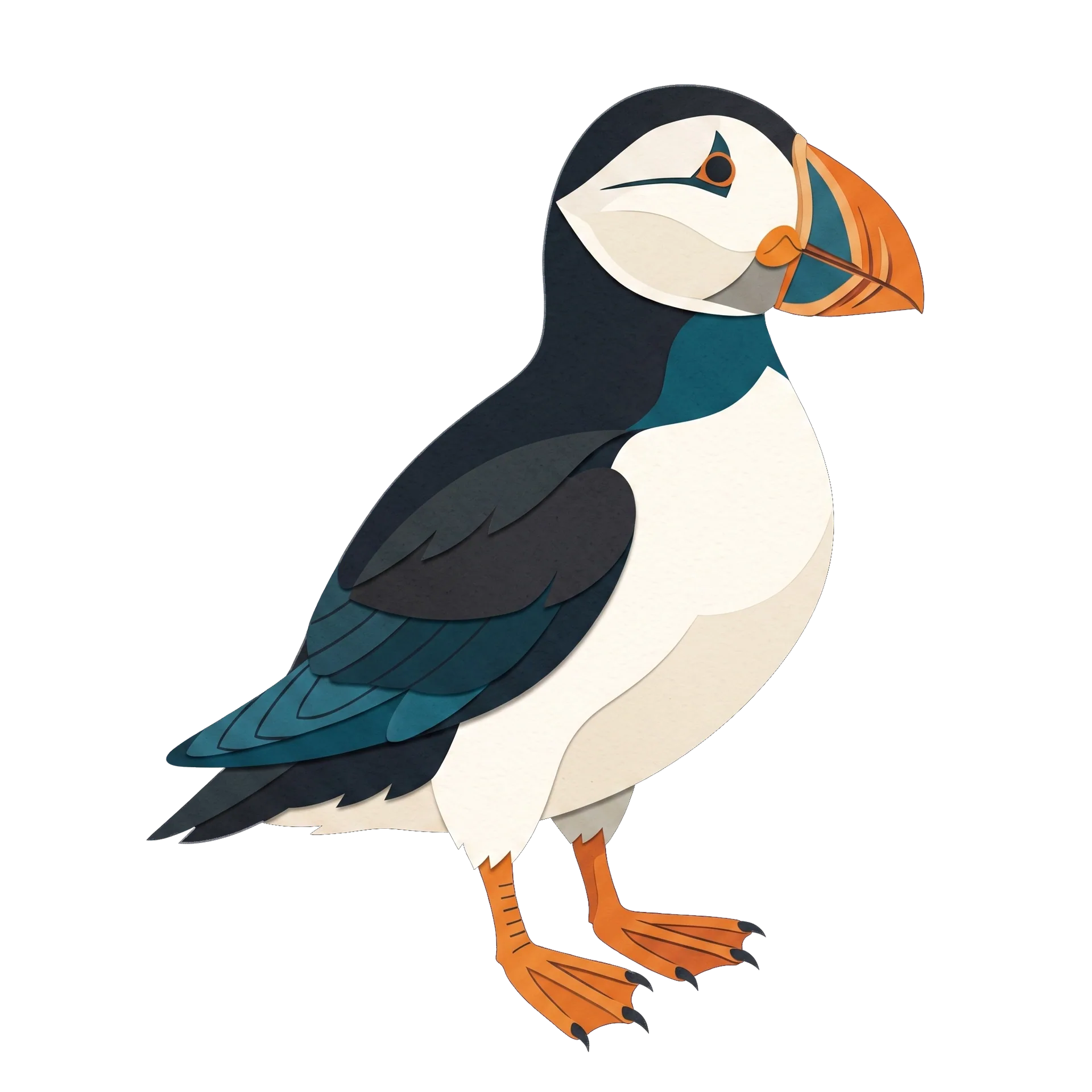
- A compact, football-shaped seabird: black above, white below, with a huge triangular bill banded in orange, yellow, and blue-gray in breeding season.
- The pale gray face with its sad-clown eye markings and the bright orange legs complete the look; no other North Atlantic seabird resembles it.
- In flight, puffins whir low over the waves on fast-beating small wings, looking like wound-up toys.
- Winter birds (rarely seen from shore) have a smaller, duller bill and dusky face — compare the Razorbill, which is larger with a deep all-dark bill.
- On breeding islands, look for them standing upright at burrow entrances on grassy clifftops.
Voice
Silent at sea; in the burrow, a low growling groan like a tiny chainsaw idling underground.
Lore
The puffin's very name has nothing to do with puffins. In Middle English, 'poffin' meant the fatty, salt-cured meat of young Manx Shearwaters, prized for the same reason as any nestling seabird: plump and easy to preserve. The name only drifted onto today's puffin later, borrowed for a burrow-nesting neighbor with the same habits.
Iceland and the Faroe Islands never stopped treating the bird as food. Icelandic hunters still work the cliffs with a háfur, a net on a pole long as a car, borrowed from Faroese fowlers roughly a century and a half ago; a good hunter watches for birds without fish in their bills, since a loaded beak means an active parent left alone. In the Faroes the equivalent tool is the fleygastong, worked from a stone seat built into the cliff edge, a technique documented since at least the 1600s. Iceland's Westman Islands turned the harvest into a party: Þjóðhátíð, running since 1874, still serves puffin as festival fare.
The bird has picked up a whole flock of nicknames along the way. British and Irish sailors called it the sea parrot, the clown of the sea, tomnoddy, coulterneb, bottlenose; in Shetland and Orkney it's the tammie norrie. Even its scientific name is a joke about its outfit: Fratercula is Medieval Latin for 'little friar,' a nod to the black-and-white plumage that looks, from a distance, like a monk's robes.
At a glance
- Family
- Alcidae (auks)
- Range
- North Atlantic — Iceland, Norway, the British Isles, and Maine
- Habitat
- Open ocean most of the year; grassy clifftop burrows to breed
- Diet
- Small fish — sand eels, herring, capelin — caught in underwater 'flight'
Where it lives
How big is it?
How is it doing?
Field notes
- A puffin can hold a whole row of fish crosswise in its bill — commonly around ten and far more recorded, thanks to backward-pointing spines on its palate and tongue that pin each fish while it grabs the next.
- The famous clown-colored bill is seasonal costume: the bright outer plates grow for breeding season and are shed afterward, leaving a smaller, duller winter bill few people ever see.
- Puffins spend most of their lives alone on the open ocean, coming ashore for just a few months to breed. Iceland hosts the majority of the world's population.
Go deeper
The daily email
Get tomorrow's bird in your inbox
One bird at 5:30am ET, every day. Free, no password, one-click unsubscribe — and your life list syncs across devices.
You're in. Your first bird arrives with the next morning email (5:30am ET) — and your life list now syncs.Your account →