At sparrow weight, the Downy Woodpecker hitches up bark like any proper woodpecker (stiff tail braced, feet in climbing position), but its lightness opens real estate no other North American woodpecker can use: weed stalks, corn stubble, the pencil-thin twigs of the outer canopy. In winter it will hammer open goldenrod galls for the fly larva inside, a food source few other birds bother with. That same season, look for a Downy tagging along in chickadee flocks, borrowing their many eyes for safety while it inspects the branches they skip.
Its most famous puzzle involves its double. The Hairy Woodpecker wears virtually the same plumage one size up, yet genetics show the two aren't close kin — one species seems to have evolved into an impersonation of the other, possibly to bluff its way past larger rivals. Telling them apart is the classic beginner's rite of passage: check the bill (stubby versus chisel-long), then the outer tail feathers (spotted on the Downy, clean white on the Hairy), and after a season it becomes automatic.
Like this? Get one bird every morning, by email.
You're in. Your first bird arrives with the next morning email (5:30am ET) — and your life list now syncs.Your account →
How to identify
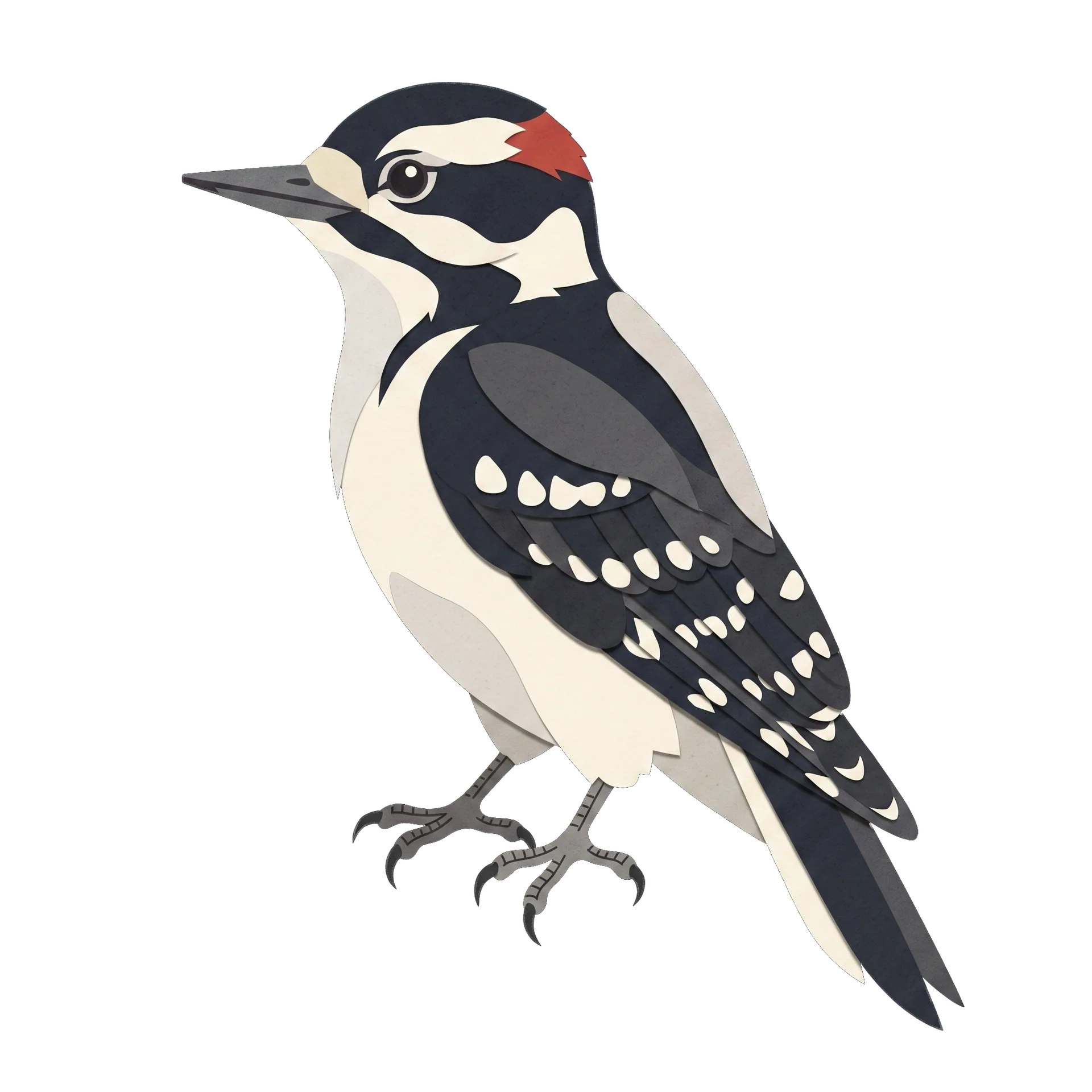
- North America's smallest woodpecker: checkered black-and-white back, white belly, bold striped face; males add a red patch on the back of the head.
- The stubby bill is the key mark: noticeably shorter than the head is deep, giving a snub-nosed profile.
- Its near-twin the Hairy Woodpecker is a size up with a bill nearly as long as its head; on the Downy, look also for black spots on the white outer tail feathers.
- Forages on twigs, weed stalks, and even goldenrod galls too slender to hold any other woodpecker.
- A regular member of winter chickadee-and-nuthatch flocks. Check those flocks for the one bird hitching up a trunk.
Voice
A sharp, friendly pik and a whinnying rattle that tumbles downhill in pitch; in late winter, its drumroll on a dead limb stands in for song.
Recording: William Whitehead, XC523177, xeno-canto.org (CC-BY-NC-SA 4.0)
At a glance
- Family
- Picidae (woodpeckers)
- Range
- North America, coast to coast, Alaska to Florida
- Habitat
- Open woods, orchards, parks, and suet feeders
- Diet
- Insects and larvae from bark, plus seeds and suet in winter
Where it lives
How big is it?
How is it doing?
Field notes
- Woodpeckers don't sing, so the Downy drums; each spring both sexes hammer out territory and courtship on the most resonant sound stage available, which is sometimes a rain gutter at 6 a.m.
- Downies and Hairy Woodpeckers look nearly identical but aren't close relatives; the resemblance appears to be evolutionary mimicry, and why one woodpecker would impersonate another is still being argued.
- Pairs divide the tree: males typically work the small upper branches and weed stems, females the trunks and larger limbs, a truce that keeps the household from competing with itself.
Go deeper
The daily email
Get tomorrow's bird in your inbox
One bird at 5:30am ET, every day. Free, no password, one-click unsubscribe — and your life list syncs across devices.
You're in. Your first bird arrives with the next morning email (5:30am ET) — and your life list now syncs.Your account →