The Shoebill hunts by refusing to exist. It stands in the papyrus, wings folded, utterly still (observers have clocked waits of an hour and more), above a pool it has chosen precisely because the water there is bad — so poor in oxygen that lungfish must rise to gulp air. When a snout finally breaks the surface, the statue detonates: the whole bird falls forward, wings out, and the great bill closes over fish, water, and vegetation together. What isn't fish gets sieved back out over the next minute with strange, deliberate patience.
Shoebills nest on floating mats of vegetation deep in some of Africa's least reachable swamps (the Sudd in South Sudan, Uganda's Lake Kyoga wetlands, Zambia's Bangweulu) and greet mates and researchers alike with volleys of wooden bill-clattering. Somewhere between 3,300 and 5,300 adults remain, thinned by wetland drainage and capture for the zoo and bird trade, which puts the species on the Vulnerable list and makes finding one, glaring at the middle distance in its swamp, a pilgrimage in its own right.
Like this? Get one bird every morning, by email.
You're in. Your first bird arrives with the next morning email (5:30am ET) — and your life list now syncs.Your account →
How to identify
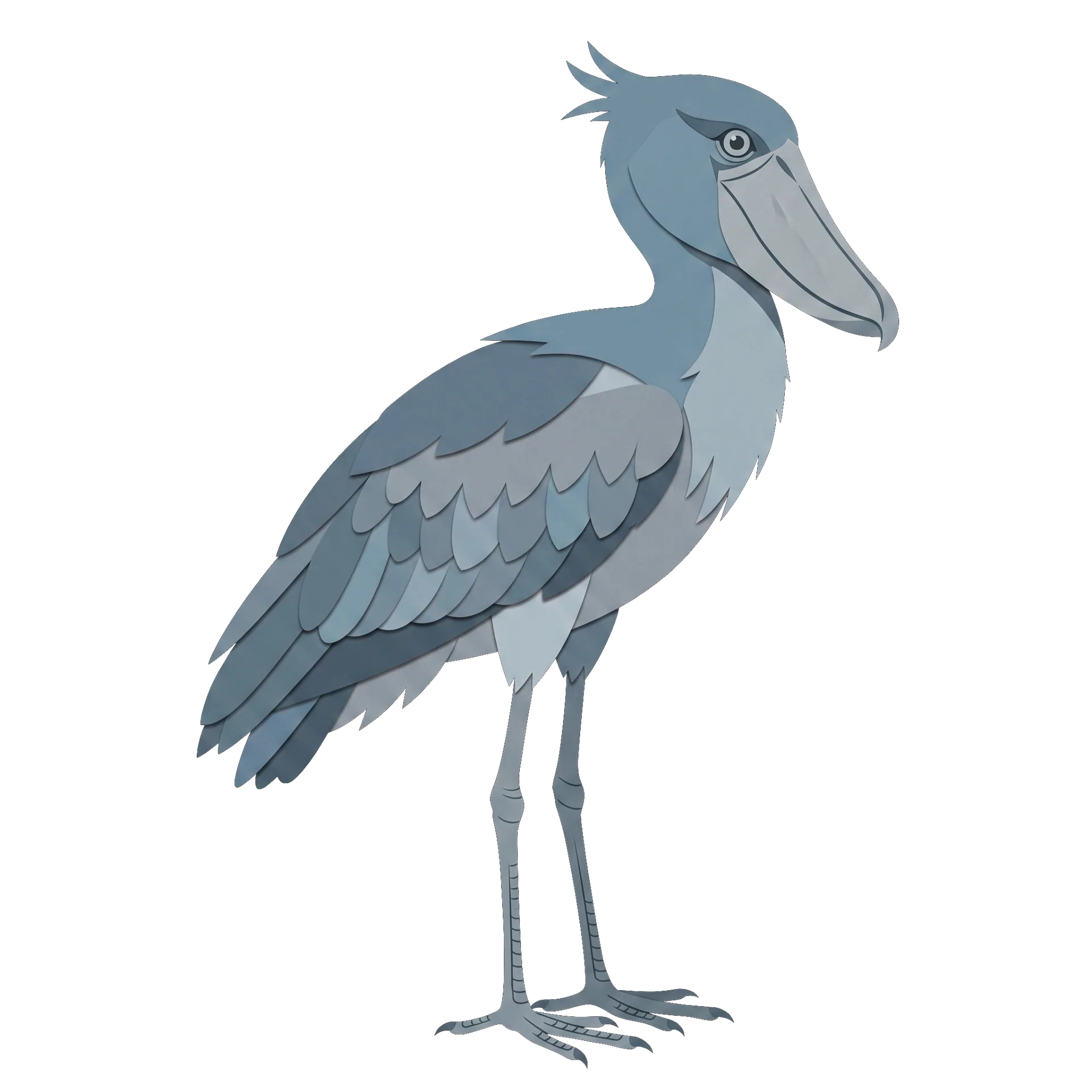
- Unmistakable: a meter-plus of slate-gray bird topped with an enormous, clog-shaped bill ending in a wicked hook.
- Stands motionless in swamp vegetation for long stretches. Scan patiently: a distant shoebill reads as a gray post until it moves.
- The pale eyes face forward beneath a heavy brow, giving it a fixed, faintly disapproving stare.
- In flight, huge broad wings and a retracted neck: more stork-silhouette than heron, and rarely seen for long.
Voice
Mostly silent. At the nest it delivers bursts of hollow, percussive bill-clattering that carry across the swamp.
Lore
Long before Western science had a name for it, people along the Nile already did. Sudanese Arabic calls the bird abu markub, 'father of the shoe,' after the immense, clog-shaped bill that also gives it its English name. European science caught up much later: the first skins reached London in 1849, brought home by traveler Mansfield Parkyns from the White Nile, and naturalist John Gould didn't formally describe the species until 1850, naming it Balaeniceps rex, 'king whale-head,' in a genus and family all its own.
Around Uganda's Mabamba Bay, fishers call the bird boolwe and have long treated a shoebill sighting before setting out as a bad omen for the day's catch. The belief tracks the biology: shoebills hunt lungfish in the same shallow, low-oxygen pools fishers work, and a shoebill's presence often means the fish have gone to ground. That competition, more than superstition alone, is one reason some fishers historically killed the birds on sight. Since Mabamba's designation as a Ramsar wetland in 2006, birdwatching tourism has flipped the incentive, and many of the same fishers now work as shoebill guides.
At a glance
- Family
- Balaenicipitidae (shoebill)
- Range
- Papyrus swamps of east-central Africa, South Sudan to Zambia
- Habitat
- Vast, undisturbed freshwater marshes with low-oxygen pools
- Diet
- Lungfish above all, plus catfish, eels, water snakes, and young crocodiles
Where it lives
How big is it?
How is it doing?
Field notes
- The bill runs up to 24 cm long, with razor edges and a hooked tip: capable of gripping a slippery lungfish, or decapitating one, in a single collapse strike.
- Shoebills exploit suffocating fish. They favor low-oxygen pools where lungfish must surface to breathe, then wait, motionless, for as long as it takes a snout to break water.
- It looks like a stork and long shared a field-guide page with them, but molecular work places the shoebill among the Pelecaniformes; its closest living relative appears to be the hamerkop, with pelicans next in line.
Go deeper
The daily email
Get tomorrow's bird in your inbox
One bird at 5:30am ET, every day. Free, no password, one-click unsubscribe — and your life list syncs across devices.
You're in. Your first bird arrives with the next morning email (5:30am ET) — and your life list now syncs.Your account →