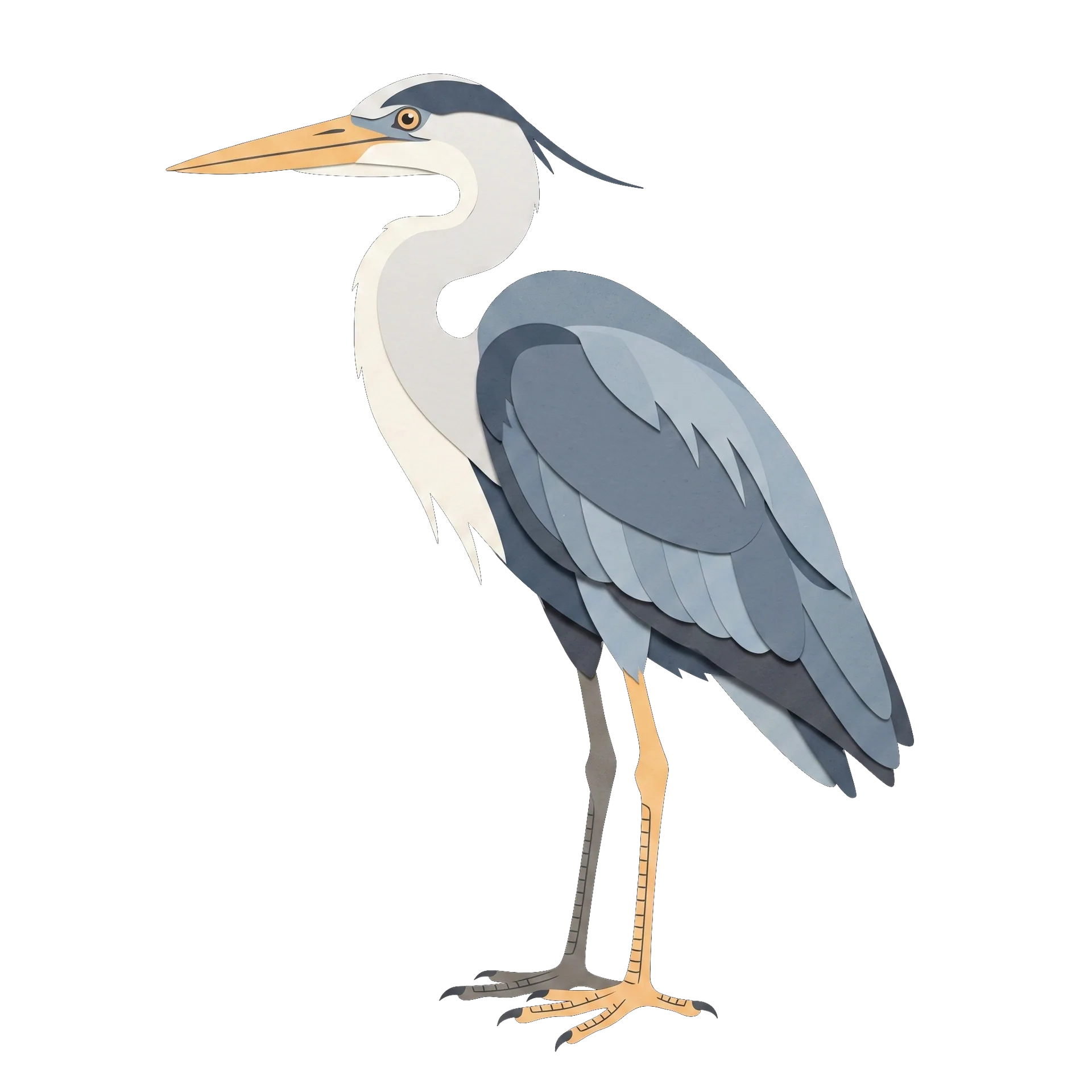
A Great Blue Heron hunting is a lesson in patience as a weapon. The bird stands motionless in the shallows, sometimes for many minutes with one yellow eye angled at the water, and then the folded neck releases and the head is simply somewhere else, underwater, gripping a fish. The strike is faster than you can properly watch. Stilt legs for silent wading, a neck that folds and fires, a dagger of a bill — each part serves that one moment.
For all that stillness, herons are travelers. At dusk they cross the sky with slow, deep wingbeats, neck tucked into a tight S and legs trailing, a silhouette so distinctive that birders identify them at a kilometer without lifting binoculars. They will hunt nearly anything wet: coastal tide pools, mountain trout streams, roadside ditches, and the pond behind the office park.
Spring packs them into treetop colonies: dozens or hundreds of pairs piling sticks into swaying nests, the air thick with croaks and bill-clatter. Stumbling on a rookery, usually in a stand of drowned timber, feels like finding a seabird colony misplaced fifty miles inland.
Like this? Get one bird every morning, by email.
You're in. Your first bird arrives with the next morning email (5:30am ET) — and your life list now syncs.Your account →
How to identify
- Enormous for a wading bird (over a meter tall), gray-blue overall, standing statue-still in shallow water or stalking in slow motion.
- Adults show a mostly white face and crown with a black stripe trailing into wispy head plumes, and a heavy yellowish dagger of a bill.
- In flight the neck folds back into a tight S while the legs trail straight behind — cranes and geese fly with necks extended, herons don't.
- Wingbeats are slow, deep, and unhurried; the silhouette reads as prehistoric from a great distance.
Voice
A deep, prehistoric croak — frahnk — usually delivered in annoyance as the bird lifts off, sounding like something left over from the age of pterosaurs.
Lore
The genus turns up in one of Europe's best-known fables. In La Fontaine's 'Le Héron' (1678), a heron stalks a river all day, rejecting one fish after another as beneath its standards, and ends the day humbled, eating a snail. La Fontaine's bird is the grey heron of the Old World, Ardea herodias's closest continental cousin, but the joke rests on the same stillness this heron is known for: all the patience and pickiness in the world, until the light runs out.
Closer to home, the Menominee of what's now Wisconsin count the heron among the totems of their Crane clan: Shakshak'eu, 'Great Heron,' alongside Crane, Old-Squaw Duck, and Coot, as ethnographer Walter James Hoffman recorded in his 1896 survey of Menominee kinship structure. It's a quieter honor than the eagle or bear crests get, but a fitting one for a bird whose whole hunting style is standing still long enough to be trusted.
At a glance
- Family
- Ardeidae (herons)
- Range
- North & Central America, the Caribbean, and the Galápagos
- Habitat
- Marshes, riverbanks, lake shores, and tidal flats
- Diet
- Fish above all, plus frogs, snakes, and unlucky voles at the water's edge
Where it lives
How big is it?
How is it doing?
Field notes
- The heron's lightning strike is built into its skeleton: specially shaped neck vertebrae let it fold the neck into an S and release it like a loaded spring.
- They nest in treetop colonies called rookeries: sometimes hundreds of bulky stick nests in a single stand of dead trees, one of North America's great hidden spectacles.
- Despite standing over a meter tall, a Great Blue Heron weighs about as much as a house cat's smaller cousin (roughly 2.5 kg), thanks to hollow bones and a great deal of feather.
Go deeper
The daily email
Get tomorrow's bird in your inbox
One bird at 5:30am ET, every day. Free, no password, one-click unsubscribe — and your life list syncs across devices.
You're in. Your first bird arrives with the next morning email (5:30am ET) — and your life list now syncs.Your account →