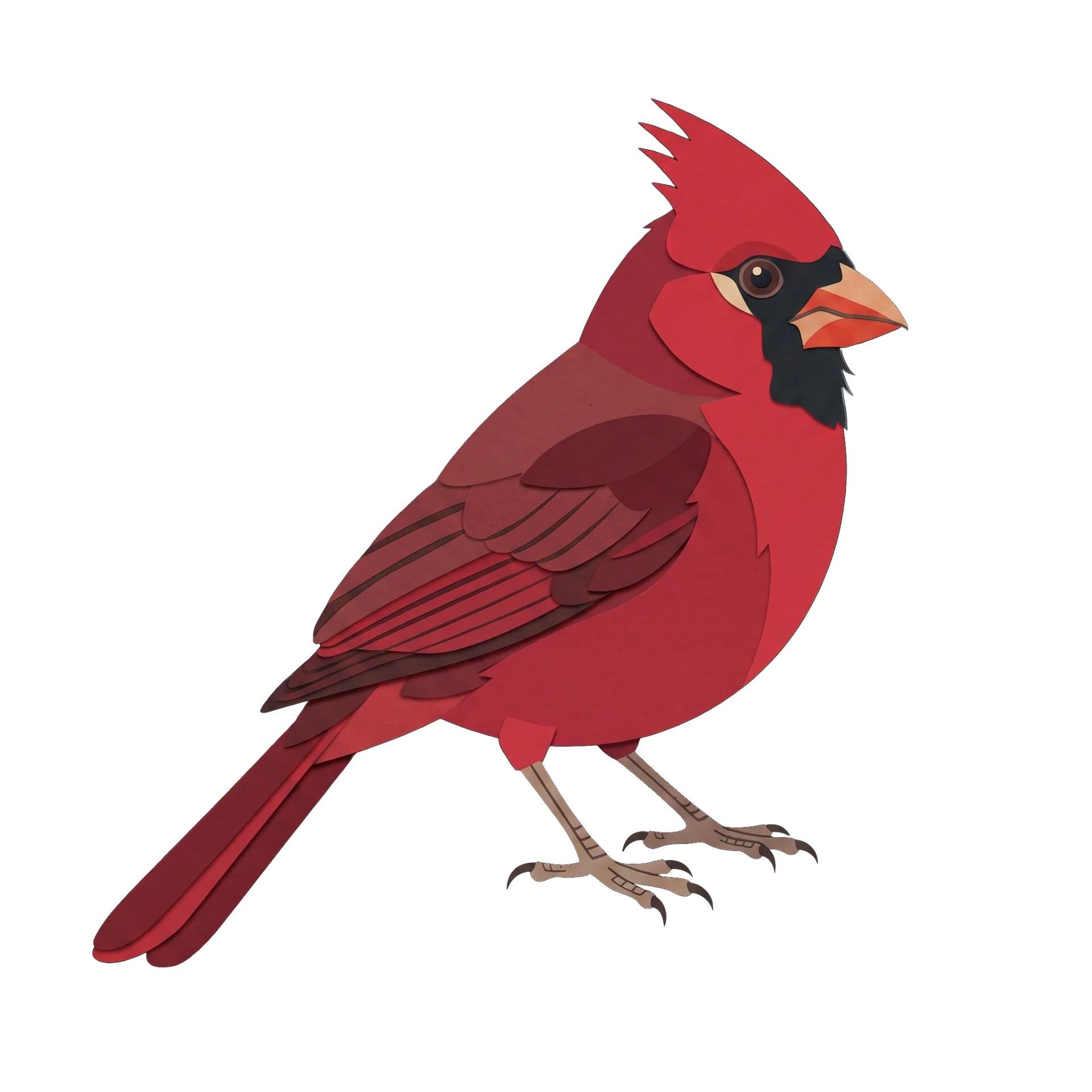
A male Northern Cardinal against snow needs no introduction: crest raised, black mask set off against a red so saturated it looks lit from inside. The female is the subtler masterpiece: warm buff and olive washed with red at the wings and crest, carrying the same jaunty silhouette. Cardinals were so admired that seven U.S. states chose them as their state bird, more than any other species.
Cardinals are devoted homebodies. They don't migrate; the pair that owns your hedge in January is the same pair that will nest in it come May, and mated birds reinforce the bond by feeding each other seeds bill-to-bill. Listen closely in early spring and you may hear something uncommon: the female singing back to the male, matching his phrases from deep in the shrubbery, a two-part conversation about territory and trust.
Their fierce attachment to home has a comic side. Every spring, cardinals across the country declare war on car mirrors and ground-floor windows, battling a rival that will not back down, because it's their own reflection. It's maddening if it's your mirror, but hard not to admire the commitment.
Like this? Get one bird every morning, by email.
You're in. Your first bird arrives with the next morning email (5:30am ET) — and your life list now syncs.Your account →
How to identify
- Both sexes wear the tall pointed crest and a heavy, cone-shaped orange-red bill — the crest alone separates cardinals from almost everything else at a feeder.
- Male: brilliant red all over with a black mask and chin. Female: warm buff-brown with red washing through the crest, wings, and tail.
- A bird of edges and thickets, usually seen low, hopping under shrubs or making short flights, rarely out in open sky.
- Listen for the sharp, metallic *chip* call from cover; it often announces a cardinal before you see any red.
Voice
Loud, liquid whistles — cheer cheer cheer, birdy birdy birdy — plus a sharp metallic chip. Both sexes sing, which is rarer than you'd think.
Lore
The cardinal's color has its own origin story. In one Cherokee account recorded by ethnographer James Mooney in 1900, a wolf is blinded by a raccoon's trick, and a small brown bird agrees to peck the mess from his eyes in exchange for a favor: the wolf leads it to a rock veined with red pigment, and the bird paints itself, 'and has ever since been a redbird.' The Cherokee also tied the bird to the sun itself: in another of Mooney's stories, a redbird flies free from a box meant to carry the sun's daughter home from the land of the dead.
The bird's English name runs the opposite direction from how people usually assume. English naturalists in the 1600s weren't naming the churchmen after the bird; they were naming the bird after the churchmen, for the same scarlet that Roman Catholic cardinals wear (Latin cardinalis, 'pivotal, principal'). The color stuck as an identity in more literal ways, too: Kentucky adopted the cardinal as its state bird in 1926, and six more states in its range followed within twenty-four years, giving it more state-bird titles than any other species in the country.
At a glance
- Family
- Cardinalidae (cardinals & allies)
- Range
- Eastern & central North America, south through Mexico
- Habitat
- Woodland edges, thickets, and backyards with dense shrubs
- Diet
- Seeds and fruit cracked in that heavy orange bill; insects for the nestlings
Where it lives
How big is it?
How is it doing?
Field notes
- Female cardinals sing, often from the nest and sometimes in duet with their mates — a rarity among northern songbirds.
- Cardinals never go drab. Many songbirds molt into camouflage for winter, but a male cardinal in a snowstorm is the same electric red as in June.
- The red comes from carotenoid pigments in their food. A cardinal on a poor diet literally fades. Rare individuals with a genetic quirk turn sunflower-yellow instead.
Go deeper
The daily email
Get tomorrow's bird in your inbox
One bird at 5:30am ET, every day. Free, no password, one-click unsubscribe — and your life list syncs across devices.
You're in. Your first bird arrives with the next morning email (5:30am ET) — and your life list now syncs.Your account →