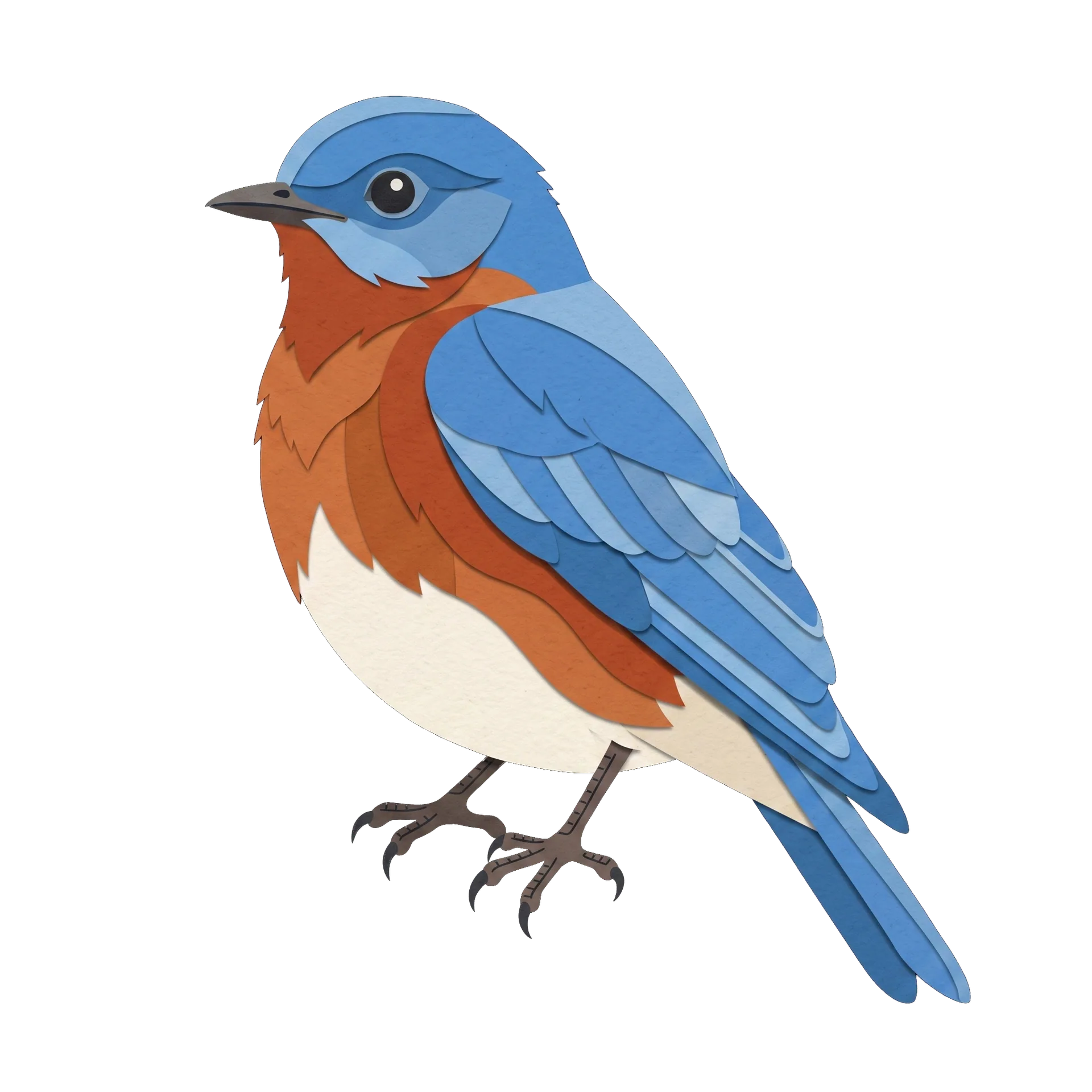
An Eastern Bluebird on a fence wire looks almost too saturated to be real: royal blue above, rust at the throat, arranged with the tidy geometry of a hand-painted toy. Thoreau wrote that the bluebird 'carries the sky on his back,' and the physics agrees with the poetry — the blue isn't pigment at all, but light itself, scattered by the microscopic structure of the feather.
Bluebirds are sit-and-wait hunters of open ground. One will perch low on a wire or post, drop suddenly into the grass, and flutter back up with a cricket, repeating the cycle across a meadow all afternoon. They are cavity nesters that cannot dig their own cavities, which nearly became their undoing: introduced starlings and house sparrows evicted them from tree hollows across the East, and by the mid-1900s bluebird numbers had fallen alarmingly.
What saved them was ordinary people with lumber. Volunteer-built nest-box trails, thousands of boxes on fence lines across the continent, gave bluebirds back their real estate, and populations have climbed steadily ever since: one of the few conservation graphs that bends the right way because of birdhouses.
Like this? Get one bird every morning, by email.
You're in. Your first bird arrives with the next morning email (5:30am ET) — and your life list now syncs.Your account →
How to identify
- A small, plump, short-tailed songbird that sits upright on wires, posts, and low branches over open grass.
- Male: vivid royal blue above with a rusty-orange throat and breast and a clean white belly. Female: gray-buff with a subdued orange breast wash and blue tinges in the wings and tail.
- Watch the hunting rhythm — perch, drop to the ground for an insect, flutter back up. That low-perch pounce over open grass is the bluebird's signature move.
- Don't confuse with the Indigo Bunting (blue all the way to the belly, no orange) or the larger, crested Blue Jay.
Voice
A soft, musical tu-a-wee — a low, liquid warble that carries gently across a meadow rather than cutting through it.
Lore
The bluebird has stood for happiness since long before anyone in North America pinned that idea to this particular species. Maurice Maeterlinck's 1908 play 'The Blue Bird' sent two children searching the world over for a blue bird that turns out to be waiting at home all along; it's an allegory, and Maeterlinck never specifies which bird he means. The phrase outlived the play: in 1934 composer Sandor Harmati and lyricist Edward Heyman set it to music, and tenor Jan Peerce's 1945 recording of 'Bluebird of Happiness' became one of the best-selling records of his career. None of that is really about Sialia sialis: it's Belgian stagecraft and Tin Pan Alley, but it's how an ordinary thrush became American shorthand for good news.
Field naturalists had already noticed something true about the bird, no metaphor required. Ohio naturalist Milton Trautman recorded that sportsmen around Buckeye Lake called a certain kind of afternoon 'bluebird weather': the calm, warm spell of Indian summer in late October, after the first frost, when bluebirds were at their most conspicuous, out foraging in the open before winter closed in. It's a small, working phrase, the kind that turns up in field notes rather than dictionaries: if the bluebirds are out, so should you be.
At a glance
- Family
- Turdidae (thrushes)
- Range
- Eastern North America to Nicaragua
- Habitat
- Open meadows, orchards, and field edges with scattered perches
- Diet
- Insects snatched from the ground; berries and fruit in winter
Where it lives
How big is it?
How is it doing?
Field notes
- There is no blue pigment in a bluebird. The color is structural: microscopic air pockets in the feathers scatter light the way the sky does. Grind the feather up and the blue disappears.
- Bluebirds hunt by sight from low perches and can spot an insect moving in the grass from over 15 meters away.
- Their comeback is one of conservation's best volunteer stories: after nest sites were lost to starlings and house sparrows, thousands of people built 'bluebird trails' of nest boxes, and it worked.
Go deeper
The daily email
Get tomorrow's bird in your inbox
One bird at 5:30am ET, every day. Free, no password, one-click unsubscribe — and your life list syncs across devices.
You're in. Your first bird arrives with the next morning email (5:30am ET) — and your life list now syncs.Your account →