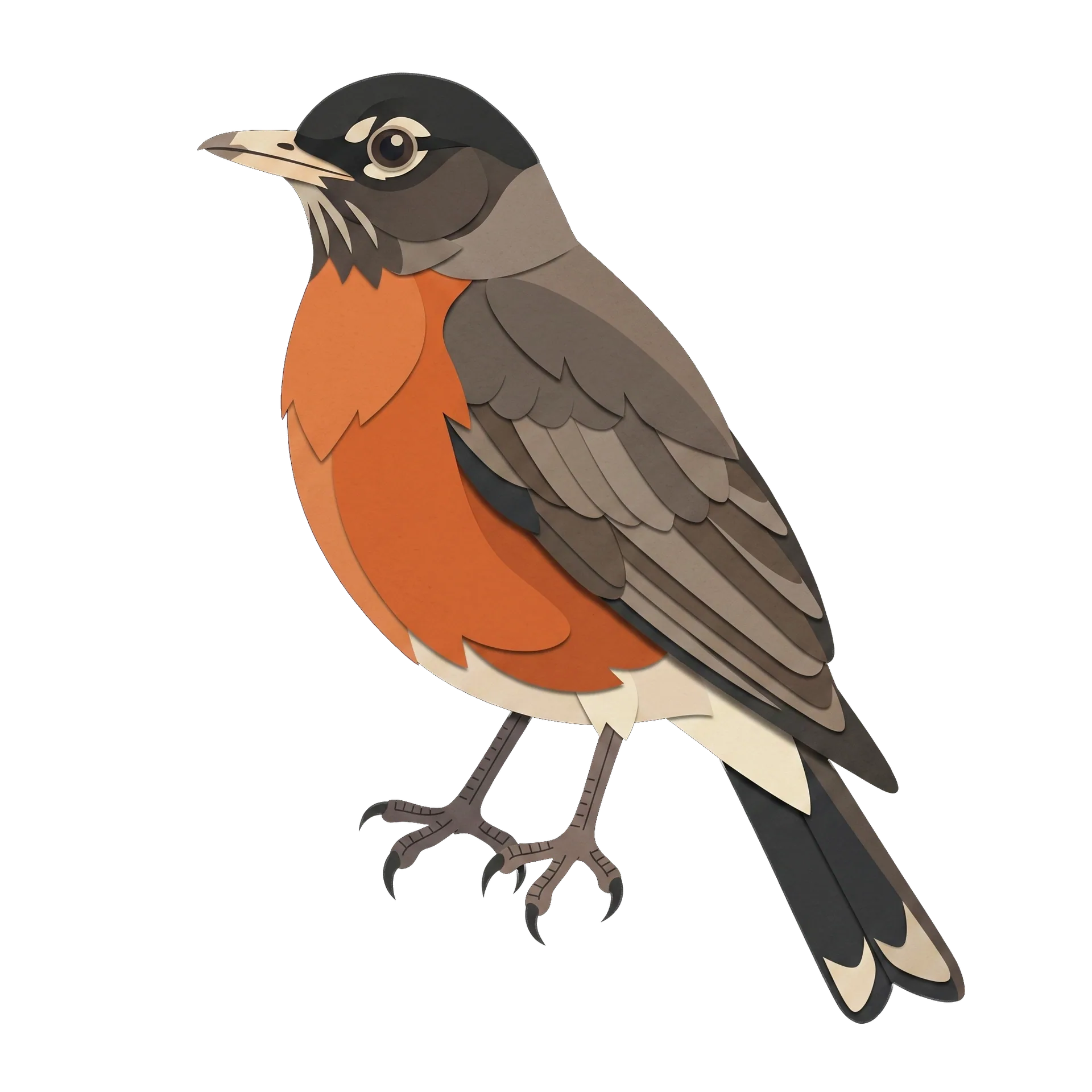
The American Robin may be the most familiar bird on the continent, which makes it the easiest to stop seeing. Look again: that head-cocked run-and-freeze across the lawn is a precision hunting technique, the bird locating earthworms mostly by sight before the quick stab and the comedy tug-of-war. And that early-morning song, among the first voices in the dawn chorus and often beginning in full dark, is one of the most complex and beautiful carols in the yard, hiding in plain earshot.
Most people only ever meet half this bird. The lawn bird of spring and summer becomes, in winter, a wild nomad: robins abandon territories, form huge roving flocks, and follow fruit (juniper, holly, crabapple) across the landscape, sometimes gathering in roosts of staggering size. The 'first robin of spring' usually never left; it just spent the cold months in the treetops instead of on your grass.
Even its errors are endearing. Toward winter's end, berries that have fermented on the branch through months of freeze and thaw turn some flocks conspicuously unsteady: tipsy robins are a documented phenomenon, and a good reminder that the suburban bird you've known since childhood is wilder than it looks.
Like this? Get one bird every morning, by email.
You're in. Your first bird arrives with the next morning email (5:30am ET) — and your life list now syncs.Your account →
How to identify
- A large, upright songbird with a gray-brown back and brick-orange breast, patrolling lawns in a distinctive run-stop-tilt rhythm.
- Dark head with broken white arcs around the eye and a yellow bill; males are darker-headed and richer orange than females.
- In flight, watch for the white lower belly and white tail corners.
- Juveniles in summer are heavily spotted below — still recognizably robins by shape and posture.
- The 'robin-shaped bird' is the reference point half of field identification is built on; learn its proportions and you can size every other songbird against it.
Voice
A rich, rolling carol — cheerily, cheer-up, cheerio — often the very first birdsong of the day, starting well before dawn.
Recording: Richard E. Webster, XC825254, xeno-canto.org (CC-BY-NC-SA 4.0)
Lore
The robin has a documented origin story in Ojibwe tradition: 'Iadilla,' recorded in the 1830s by Jane Johnston Schoolcraft (Bamewawagezhikaquay, granddaughter of an Ojibwe chief) with her husband Henry Rowe Schoolcraft, published in his 1839 Algic Researches and later retold in Cornelius Mathews's The Indian Fairy Book (1869). A father pushes his son Iadilla into a twelve-day fast for a guardian spirit, chasing more renown than the boy ever wanted. On the final morning he finds the boy has painted his own chest red with vermilion; before he can stop him, Iadilla springs to the lodge's rooftop pole as a robin, promising to nest near people's homes and open every morning with a song.
Folklorist Fanny D. Bergen recorded a stranger spring rite in her 1896 Current Superstitions: on hearing the year's first robin, in Mount Desert, Maine, and on Prince Edward Island, you pulled off your left shoe and stocking, turned the stocking inside out, and searched the heel for a stray hair, its color meant to match your future spouse's. Emily Dickinson's 1862 poem 'I dreaded that first Robin, so' seems to draw on that same folk expectation, that the year's first robin promises something good, setting it against a grief that refuses to join in.
At a glance
- Family
- Turdidae (thrushes)
- Range
- Throughout North America, from tundra edge to Mexico
- Habitat
- Lawns, parks, forests — anywhere with worms below and fruit above
- Diet
- Earthworms and insects by day, wild fruit by season
Where it lives
How big is it?
How is it doing?
Field notes
- The American Robin isn't a robin. Homesick European colonists named it after the (unrelated) orange-breasted robin back home; ours is actually a thrush, cousin to bluebirds.
- Robins switch diets by the clock: earthworms in the morning when lawns are damp, fruit later in the day. In late winter, when freeze-thaw cycles ferment the leftover berries, they sometimes get visibly tipsy.
- In winter, robins vanish from lawns not because they've left, but because they've gone social, gathering in nomadic fruit-eating flocks and roosts that can number in the hundreds of thousands.
Go deeper
The daily email
Get tomorrow's bird in your inbox
One bird at 5:30am ET, every day. Free, no password, one-click unsubscribe — and your life list syncs across devices.
You're in. Your first bird arrives with the next morning email (5:30am ET) — and your life list now syncs.Your account →