A British robin at a gardener's shoulder the moment a spade breaks the soil is running a routine older than gardens. Biologists think the habit traces back to birds that once followed wild boar through the forest, snatching worms and grubs the boar's rooting turned up; boar vanished from Britain centuries ago, and gardeners simply inherited the role. Robins on the European mainland, where boar are still common, never made that switch to the same degree, and tend to stay markedly warier of people than their British relatives.
The song carries an unusual amount of the year's weight. Both sexes sing, which is rare enough among songbirds, and both hold individual territories through the winter rather than only during the breeding season — meaning a robin's warble can be heard from a garden hedge in the depths of a European winter, when almost everything else has gone quiet.
None of that biology explains why the bird ended up on a century of Christmas cards, which has more to do with Victorian postmen: their red-breasted uniforms earned them the nickname 'robins,' and the association between the postman, the season, and the bird's own red breast stuck hard enough that the two are now inseparable in British popular imagination.
Like this? Get one bird every morning, by email.
You're in. Your first bird arrives with the next morning email (5:30am ET) — and your life list now syncs.Your account →
How to identify
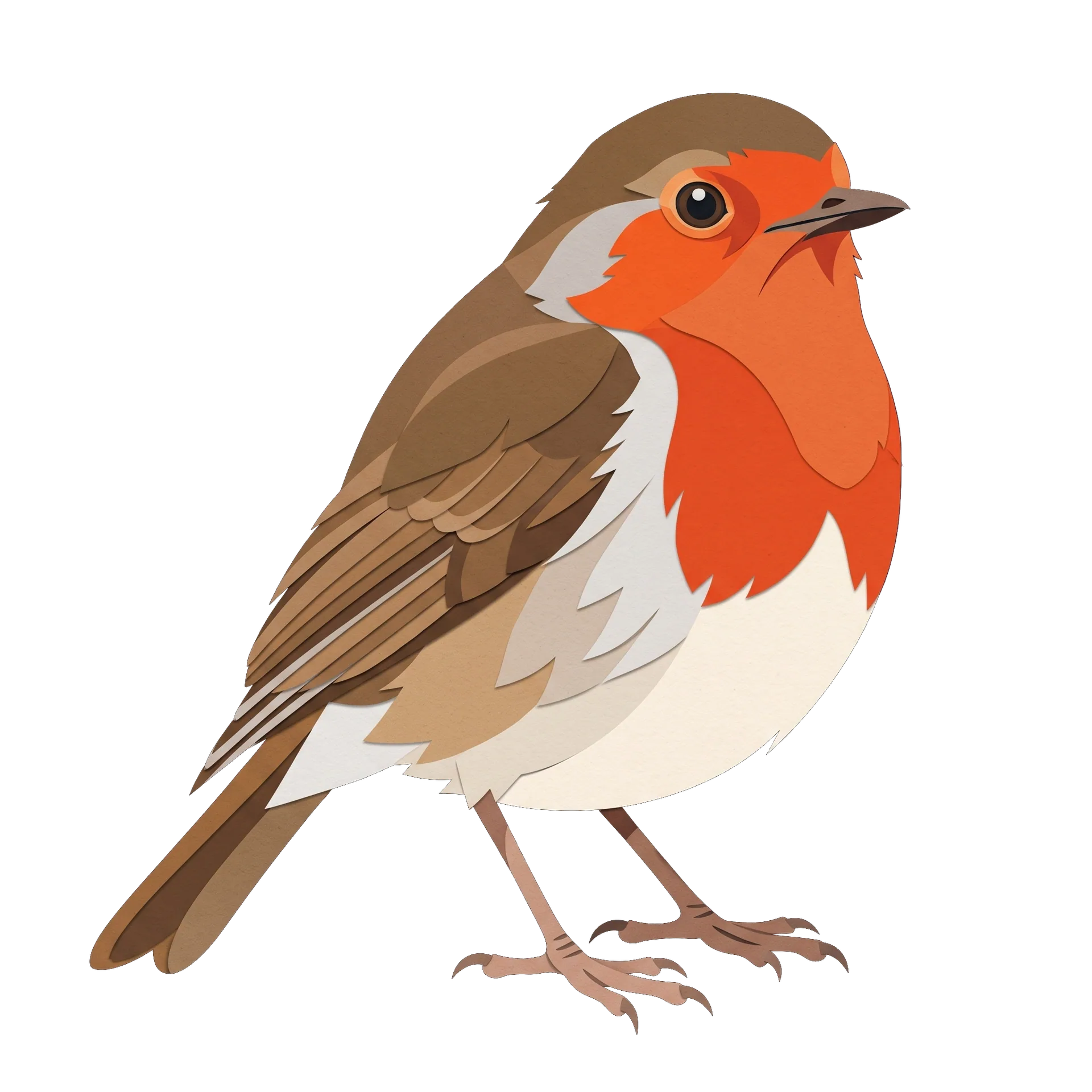
- A small, round songbird — olive-brown above with a bright orange-red face and breast bordered by blue-gray.
- Large dark eyes and an upright, alert stance; the tail flicks frequently.
- Famously bold around people, often hopping close to a gardener turning soil to snatch disturbed worms and insects.
- Both sexes look alike and both sing, unlike many songbirds where only the male performs.
Voice
A sweet, wistful, warbling song, delivered in short phrases and heard nearly year-round, including in winter.
Recording: Noé Ferrari, XC995598, xeno-canto.org (CC-BY 4.0)
Lore
The robin's red breast has its own origin story in British and Irish Christian folklore, though the tellings vary. In one version, a robin plucked a thorn from Christ's brow on the way to the crucifixion and was marked by a fallen drop of his blood; in another, the robin singed its breast fanning a fire to keep the infant Jesus warm in the stable. Either way, the color was read as a badge of kindness shown to Christ, and it hardened into a real taboo: British and Irish tradition held that a robin was a friend of the house never to be harmed, and the nineteenth-century folklorist Jacob Grimm recorded a related German belief that disturbing a robin's nest would bring a lightning strike. William Blake made the taboo literary in 1803, opening 'Auguries of Innocence' with the image of a caged robin provoking heaven's own anger.
At a glance
- Family
- Muscicapidae (Old World flycatchers)
- Range
- Europe, western Asia, and North Africa
- Habitat
- Gardens, hedgerows, and woodland edges
- Diet
- Insects, worms, berries, and seeds
Where it lives
How big is it?
How is it doing?
Field notes
- Both sexes hold and defend individual winter territories with song — an unusual arrangement, since in most songbirds only males sing and territorial defense mostly ends after the breeding season.
- In Britain, where wild boar were hunted to extinction centuries ago, robins are famously tame; naturalists think that tameness traces to a habit of following boar through the forest to snatch up invertebrates their rooting turned up, a behavior redirected toward gardeners once the boar were gone. Continental European robins, sharing forests with boar populations that remain common today, tend to stay noticeably warier of people.
- The robin's association with the British Christmas card, an image dating to Victorian postmen who wore red-breasted uniforms nicknamed 'robins,' has nothing to do with the bird's actual biology, but it's cemented the species as one of Europe's most universally recognized.
Go deeper
The daily email
Get tomorrow's bird in your inbox
One bird at 5:30am ET, every day. Free, no password, one-click unsubscribe — and your life list syncs across devices.
You're in. Your first bird arrives with the next morning email (5:30am ET) — and your life list now syncs.Your account →