A Great Horned Owl's hoot carries a strange kind of authority for a bird most people never see. It nests earlier than almost anything else in the North American woods, often sitting on eggs in a borrowed hawk or crow nest while snow is still on the ground, a head start that matters because owlets stay dependent on their parents for months, well into fall, and need the extra runway to be ready for the following winter. The parents defend that investment fiercely, and reports of great horned owls striking people who wander too close to a nest are common enough to take seriously.
Few animals are safe from one. Great Horned Owls take prey from mice up through full-grown skunks, herons, and other raptors nearly their own size, including, on occasion, smaller owls. The skunk-hunting habit in particular sets them apart from nearly every other predator, which tend to learn fast to leave skunks alone.
The kill itself is silent. The leading edge of each flight feather is fringed with comb-like serrations that break turbulent air into smaller, quieter eddies, letting the owl close in on prey without the whoosh of ordinary wingbeats. Aircraft and wind-turbine engineers have studied the same feather structure looking for a way to build quieter blades.
Like this? Get one bird every morning, by email.
You're in. Your first bird arrives with the next morning email (5:30am ET) — and your life list now syncs.Your account →
How to identify
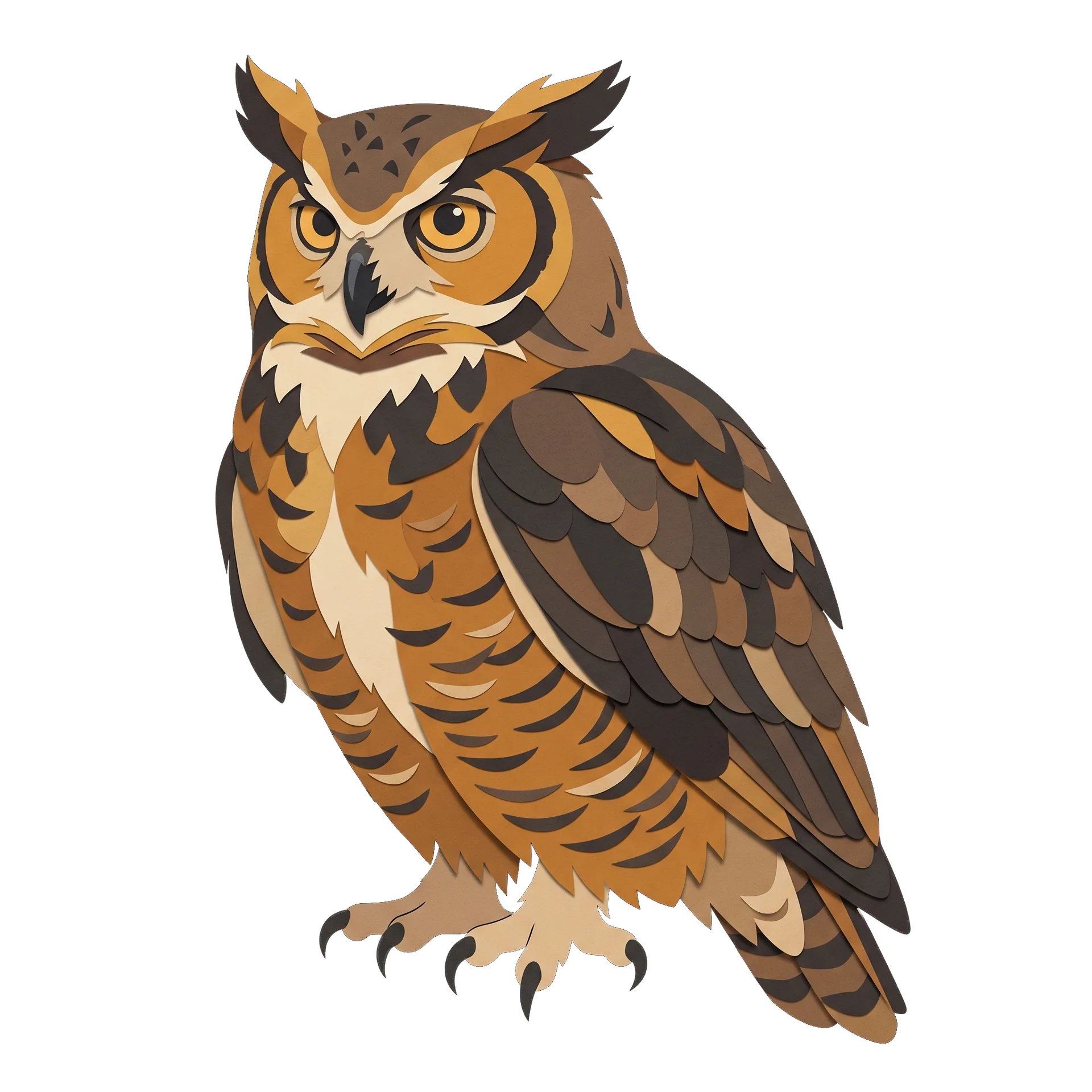
- A big, thick-bodied owl with prominent feathered ear tufts ('horns') and piercing yellow eyes set in a tawny facial disc.
- Mottled gray-brown overall with a white throat patch, visible even in poor light.
- Flies in near-total silence on broad rounded wings, thanks to soft, fringed feather edges that break up turbulence.
- One of the earliest nesters in North America, often taking over an old hawk or crow nest by midwinter.
Voice
A deep, rhythmic series of hoots — hoo, h'HOO, hoo-hoo — often traded back and forth between a pair at dusk.
Lore
In Hopi tradition, the great horned owl appears as Mongwu, one of the katsinam who take physical form at ceremony when dancers carry their masks and regalia. Mongwu's job is discipline. At the Powamuya, or Bean Dance, when the Koshari clown kachinas get too rowdy, mocking onlookers and breaking the day's usual rules for laughs, Mongwu steps in, carrying a yucca whip or a bow and arrows, and puts a stop to it. He plays the role completely straight; the Koshari's comedy depends on having someone in the plaza who refuses to find any of it funny.
At a glance
- Family
- Strigidae (typical owls)
- Range
- Throughout the Americas, from the subarctic to South America
- Habitat
- Nearly everywhere with trees or cliffs: forests, deserts, swamps, and city parks
- Diet
- Varied: rabbits, rodents, and birds up to the size of ospreys and other owls, occasionally skunks
Where it lives
How big is it?
How is it doing?
Field notes
- It's one of the only predators that regularly kills skunks, apparently undeterred by a sense of smell most other animals go out of their way to avoid provoking.
- Silent flight comes from comb-like serrations on the leading edge of the wing feathers that break up airflow noise, a design engineers have studied for quieter wind turbines and fans.
- Pairs start nesting as early as December or January in much of their range, incubating through snow and cold long before most other birds have returned.
Go deeper
The daily email
Get tomorrow's bird in your inbox
One bird at 5:30am ET, every day. Free, no password, one-click unsubscribe — and your life list syncs across devices.
You're in. Your first bird arrives with the next morning email (5:30am ET) — and your life list now syncs.Your account →