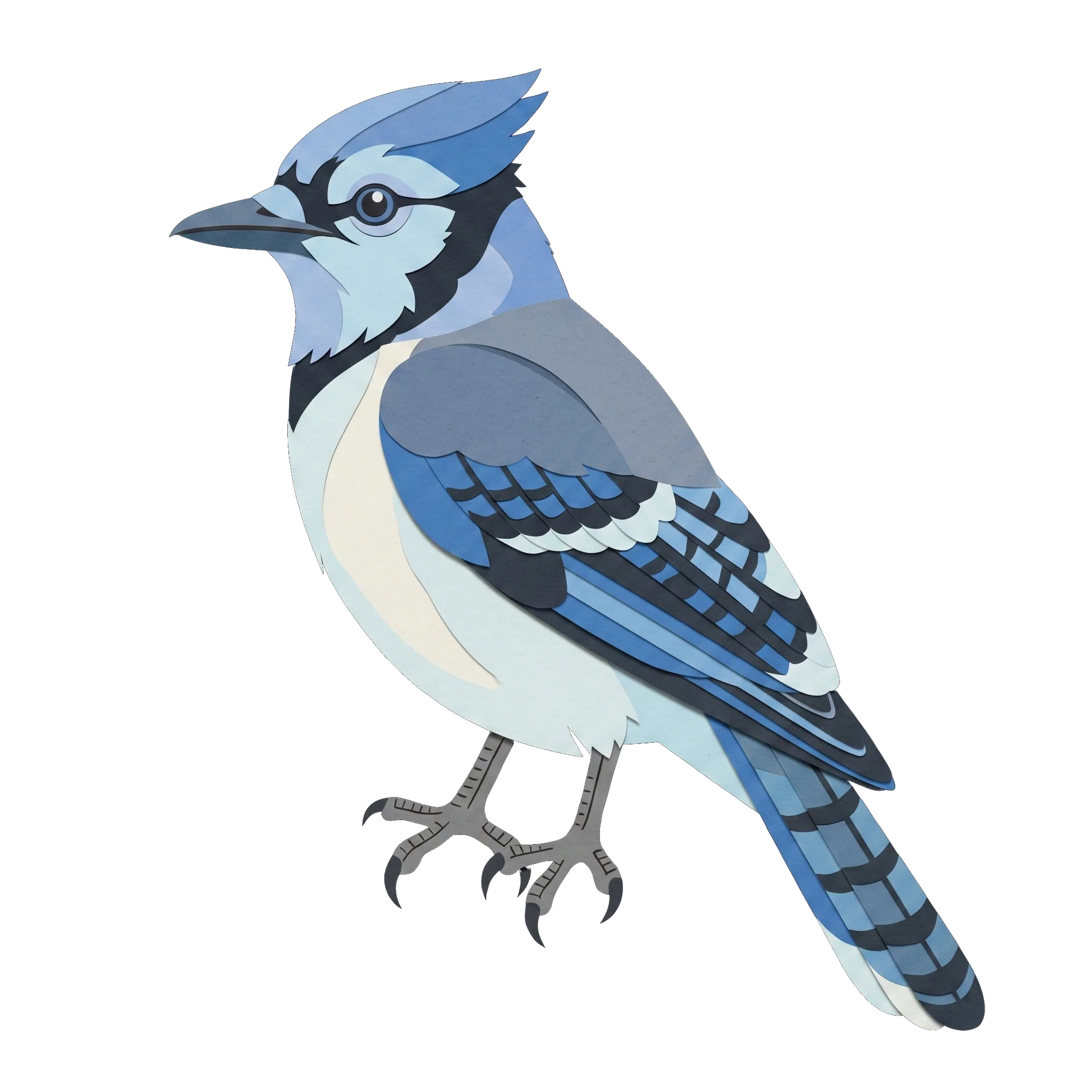
Here is a corvid (kin to crows and ravens, one of the sharpest bird families on Earth) dressed in crested blue lace, screaming like a hawk, and quietly running one of the continent's great reforestation programs out of its throat pouch. A single jay may cache thousands of acorns in a fall, hammering each into soil or leaf litter, and the ones it never reclaims grow into oaks. Ecologists credit jays with moving oak forests northward at the end of the last ice age faster than acorns could ever have rolled.
The voice is the giveaway that something clever is going on. Beyond the familiar jeer, jays produce gurgles, rattles, whisper-songs, and uncanny imitations of Red-shouldered and Red-tailed Hawks, sometimes, it seems, simply to clear the feeder before landing. In the woods, birders learn to treat jay racket as a broadcast service: they mob and announce owls, hawks, and snakes long before a human would spot them.
Their migration might be the best mystery in a backyard bird. Thousands of jays stream along the Great Lakes shorelines each fall, yet most jays stay home all winter, and a bird that migrated last year may not bother this year. Decades of banding data have produced no tidy rule.
Like this? Get one bird every morning, by email.
You're in. Your first bird arrives with the next morning email (5:30am ET) — and your life list now syncs.Your account →
How to identify
- A big, crested, loud songbird: blue above, whitish-gray below, with a black necklace across the throat.
- White wing-bars and white tail corners flash in flight; the black barring across wings and tail reads like lace up close.
- The crest is a mood ring: raised when agitated, flattened when relaxed.
- Travels in bold, noisy family groups; persistent jay racket from one tree is worth investigating, since they gang up loudly on hawks and owls.
- Steller's Jay, its darker crested cousin, replaces it in the mountain West. Overlap is narrow.
Voice
A harsh, far-carrying jeer, a musical pump-handle squeak, and dead-on impressions of hawks; no other backyard voice covers as much ground.
Recording: Stanislas Wroza, XC1012555, xeno-canto.org (CC-BY-NC-SA 4.0)
Lore
Southern Black folklore gave the Blue Jay two very different reputations. Folklorist Ernest Ingersoll, in his 1923 Birds in Legend, Fable and Folklore, recorded a creation story in which the jay built solid ground: when the world was still all water, it carried down the first grains of dirt and made the earth out of them. Far more widespread was the opposite story, that the jay had switched sides to work for the devil. Versions collected across the plantation South held that jays vanished every Friday, sent to haul kindling, or in other tellings sand to smother the flames, for hell's fires, and came back Saturday looking and sounding unmistakably relieved.
The belief held on long enough to turn up in verse and travel far from where it started. Thomas W. Talley's 1922 collection Negro Folk Rhymes preserves a jaybird dance song built entirely around the Friday errand: a hunter's gun misfires twice, the bird gets away, and flies off calling back that he's been down where the bad men dwell, bidding the Friday Devil farewell. Decades later and states away, folklorist Vance Randolph recorded the same devil's-errand belief in the Ozarks, printed in his 1947 Ozark Superstitions and later reissued as Ozark Magic and Folklore.
At a glance
- Family
- Corvidae (crows & jays)
- Range
- Eastern & central North America to the southern edge of Canada
- Habitat
- Oak woods, forest edges, parks, and feeders
- Diet
- Acorns and other nuts, seeds, insects, and the occasional egg
Where it lives
How big is it?
How is it doing?
Field notes
- Blue Jays plant forests. A single jay can carry several acorns at once in a throat pouch and cache thousands each fall; the forgotten ones become oaks, and jays are credited with helping oaks spread north after the last ice age.
- They do a convincing Red-shouldered Hawk. Whether it's to warn the flock or to scatter competition at a feeder is still argued, but the impression fools birders constantly.
- Some Blue Jays migrate and some don't, and an individual may migrate south one year and stay put the next. Why remains unsolved.
Go deeper
The daily email
Get tomorrow's bird in your inbox
One bird at 5:30am ET, every day. Free, no password, one-click unsubscribe — and your life list syncs across devices.
You're in. Your first bird arrives with the next morning email (5:30am ET) — and your life list now syncs.Your account →