An osprey hunting a shoreline wastes no motion. The hover is steady, thirty meters up; then the wings fold and the bird drops, swinging its feet forward at the last instant to hit the water talons-first in a burst of spray. More often than any other raptor's, the gamble pays — studies routinely find ospreys succeeding on a quarter to half of their dives, numbers a bald eagle can only envy. Underwater, closable nostrils and those spiked, double-jointed feet finish the job.
The specialization runs all the way down to the family tree. Ospreys eat fish and nearly nothing else, and they are the only species in Pandionidae: no cousins, no subspecies debates worth the name, just one design repeated on every continent that has fishable water. That worldwide range made the osprey one of the sentinel species of the DDT era; like the peregrine, it crashed hard in mid-century North America and came roaring back after the ban, aided by an amiable willingness to nest on whatever humans stick above water: channel markers, cell towers, and thousands of purpose-built platforms.
Those bulky stick nests, reused and enlarged for years, now anchor beloved nest cams from Scotland to Chesapeake Bay. And the field mark that settles any argument: a big raptor overhead, carrying a fish head-first like a torpedo.
Like this? Get one bird every morning, by email.
You're in. Your first bird arrives with the next morning email (5:30am ET) — and your life list now syncs.Your account →
How to identify
- A large, long-winged raptor that flies with a distinctive kink at the wrist, making an M-shape head-on.
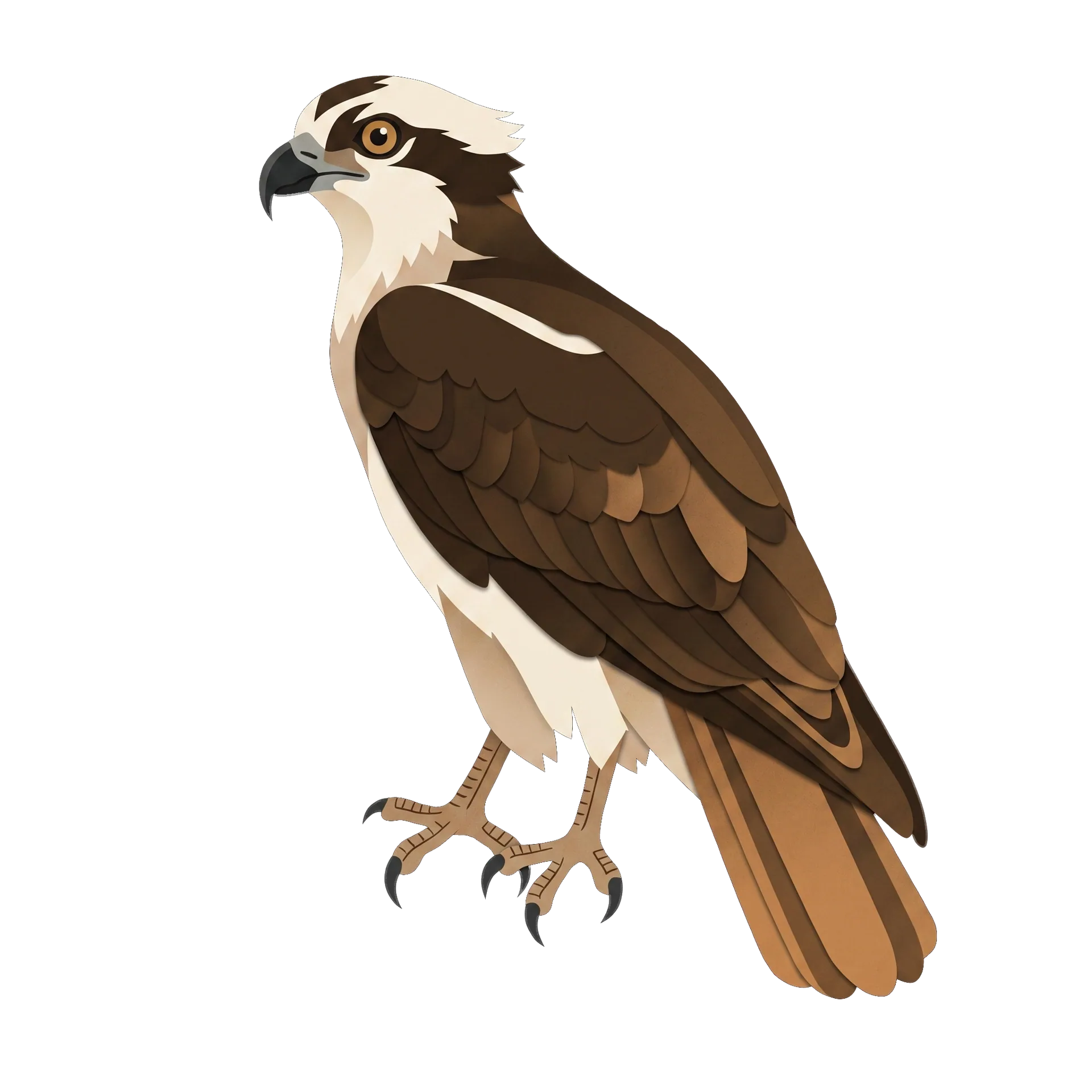
- Dark brown above and clean white below, with a dark eye-stripe through a white head — like a bald eagle that's been half bleached.
- Watch the hunt: a hover, then a feet-first plunge that throws spray. Eagles snatch from the surface; ospreys go in.
- Flying ospreys carry fish head-forward, torpedo-style, gripped in both feet.
- The huge stick nest on a channel marker, light pole, or platform is often the first sign one lives nearby.
Voice
A series of short, high, chirping whistles, so thin for a bird this size that first-timers usually go looking for a songbird.
Recording: Mike Nelson, XC131039, xeno-canto.org (CC-BY-NC-SA 3.0)
Lore
Medieval naturalists loved this bird's fishing enough to invent extra powers for it. Gerald of Wales, writing around 1200, claimed the osprey had one foot armed with talons and the other webbed for swimming; the story passed on through Albertus Magnus and into Holinshed's Chronicles, repeated as fact for centuries. A companion belief held that fish were so mesmerized by an osprey overhead that they surrendered belly-up rather than flee. The picture was vivid enough that Shakespeare used it directly: in Coriolanus, Aufidius predicts his rival will take Rome 'as is the osprey to the fish, who takes it / By sovereignty of nature.'
Not every culture read the bird as a predator to be feared. The Book of Songs, compiled by around the seventh century BCE, opens its very first poem with the cry of ospreys calling to each other across a river sandbar, read for centuries as an image of marital devotion, since the birds were believed to pair for life. 'Guan Ju' became one of the most quoted verses in the Chinese classical tradition, cited by scholars for two thousand years as a model of balanced courtship.
At a glance
- Family
- Pandionidae (ospreys)
- Range
- Every continent except Antarctica: coasts, lakes, and rivers worldwide
- Habitat
- Any fishable water: coastlines, reservoirs, rivers, marshes
- Diet
- Fish, almost exclusively, caught alive in feet-first dives
Where it lives
How big is it?
How is it doing?
Field notes
- An osprey's outer toe is reversible, letting it grip a fish with two toes forward and two back, and its footpads are studded with spiny scales called spicules: a fish, once gripped, rarely gets loose.
- They aim the catch. Ospreys shift the fish in flight to point head-first, cutting drag on the trip back to the nest.
- Ospreys are the only living member of their family, Pandionidae, a raptor lineage so specialized for fishing that taxonomists gave it a branch to itself.
Go deeper
The daily email
Get tomorrow's bird in your inbox
One bird at 5:30am ET, every day. Free, no password, one-click unsubscribe — and your life list syncs across devices.
You're in. Your first bird arrives with the next morning email (5:30am ET) — and your life list now syncs.Your account →