A loon's wail can carry across a mile of still water at dusk: that is how separated pairs find each other in the dark. The tremolo, the so-called crazy laugh, signals alarm; the male's yodel is a territorial declaration so specific that researchers can identify individual birds by it. Hear all three roll across a northern lake at night and it's obvious why so many cultures built stories around this bird.
Almost everything strange about a loon traces back to water. Its bones are dense where most birds' are hollow, its feet sit at the very stern of its body, and together those choices let it slip under without a splash and fly through the water after fish, steering with huge paddle feet. The same design leaves it nearly helpless on land — loons come ashore only to nest, shuffling mere feet from the waterline.
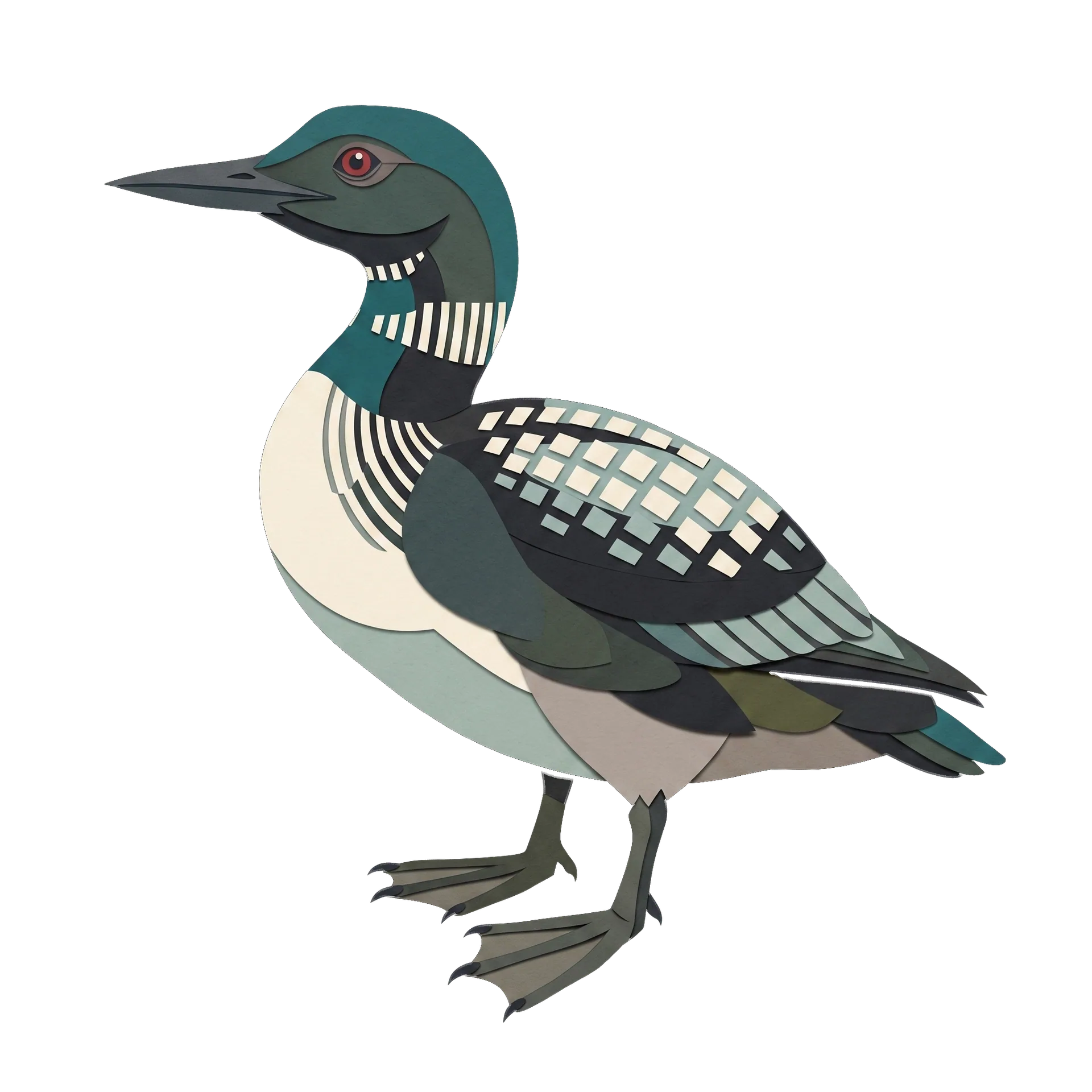
In summer plumage the Common Loon is also simply one of the continent's most beautiful birds: black head glinting green, a checkerboard of white across the back, a necklace of white stripes. Watch for the chicks in early summer: for their first weeks they ride on their parents' backs, tucked between the wings, periscoping out at a lake they will one day own.
Like this? Get one bird every morning, by email.
You're in. Your first bird arrives with the next morning email (5:30am ET) — and your life list now syncs.Your account →
How to identify
- A big, long-bodied waterbird riding low in the water, with a heavy dagger bill held level — never tilted up like a cormorant's.
- Breeding plumage is unmistakable: glossy black head, checkerboard back, and a striped white necklace.
- Winter birds are plain gray above and white below with a jagged border on the neck — shape and the frequent long dives still give them away.
- Loons swim then vanish, surfacing far from where they went under; cormorants surface sooner and often perch with wings spread, which loons never do.
- In flight: hunchbacked profile, feet trailing past the tail, and fast, shallow wingbeats.
Voice
A repertoire like no other bird: the long mournful wail, the laughing tremolo, and the male's territorial yodel — the defining soundtrack of the north woods.
Recording: Sunny Tseng, XC479757, xeno-canto.org (CC-BY-NC-SA 4.0)
Lore
Among the Ojibwe, the loon (maang) names one of the traditional doodemag, the clans that once organized society and still do for many families today. The Loon Clan shared civil leadership with the Crane Clan, and its members took on roles as diplomats and peacemakers, valued for patience and for listening before they spoke. The teaching survives as everyday advice, still repeated today: 'lead with your loon.'
A story told across Cree, Tsimshian, Inuit, and other northern peoples explains the bird's white collar. In it, a blind man, in some tellings an old medicine man abandoned by his own family, sits by a lake until a loon offers to help, diving again and again with the man on its back until enough water washes over his eyes to restore his sight. In gratitude, the man gives the loon his own necklace of white shells, and it has ringed the bird's throat ever since. The 1948 short 'The Loon's Necklace,' produced by Crawley Films for Imperial Oil and based on a Tsimshian telling, carried the story to audiences far outside the lake country where it began; it's preserved today in the National Film Board of Canada's collection.
At a glance
- Family
- Gaviidae (loons)
- Range
- Northern lakes of North America; winters on both coasts
- Habitat
- Large, clear lakes in summer; open coastal water in winter
- Diet
- Fish, pursued and caught in underwater chases
Where it lives
How big is it?
How is it doing?
Field notes
- Unlike most birds, loons have relatively solid bones. The extra density costs them in the air but lets them sink and dive with barely a ripple.
- A loon's legs sit so far back on its body that it can barely walk on land. It needs a long watery runway, sometimes hundreds of meters, flapping and running across the surface to get airborne.
- Each male's yodel is individually distinctive. When a male takes over a new lake, he changes his yodel, as if the territory comes with a required new signature.
Go deeper
The daily email
Get tomorrow's bird in your inbox
One bird at 5:30am ET, every day. Free, no password, one-click unsubscribe — and your life list syncs across devices.
You're in. Your first bird arrives with the next morning email (5:30am ET) — and your life list now syncs.Your account →