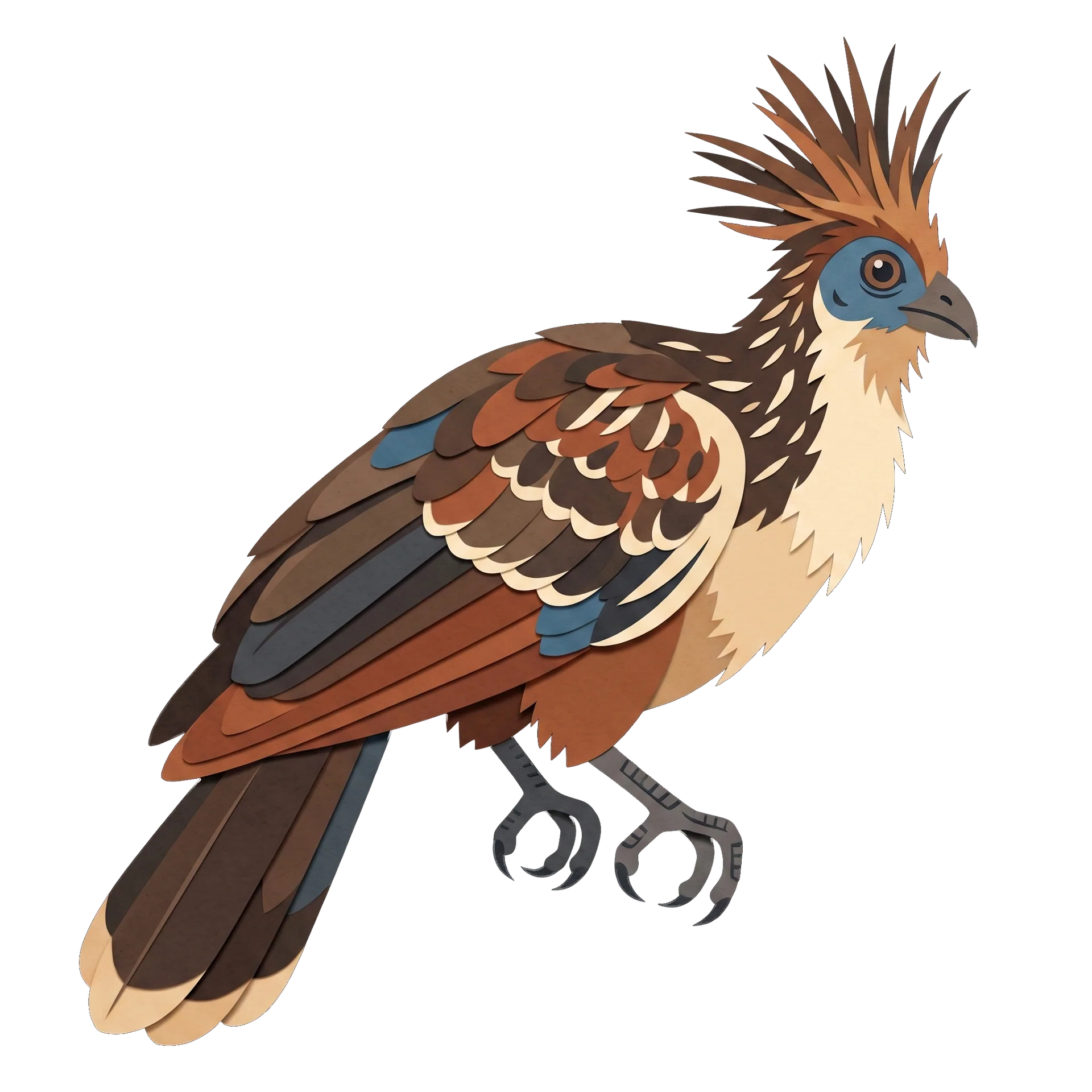
A Hoatzin looks like it wandered out of an earlier chapter of bird evolution, though the resemblance is coincidence rather than ancestry: chicks are born with small, functional claws on each wing, used to clamber back up a branch after dropping into the water below to dodge a predator. Early observers assumed this meant hoatzins were a direct link back to clawed fossil birds like Archaeopteryx; modern genetics instead place hoatzins near cuckoos and turacos, meaning the claws likely re-evolved independently rather than surviving unbroken from some ancient ancestor. The claws disappear as the chick matures either way.
The adult digestive system is just as unusual. Hoatzins eat leaves almost exclusively and break them down through foregut fermentation, using bacteria in a hugely enlarged crop to do the work, the same basic strategy a cow uses on grass, and found in no other bird. The fermentation smell is strong enough that local communities call it the 'stinkbird,' a nickname that may double as unintentional protection, since it makes for an unappetizing meal.
For all that strangeness, Hoatzins are weak, clumsy fliers, mostly clambering through branches over slow rivers and swamps rather than taking wing — the crest, claws, and general oddity are enough on their own to draw a steady stream of curious birders deep into the Amazon just to see something that looks like nothing else alive.
Like this? Get one bird every morning, by email.
You're in. Your first bird arrives with the next morning email (5:30am ET) — and your life list now syncs.Your account →
How to identify
- A strange, chicken-sized bird with a spiky rufous crest, bare blue facial skin, and maroon eyes.
- Body plumage is dark olive-brown above with buff underparts, chestnut flanks and undertail, and a long tail.
- Awkward, weak flier, usually seen clambering through branches over water rather than flying any distance.
- Chicks have functional claws on their wings, used to climb back into the nest if they fall or jump into water to escape a predator.
Voice
A series of hoarse hisses, grunts, and wheezing groans, unlike any typical bird song.
Recording: Rolf A. de By, XC463656, xeno-canto.org (CC-BY-NC-SA 4.0)
Lore
The Hoatzin is Guyana's national bird, pictured at the base of the national coat of arms granted by the College of Arms on February 25, 1966, three months ahead of independence. Guyanese call it the Canje Pheasant, for the Canje River and Canje Creek in the Berbice region where it's common along the banks, though the name is a stretch: hoatzins aren't pheasants, or close kin to them. Across the wider Amazon and Orinoco basins the bird picks up a different name in nearly every country it crosses: chenchena in Colombia and Venezuela's Llanos, guacharaca de agua in Venezuela, pava hedionda in Colombia, and shansho in Peru.
At a glance
- Family
- Opisthocomidae (hoatzin)
- Range
- Amazon and Orinoco river basins of South America
- Habitat
- Swampy forest and vegetation along slow rivers, lakes, and wetlands
- Diet
- Leaves, fermented in an enlarged crop like a cow's rumen
Where it lives
How big is it?
How is it doing?
Field notes
- Hoatzins digest leaves through foregut fermentation, using bacteria in an oversized crop to break down tough plant material: the same basic digestive strategy cows use, and unique among birds.
- That fermentation process gives the bird a strong, musky odor that has earned it the local nickname 'stinkbird,' and is thought to be one reason it faces relatively little hunting pressure from people despite living in accessible, populated river habitat.
- Hoatzin chicks are born with two small claws on each wing, which they use to clamber back up into branches after dropping into the water to escape a predator, a trait otherwise associated mainly with Archaeopteryx and other early fossil birds, and lost as the chicks mature.
Go deeper
The daily email
Get tomorrow's bird in your inbox
One bird at 5:30am ET, every day. Free, no password, one-click unsubscribe — and your life list syncs across devices.
You're in. Your first bird arrives with the next morning email (5:30am ET) — and your life list now syncs.Your account →