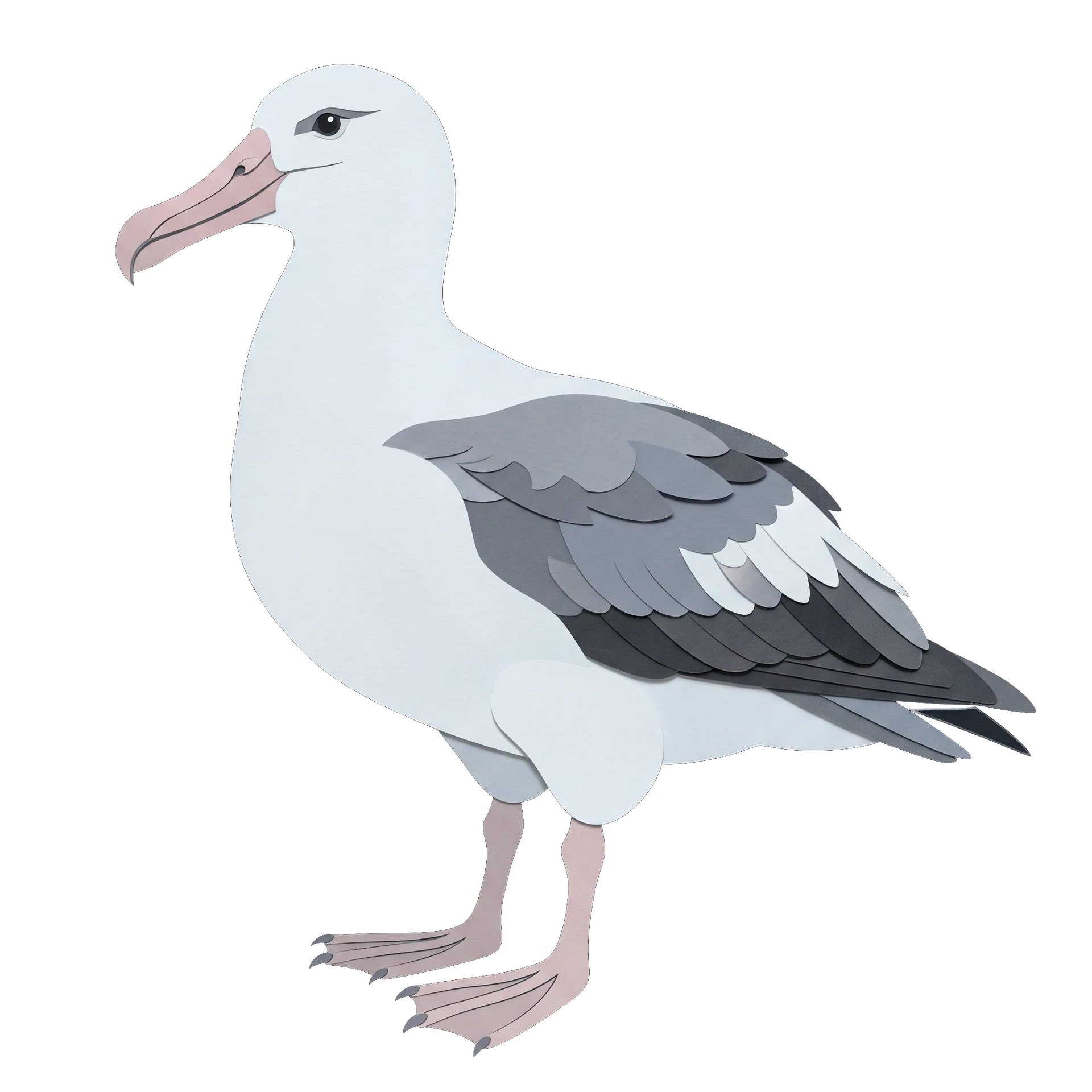
A Wandering Albatross can cross an entire ocean without flapping more than a few dozen times. A tendon locks the wing rigid at the shoulder, so once it's airborne the bird simply rides the pressure difference between wind layers close to the water and higher up, tacking back and forth in long arcs that cost almost no energy. Sailors have logged individual birds following ships for days at a stretch, apparently for the free updraft off the hull.
That efficiency is what makes a life spent almost entirely at sea possible. Adults come ashore only to breed, on a handful of wind-scoured sub-Antarctic islands, where they raise one chick every two years — a slow enough pace that a pair fledges only a modest handful of chicks over a lifetime. Courtship there involves a genuinely strange dance: mutual bill-clacking, spread wings, and sky-pointing calls that young non-breeders spend years practicing on each other before they're any good at it.
Longline fishing has made adult albatrosses a bycatch casualty across much of the Southern Ocean, and the species is now listed as Vulnerable — a serious problem for a bird that reproduces this slowly, since a population built around long lifespans and rare chicks has almost no capacity to absorb extra adult deaths.
Like this? Get one bird every morning, by email.
You're in. Your first bird arrives with the next morning email (5:30am ET) — and your life list now syncs.Your account →
How to identify
- The longest wingspan of any living bird, held stiff and nearly flat while gliding for hours without a single wingbeat.
- Adults are mostly white with black wingtips and a pale pink bill; young birds are almost entirely chocolate brown and whiten gradually over decades.
- Rarely seen from land except at breeding colonies; most sightings elsewhere are from ships far offshore.
- Compare the smaller 'mollymawk' albatrosses (Black-browed, Yellow-nosed, etc.), which show darker backs and noticeably shorter wings.
Voice
Silent at sea; bill-clacking, grunts, and whinnying calls accompany elaborate courtship dances at the colony.
Recording: Hichem MACHOUK, XC623841, xeno-canto.org (CC-BY-NC-SA 4.0)
Lore
Samuel Taylor Coleridge made the Wandering Albatross literature's most famous cursed bird. In 'The Rime of the Ancient Mariner' (1798), a sailor kills the albatross that has been trailing his ship, shooting it with a crossbow, and the fair wind that came with the bird dies too; his shipmates hang the dead bird around his neck as punishment, blaming him for the calm that follows, the origin of 'an albatross around one's neck,' the idiom for a guilt that won't come off. Coleridge built the scene from a real voyage: in 1719 the privateer Simon Hatley shot a black albatross off Cape Horn because he privately thought it an ill omen, an account Wordsworth read and handed him as a plot.
The popular idea that Coleridge was just recording an old sailors' taboo doesn't hold up well. Hatley's own account describes a private superstition, not a shared rule, and no maritime source describes a broad prohibition on killing albatrosses before the poem existed. If anything, sailors treated them as a resource: a whaling captain logged killing one in 1876, decades after the poem, and sailors routinely turned albatross feet into tobacco pouches, skin intact once the bones were removed. The famous curse against harming an albatross looks like something Coleridge invented, later mistaken for an old sailors' rule.
At a glance
- Family
- Diomedeidae (albatrosses)
- Range
- Southern Ocean, circumpolar; breeds on remote sub-Antarctic islands
- Habitat
- Open ocean year-round; comes ashore only to breed, on windswept island tussock grass
- Diet
- Squid, fish, and carrion, taken from the ocean surface
Where it lives
How big is it?
How is it doing?
Field notes
- A tendon locks the wing straight at the shoulder, letting the bird glide for hours at almost no muscular cost — the anatomy behind its ability to circle the globe on wind alone.
- Pairs bond for life and reunite at the same nest site every other year, greeting each other with a synchronized dance of bill-clacking, head-swaying, and sky-pointing that takes young birds years to perfect.
- Because they raise one chick every two years and typically don't breed until sometime in their second decade, a single Wandering Albatross can live well past fifty — one banded bird on Bird Island, South Georgia, has been tracked for 57 years and counting, among the oldest known individuals of the species.
Go deeper
The daily email
Get tomorrow's bird in your inbox
One bird at 5:30am ET, every day. Free, no password, one-click unsubscribe — and your life list syncs across devices.
You're in. Your first bird arrives with the next morning email (5:30am ET) — and your life list now syncs.Your account →