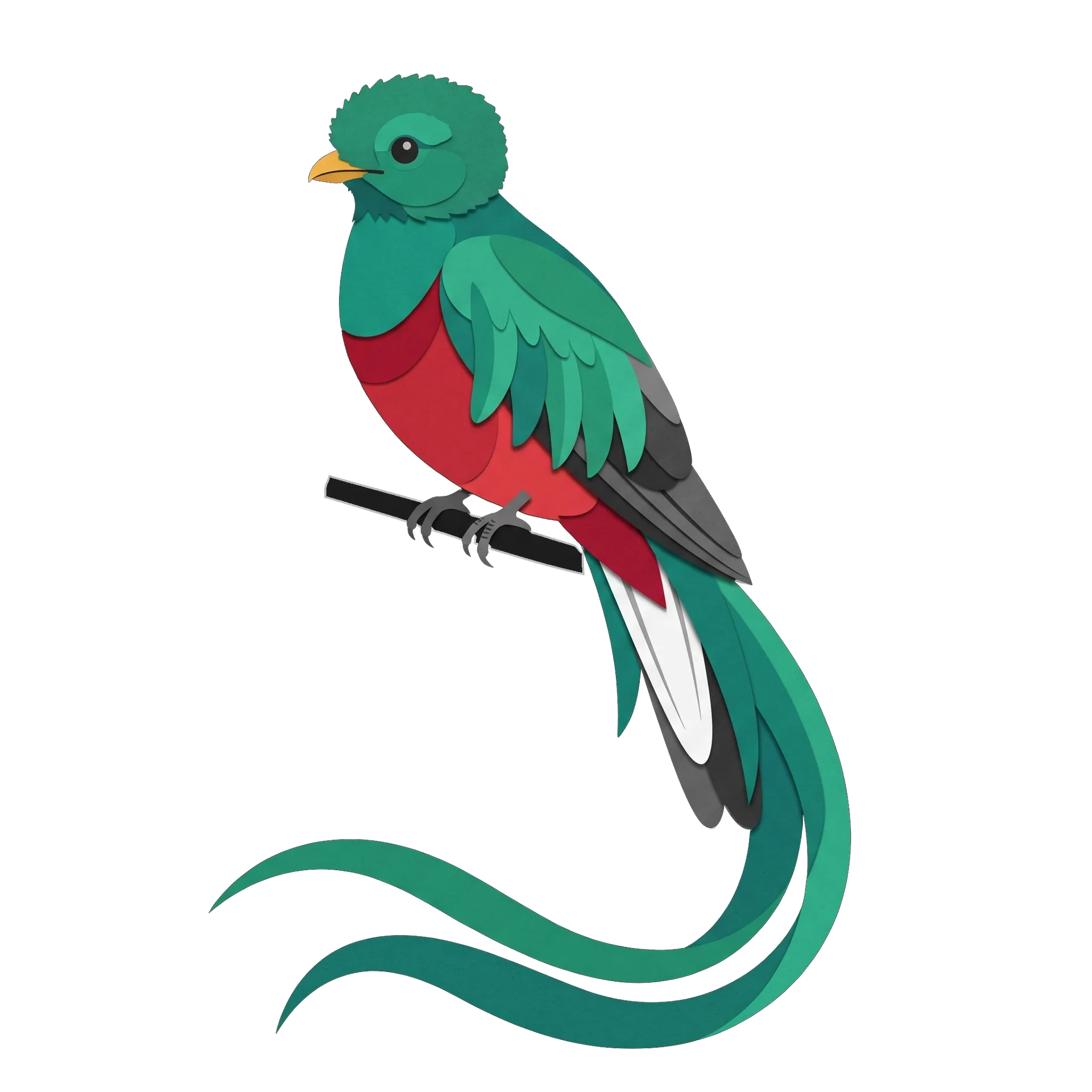
There's a reason two civilizations organized part of their economies around this bird's feathers. A male Resplendent Quetzal in filtered cloud-forest light doesn't look colored so much as lit: the emerald back and streamers are iridescent structures that flash green, gold, or blue-violet depending on the angle, above a belly of pure crimson. To the Maya and Aztecs those plumes outranked gold; rulers wore them in headdresses, and the birds themselves were caught, plucked of a few streamers, and released, since quetzals were understood (correctly, it turns out) to fare badly in captivity.
The daily business of a quetzal, finery notwithstanding, is fruit. It specializes in the laurel family, above all wild avocados, swallowing them whole and later regurgitating the pit. That makes the quetzal both dependent on intact cloud forest and one of its principal tree-planters. That dependence is the problem: as mountain forest is cleared for coffee and cattle from Chiapas to Panama, the bird's altitudinal migrations run out of forest to move through, and the species now sits at Near Threatened.
Seeing one is easier than the mystique suggests. In Costa Rica's highlands or Guatemala's cloud reserves, find a fruiting little avocado tree at dawn, learn the soft two-note whistle, and wait. The forest will seem empty right up until a branch turns out to have been a quetzal the whole time.
Like this? Get one bird every morning, by email.
You're in. Your first bird arrives with the next morning email (5:30am ET) — and your life list now syncs.Your account →
How to identify
- A pigeon-sized bird that glows: metallic emerald above, crimson belly, with a golden-green shimmer that shifts as it turns.
- Breeding males trail tail-covert streamers commonly 75 cm long and sometimes near a meter; in flight they ripple behind like ribbons.
- Sits bolt upright and still on mossy branches, often at mid-height near fruiting wild avocado trees; listen before you look.
- Females skip the streamers and trade the male's crimson belly for smoky gray, with a bronze-green head, but they keep the metallic glow above.
- Range matters: in the cloud forests of Costa Rica and Guatemala, no other bird combines emerald body and red belly at this size.
Voice
A soft, mournful two-note whistle, kyow kyow; gentle, carrying, and easy to track down once you've learned it.
Recording: Alain Verneau, XC1188164, xeno-canto.org (CC-BY-NC-SA 4.0)
Lore
Two Mesoamerican civilizations wove this bird into their creation stories. The Aztec god Quetzalcoatl, a feathered serpent credited with giving people light, wind, and the knowledge to grow food, wore quetzal plumage as his emblem; the Maya's own feathered serpent, Kukulkan, carried the same iridescent train. The word quetzal reflects that standing: in several Mesoamerican languages it doubled as a word for precious, sacred, or noble, and Mesoamerican rulers wore feather diadems specifically to borrow Quetzalcoatl's authority for themselves.
The K'iche' Maya tell a more specific story about why the bird looks the way it does. According to legend, as the K'iche' prince Tecún Umán fought the Spanish conquistador Pedro de Alvarado in 1524, a resplendent quetzal, until then an entirely green bird, landed on the dying prince and came away with its chest soaked in his blood: the origin, in the telling, of the crimson breast every quetzal has worn since. The feathers themselves were valuable enough to serve as currency in Maya markets, plucked from live birds rather than the dead, since killing one was against both Aztec and Maya law.
At a glance
- Family
- Trogonidae (trogons)
- Range
- Cloud forests from southern Mexico to western Panama
- Habitat
- Mountain cloud forest rich in wild avocado trees
- Diet
- Fruit of the laurel family (wild avocados especially), plus insects and small frogs
Where it lives
How big is it?
How is it doing?
Field notes
- The Maya and Aztecs treated quetzal tail feathers as treasure on par with jade, harvesting plumes from live birds that were released unharmed — killing a quetzal was, by several accounts, a capital offense.
- Guatemala named its currency the quetzal and put the bird on its flag; the species is a national symbol of liberty, buoyed by the folk belief that a caged quetzal dies of a broken heart.
- Quetzals are gardeners of the cloud forest: they swallow wild avocados whole, digest the flesh, and cough up the seed elsewhere, replanting the very trees their lives depend on.
Go deeper
The daily email
Get tomorrow's bird in your inbox
One bird at 5:30am ET, every day. Free, no password, one-click unsubscribe — and your life list syncs across devices.
You're in. Your first bird arrives with the next morning email (5:30am ET) — and your life list now syncs.Your account →