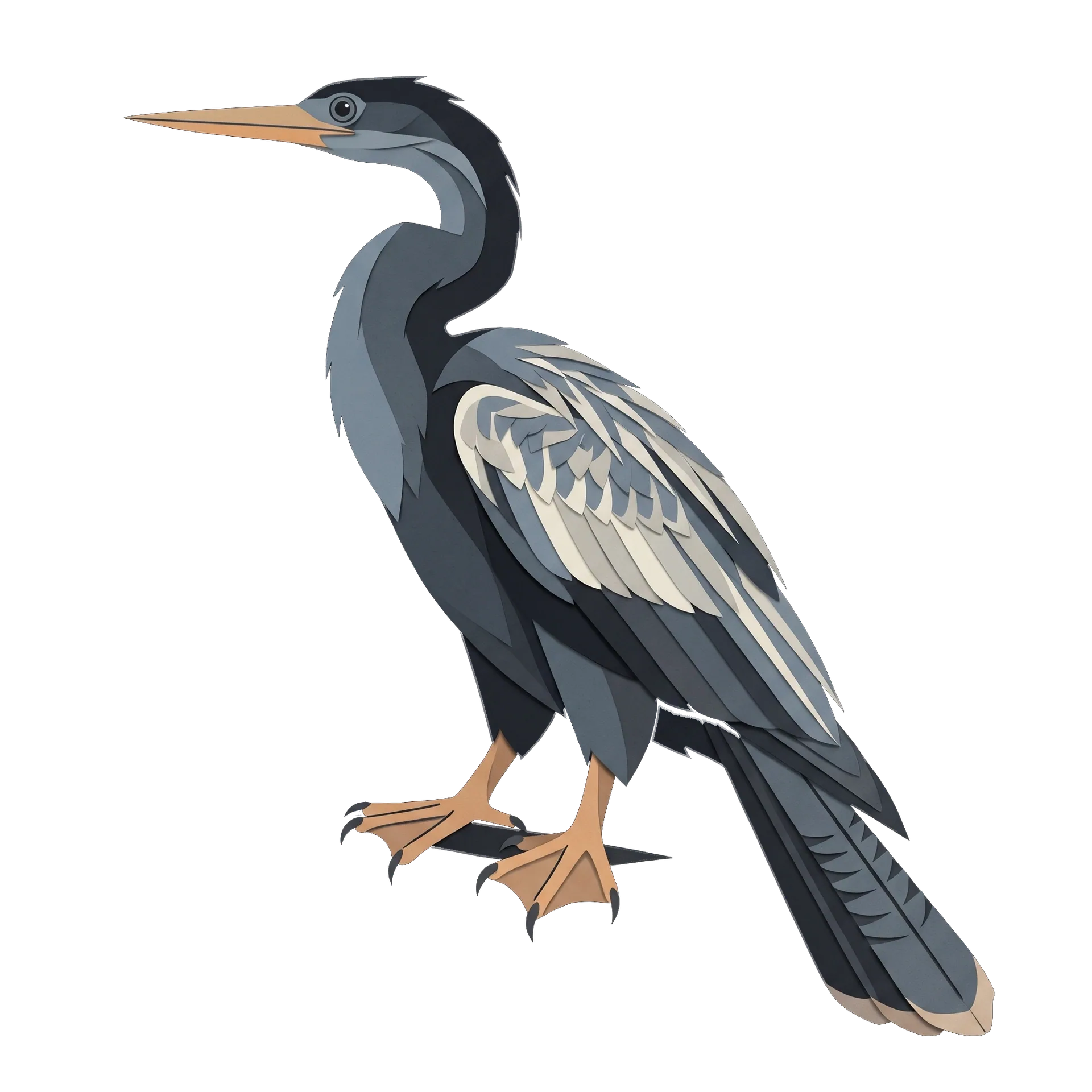
An Anhinga swimming low in a swamp, only its thin neck and small head above the waterline, does a convincing impression of a snake — close enough that the nickname 'snakebird' has stuck for centuries. The bird's feathers aren't waterproof, and rather than being a design flaw, that costs it less trapped air and less buoyancy, letting it sit lower and dive more easily than a fully waterproofed bird could.
Every swim leaves it soaked, which is why an Anhinga standing with wings spread wide in the sun is such a familiar sight around Southern wetlands.
The bill itself is a specialized weapon: straight, thin, and pointed rather than hooked like a cormorant's, built to spear a fish clean through rather than grab it. A successful Anhinga surfaces with a fish skewered on the bill, flips it into the air with a practiced toss, and catches it again to swallow head-first — a maneuver that takes young birds real practice to get right.
Like this? Get one bird every morning, by email.
You're in. Your first bird arrives with the next morning email (5:30am ET) — and your life list now syncs.Your account →
How to identify
- A slim, long-necked waterbird, glossy black overall with striking silvery-white streaking across the wings and back in males.
- Swims with only the head and long, thin neck above the surface, giving rise to the nickname 'snakebird.'
- Often perched with wings spread wide to dry, since its feathers lack the waterproofing most waterbirds rely on.
- Spears fish underwater with a sharp bill rather than grabbing them, then surfaces and flips the catch into the air to swallow head-first.
Voice
A series of clicking, rattling, and grunting notes, mostly given around the nest.
Recording: Raul A. Spais, XC1028752, xeno-canto.org (CC-BY-NC-SA 4.0)
Lore
William Bartram, the Philadelphia naturalist, described the anhinga in his Travels (1791), in the chapter on his 1774 voyage up the St. Johns River in East Florida. He reported that the people there called the birds Snake Birds, and thought them a kind of cormorant or loon, though far more beautiful and delicately formed than any he had ever seen; he believed he had seen paintings of them on Chinese screens. They liked to sit in little peaceable companies on dry limbs hanging over still water, wings and tails spread, which he supposed was to cool and air themselves while they beheld their images in the watery mirror. When anyone approached, they dropped into the water as if dead, and a minute or two later, at a vast distance, only a long slender head and neck appeared, looking very much like a snake. Bartram did not doubt that if the bird had lived on the Tiber in Ovid's day, it would have furnished the poet with a subject for some beautiful and entertaining metamorphoses. About its table qualities he was less poetic: he believed it fed entirely on fish, for its flesh smelled and tasted intolerably strong of it, and it was scarcely to be eaten unless hunger forced the matter.
At a glance
- Family
- Anhingidae (anhingas)
- Range
- Southeastern U.S., Mexico, Central America, the Caribbean, and much of South America
- Habitat
- Freshwater swamps, slow rivers, and lakes with overhanging perches
- Diet
- Fish, speared underwater with a sharp, pointed bill after a slow stalking swim
Where it lives
How big is it?
How is it doing?
Field notes
- The nickname 'snakebird' comes from its swimming posture — with the buoyant body submerged and only the sinuous neck and small head above water, a swimming Anhinga can look startlingly like a snake gliding across the surface.
- Unlike most waterbirds, Anhinga feathers aren't waterproof, which actually helps it hunt: less trapped air means less buoyancy, letting the bird stay submerged and stalk fish underwater more easily — the tradeoff is that it has to spread its wings to dry after every swim.
- The bill has no hook at the tip, unlike a cormorant's; instead it's built like a thin spear, and the anhinga kills fish by impaling them directly rather than grabbing and gripping.
Go deeper
The daily email
Get tomorrow's bird in your inbox
One bird at 5:30am ET, every day. Free, no password, one-click unsubscribe — and your life list syncs across devices.
You're in. Your first bird arrives with the next morning email (5:30am ET) — and your life list now syncs.Your account →