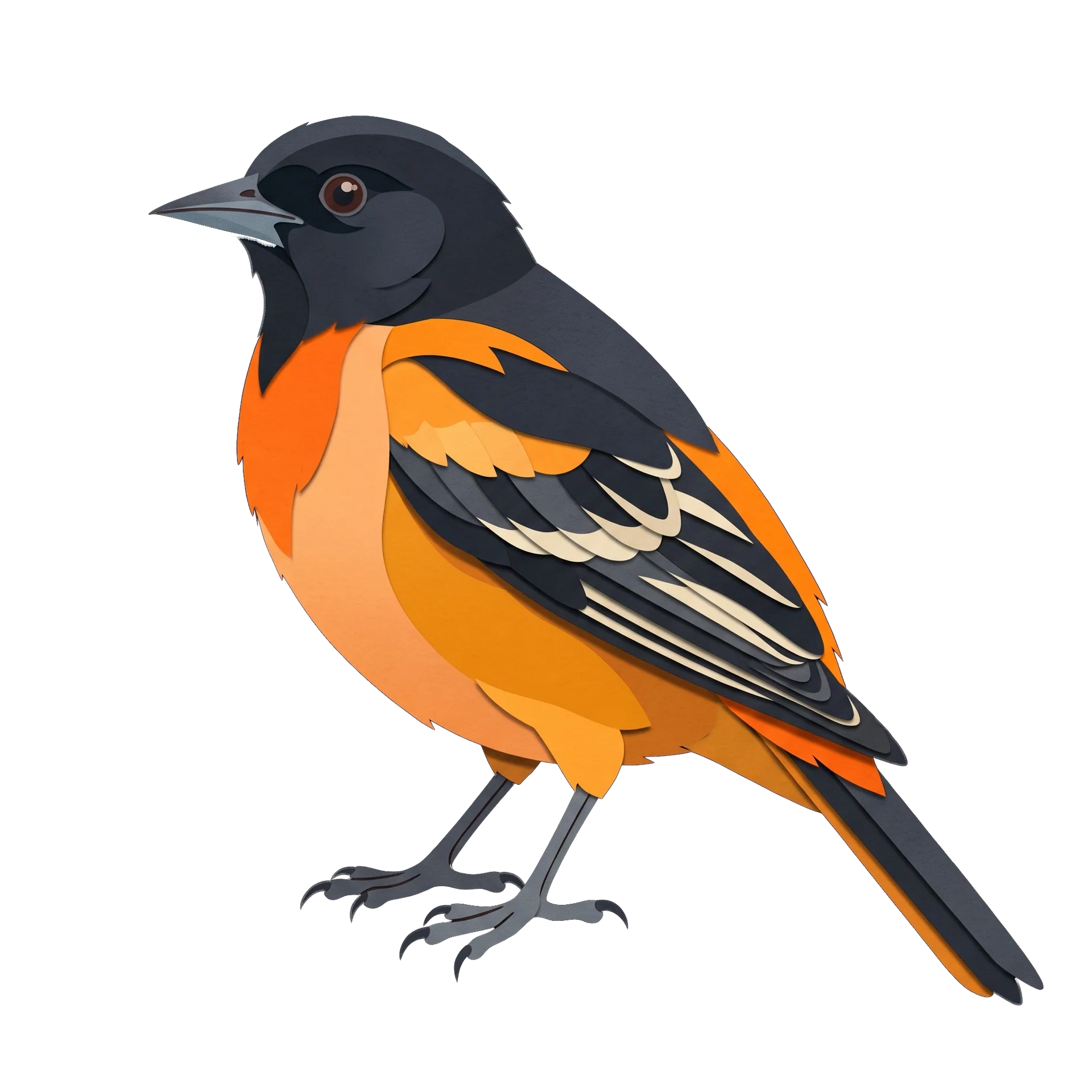
A Baltimore Oriole spends most of spring somewhere you can hear but not see — high in the crown of an elm or sycamore, working through new leaves for caterpillars while its whistled song drops down to the yard below. When it finally comes into view, the flame-orange body set against solid black can stop a conversation mid-sentence.
The nest gives away how much skill is packed into that small body. A female oriole builds a deep, sock-shaped pouch entirely by herself, knotting and weaving plant fibers, grass, and the odd bit of string into a structure (sometimes thousands of stitches, tens of hours of work) that sways in the wind without spilling its contents. Males don't help build, but they defend the territory hard enough that a rival oriole singing nearby can trigger an immediate, furious response.
Orioles used to nest overwhelmingly in American elms, and Dutch elm disease reshaped where they're found as those trees died off across the East. They adapted to maples and other shade trees readily enough, and they've adapted just as well to bird feeders: an orange half nailed to a post or a dish of grape jelly in April is one of the more reliable ways to pull a male oriole down from the canopy for a proper look.
Like this? Get one bird every morning, by email.
You're in. Your first bird arrives with the next morning email (5:30am ET) — and your life list now syncs.Your account →
How to identify
- A chunky, sharp-billed songbird bigger than a sparrow but smaller than a robin, with a long tail and an upright posture in the treetops.
- Male: flame-orange body with a solid black hood, back, and wings crossed by one white bar.
- Female and immature males: mustard-yellow below with olive-gray upperparts, more muted but still warm-toned.
- Forages high in leafy canopy for caterpillars rather than at feeders, though it comes readily to orange halves and grape jelly in spring.
- Compare the smaller, chestnut-colored Orchard Oriole where ranges overlap.
Voice
A rich, flutey whistled song strung into short phrases, plus a dry, chattering rattle used as an alarm.
Recording: Richard E. Webster, XC818930, xeno-canto.org (CC-BY-NC-SA 4.0)
Lore
The 1731 naming has real heraldry behind it. English naturalist Mark Catesby illustrated the bird that year in his Natural History of Carolina, Florida, and the Bahama Islands, noting that Marylanders already called it the Baltimore bird for its likeness to the colors of the Calverts, the colony's proprietors. George Calvert, the first Lord Baltimore, had registered a coat of arms quartering black and gold vertical bars, his father's colors, with red and white, his mother's, the Crosslands, a design that still forms Maryland's state flag and seal today. Linnaeus used Catesby's account to describe the species formally in 1758.
The color story kept going. Maryland made the oriole its official state bird in 1947, two centuries after Catesby first wrote the name down. When a struggling St. Louis franchise moved to Baltimore in 1954, it adopted the local bird's name and its black-and-orange colors rather than choosing new ones. The team's first costumed mascot, Mr. Oriole, was drawn that year by Baltimore Sun cartoonist Jim Hartzell, and the same heraldic color scheme has stayed on the uniform ever since.
At a glance
- Family
- Icteridae (blackbirds & orioles)
- Range
- Eastern & central North America; winters Mexico to northern South America
- Habitat
- Open deciduous woodland, shade trees, orchards, and leafy suburban streets
- Diet
- Caterpillars and other insects, nectar, and ripe fruit
Where it lives
How big is it?
How is it doing?
Field notes
- Females weave the nest alone: a deep, sock-like pouch of plant fibers, grass, and sometimes string or horsehair, lashed to the tip of a drooping branch where few predators can reach.
- The name predates the U.S. entirely — in 1731, naturalist Mark Catesby matched the male's black-and-orange to the coat of arms of the 17th-century Lord Baltimore, and both the bird and the city ended up named after the same family.
- Nearly the whole population funnels south each fall to winter from southern Mexico into northern South America, then reappears in roughly the same northern yards around the same time each spring.
Go deeper
The daily email
Get tomorrow's bird in your inbox
One bird at 5:30am ET, every day. Free, no password, one-click unsubscribe — and your life list syncs across devices.
You're in. Your first bird arrives with the next morning email (5:30am ET) — and your life list now syncs.Your account →