East of the Rocky Mountains, Purple Martins nest almost exclusively in birdhouses put up specifically for them, by landlords who get nothing back but the birds themselves. The relationship goes back centuries: Native American communities were hanging hollow gourds for martins long before European settlers arrived, and the practice spread and formalized into today's dedicated martin-house hobby, without which the eastern population would likely struggle to find nest sites at all.
Come late summer, that same dependence on people gives way to a spectacle nobody arranges. Martins gather at traditional pre-migration roosts in huge numbers — some sites in the Southeast host hundreds of thousands of birds pouring into a single stand of trees at dusk, a swirling, funneling mass visible for miles and even detectable on weather radar.
All of that builds toward one of the more precisely tracked migrations in North American birding: most of the eastern population funnels down through Central America and settles into Brazil's Amazon basin for the winter, part of a South American wintering range that geolocator studies have traced across eleven countries, from Colombia down to Argentina.
Like this? Get one bird every morning, by email.
You're in. Your first bird arrives with the next morning email (5:30am ET) — and your life list now syncs.Your account →
How to identify
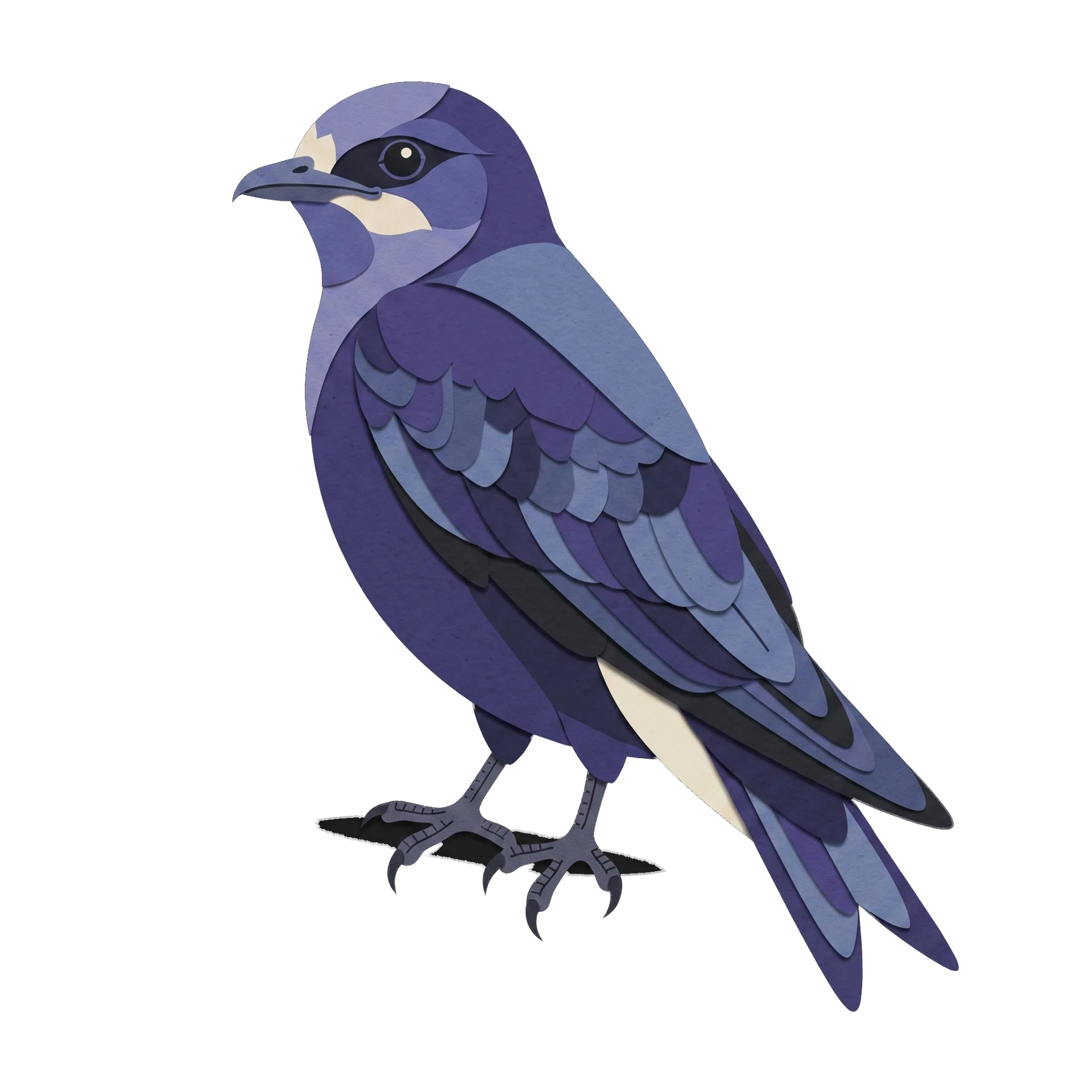
- North America's largest swallow: males are glossy, iridescent blue-black all over; females and immatures are duller gray-brown below.
- Broad-chested and forked-tailed, with a distinctive smooth, gliding flight mixed with quick wingbeats.
- East of the Rockies, almost exclusively nests in multi-compartment birdhouses ('martin houses') or hung gourds put up by people.
- Highly social — forms noisy colonies, sometimes dozens of pairs sharing one housing structure.
Voice
A rich, gurgling, warbled chortle, often given in flight over the colony.
Recording: Paul Marvin, XC649107, xeno-canto.org (CC-BY-NC-SA 4.0)
Lore
Naturalist Alexander Wilson, traveling through Choctaw and Chickasaw territory in the early 1800s, described a common sight at their settlements: saplings stripped of branches down to a few short prongs, a hollowed gourd hung from each one for the martins to nest in. Mark Catesby had sketched the same setup decades earlier, in Carolina towns, noting the birds' use for 'pursuing and chasing away Crows, Hawks, and other vermin from the Poultry.' The corn fields got the same protection: a colony of martins overhead meant fewer crows and blackbirds working the rows at planting time.
Anthropologist Frank Speck, who spent decades documenting gourd culture among Southeastern tribes, argued the practice took hold well before European contact, an early, deliberate case of drawing a wild bird in to do farm work no one else wanted. That origin isn't settled beyond argument, but the custom's staying power is: colonial and early American settlers adopted the gourd poles wholesale, and the multi-compartment martin house sold at hardware stores today is a direct descendant of those original hanging gourds.
At a glance
- Family
- Hirundinidae (swallows)
- Range
- Eastern and central U.S., breeding; winters in the Amazon basin of South America
- Habitat
- Open country near water, nesting almost entirely in human-supplied housing in the east
- Diet
- Flying insects, caught entirely on the wing
Where it lives
How big is it?
How is it doing?
Field notes
- East of the Rocky Mountains, Purple Martins have become almost entirely dependent on human-supplied housing, a shift traced back centuries to Native American communities who hung hollow gourds for the birds — a tradition later adopted and expanded by European settlers.
- Martins gather in enormous post-breeding roosts before migrating south, with some traditional sites in the southeastern U.S. hosting hundreds of thousands of birds swirling into a single stand of trees at dusk.
- Most Purple Martins, including the bulk of the eastern population, winter in Brazil's Amazon basin, though the species' full South American winter range stretches across eleven countries from Colombia to Argentina.
Go deeper
The daily email
Get tomorrow's bird in your inbox
One bird at 5:30am ET, every day. Free, no password, one-click unsubscribe — and your life list syncs across devices.
You're in. Your first bird arrives with the next morning email (5:30am ET) — and your life list now syncs.Your account →